


If you terminate medium- or high-current copper conductors, you have almost certainly met the tinned copper cable lugs that sit at the end of every power cable. Also called SC type cable lugs, tubular crimp lugs or copper cable terminals, they are the quiet workhorses that connect conductors to busbars, breakers and equipment. This guide explains what tinned copper cable lugs are, why the tin layer matters, how the crimp-and-bolt connection works, and exactly when to specify them across panels, machinery, EV charging and renewable energy systems. By the end, you will know how to read a cable lug size chart and pick the right stud size for your job.

What Are Tinned Copper Cable Lugs?
A cable lug is a terminated end fitted to a conductor so the conductor can be bolted to a terminal, busbar or piece of equipment. A tinned copper cable lug pairs a high-conductivity copper body with a thin electroplated tin surface. The copper carries the current; the tin protects the surface and helps the joint stay reliable over time.
At Niuli Electric, the SC / DTGA series of tinned copper cable lugs is manufactured from copper with a tin-plated surface, built as non-insulated fittings with a tubular crimp barrel and a flat, single-hole mounting palm. Conductors are offered across the catalog range from 1.5 mm² up to 1200 mm², with multiple stud-hole options, so the same basic design covers everything from control wiring to heavy distribution feeders.
Because the body is copper rather than aluminium, these lugs are intended for copper conductors. The tin layer is not a structural coating — it is a few microns of solderable, oxidation-resistant metal that keeps the contact face clean and lowers the risk of a resistive joint.
Why the Tin Plating Actually Matters
Bare copper forms an oxide layer when exposed to air, and that oxide is far less conductive than the metal beneath it. In a dry indoor panel this is slow, but in humid, coastal or industrial air the effect accelerates. Tin plating slows that oxidation, protects the lug during storage and shipping, and gives installers a bright, consistent surface to work with.
Tin also improves solderability and helps the lug seat evenly against a mating surface. Where a copper-to-aluminium transition is involved, the tinned face is more forgiving than bare copper, though standard copper lugs should still only be used on compatible copper conductors (bimetallic lugs are specified for aluminium). For marine, offshore, wastewater, galvanizing and other corrosive environments, tin plating is one of the simplest ways to extend service life without changing the lug geometry.
How the Connection Works: Crimp Plus Bolted Palm
A tinned copper cable lug makes its joint in two stages. First, the stripped copper conductor is inserted into the tubular barrel and compressed with a matching crimp die, forming a tight mechanical and electrical bond between conductor and lug. Second, the flat palm is bolted onto a stud, busbar or equipment terminal with the correct tightening torque.
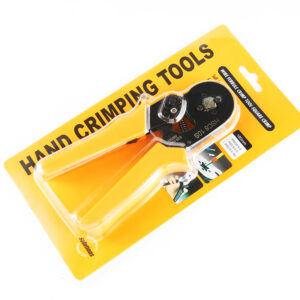
The quality of the first stage depends entirely on using the right cable lug crimping tools and dies. A correct crimp fills the barrel, grips every strand, and leaves no gaps where moisture or movement can start a failure. A poor crimp — too shallow, off-centre or with the wrong die — can pass a pull test on the bench yet loosen under thermal cycling and vibration. Always match the die to the lug series and conductor size, and verify the finished crimp against the manufacturer’s specification.
Reading a Cable Lug Size Chart
The model code tells you almost everything. In the SC series, “SC25-8” means a lug for a nominal 25 mm² conductor with an M8 stud hole; the actual hole diameter is 8.5 mm. The catalog runs from SC1.5 up to SC1200-BL, covering 1.5–1200 mm² and stud sizes from M4 to M20, with AWG and kcmil equivalents for North American projects.
| Model | Conductor (mm²) | AWG / kcmil | Stud | Hole Ø (mm) | Barrel Ø d (mm) | Length L (mm) |
|---|---|---|---|---|---|---|
| SC1.5-4 | 0.5–1.5 | 22–16 | M4 | 4.3 | 2.1 | 18.0 |
| SC10-6 | 6–10 | 8 | M6 | 6.5 | 5.1 | 25.0 |
| SC25-8 | 16–25 | 4 | M8 | 8.5 | 7.0 | 34.0 |
| SC50-10 | 35–50 | 1/0 | M10 | 10.5 | 9.8 | 43.5 |
| SC95-12 | 70–95 | 3/0 | M12 | 13.0 | 13.4 | 55.0 |
| SC150-12 | 150 | 300 kcmil | M12 | 13.0 | 17.0 | 69.0 |
| SC240-16 | 240 | 500 kcmil | M16 | 17.0 | 21.0 | 92.0 |
| SC400-20 | 400 | 800 kcmil | M20 | 21.0 | 27.0 | 114.0 |
| SC1200-BL | 1200 | – | M20 | 21.0 | 47.0 | 210.0 |
Representative sizes from the SC series catalog. The full cable lug size chart covers every intermediate model, including SC16, SC35, SC70, SC185, SC300, SC500, SC630, SC800 and beyond. Always confirm conductor and crimping compatibility with the manufacturer’s drawing before installation.
When to Use Tinned Copper Cable Lugs
Tinned copper cable lugs are the default choice wherever a copper conductor must be bolted to equipment with a reliable, low-resistance joint. Typical applications include:
- Power distribution panels — copper cables landed onto busbars, switchgear and metering equipment.
- Industrial machinery — power terminations inside control cabinets, motor starters and drives.
- EV charging stations — high-current DC and AC feeds where a secure bolted joint is critical to safety.
- Solar PV and battery energy storage (BESS) — string and combiner connections that must survive outdoor temperature swings.
- Marine, offshore and coastal installs — tin plating resists salt-air corrosion better than bare copper.
- Data centers and UPS rooms — dense copper terminations where consistency and low contact resistance matter.
- Motors and control equipment — replacement of worn or damaged terminations during maintenance.
In each of these, the lug works alongside other electrical terminals and connection accessories. Where the cable passes through an enclosure wall, pair the lug with the correct brass cable glands to keep the seal and strain relief intact.

Copper vs Aluminium — and When Not to Use Them
Standard tinned copper cable lugs are built for copper conductors. If your feeder is aluminium, do not crimp a copper lug onto it and hope for the best: the dissimilar metals invite galvanic corrosion at the joint. Use a purpose-made bimetallic (Cu/Al) lug or a bi-metallic transition, and follow the applicable installation standard.
Another common mistake is assuming “a lug is a lug.” An SC tubular lug is not automatically interchangeable with a DIN 46235 lug — barrel diameter, length and palm dimensions can differ, which changes how the die seats and how the joint performs. Check the exact dimensional drawing rather than the label, especially on cross-border or mixed-standard projects.
How to Choose the Right Cable Lug
Select the correct lug by checking five things: the conductor cross-section and strand construction, the barrel inside diameter, the stud hole diameter, the crimping tool and die compatibility, and the plating and certification required by the project. For regulated or export work, confirm the lug meets the certifications your customer expects — Niuli’s production is built around UL, CE, RoHS and REACH compliance, with ISO-based quality control from incoming material to pre-shipment inspection.
When in doubt, give your supplier four numbers: conductor size in mm², stud size, required quantity, and any packaging or marking requirement. That is enough for a manufacturer to return a matched part number and a quote.
Installation Best Practices
A good lug is only as good as its installation. Strip the conductor to the barrel depth, insert it fully so no strands are splayed, crimp with the matched die in the correct position, and torque the palm to the equipment specification. Add suitable insulating protection wherever the installation calls for it, and keep a record of the crimp tool and die used for traceability on critical projects. For compact or fine-strand conductors, consider paired non-insulated terminals and ferrules in the same material family to keep the whole connection consistent.
Frequently Asked Questions
What is the difference between tinned and bare copper cable lugs?
A tinned copper cable lug has a thin layer of tin electroplated over the copper body. Bare copper slowly forms an oxide layer in air, and that oxide is less conductive than the metal beneath it — the effect accelerates in humid, coastal or industrial air. The tin layer slows oxidation, protects the lug during storage and shipping, and improves solderability. The copper underneath still carries the current, so for outdoor, marine and industrial jobs tinned lugs are the safer default.
Can I use tinned copper cable lugs on aluminium cables?
No. Standard tinned copper lugs are built for copper conductors only. Copper and aluminium are dissimilar metals, and joining them directly invites galvanic corrosion at the joint, which raises contact resistance and can cause failure. For aluminium feeders, use a purpose-made bimetallic (Cu/Al) lug or a bi-metallic transition, and follow the applicable wiring standard.
What does “SC” mean in SC cable lugs?
SC is the common model code for a tubular crimp lug with a flat, single-hole mounting palm. In a code such as “SC25-8”, SC is the series, 25 is the nominal conductor size in mm², and 8 is the stud size (an M8 bolt, roughly 8.5 mm hole). Other series exist (DT, DTG, DTGA), but SC is the most widely specified tubular lug shape.
How do I choose the right cable lug size?
Match four things: the conductor cross-section in mm² (for example 25 mm²), the strand type, the stud hole or bolt size (M4–M20), and the crimp tool and die compatibility. Read the manufacturer’s size chart, then confirm the barrel inside diameter and palm dimensions against your cable and equipment drawing before you order.
Are tinned copper lugs suitable for outdoor and marine use?
Yes — that is one of their main advantages. The tin layer resists salt-air and humidity corrosion far better than bare copper, which is why tinned lugs are widely used in marine, offshore, coastal, wastewater, solar PV and battery storage (BESS) installations. Where the cable passes through an enclosure wall, pair them with an IP-rated cable gland to keep the seal intact.
Do tinned copper cable lugs need insulation?
The lug body itself is non-insulated bare metal. Whether you add insulation depends on the joint. In open busbar or exposed environments, fit heat-shrink tubing, boots or covers rated for the voltage and temperature; inside enclosed terminal blocks insulation may not be required. Always follow the equipment manufacturer’s guidance.
Installation Best Practices
Conclusion
Tinned copper cable lugs remain the default choice wherever a copper conductor must be bolted to equipment with a reliable, low-resistance joint. The tin layer protects against oxidation, the tubular barrel gives a compression crimp, and the palm delivers a secure bolted connection across panels, machinery, EV and renewable systems. Choose by conductor size, stud size and crimp tool compatibility, and always verify dimensions against the manufacturer’s size chart before installation. For distributor, OEM and project pricing on SC type tinned copper cable lugs, contact the Niuli Electric team for a tailored quote.
Need Tinned Copper Cable Lugs in Custom Sizes or OEM Branding?
Niuli Electric supplies SC type tinned copper cable lugs from 1.5 to 1200 mm², with full size charts. Send us your conductor size, stud size and quantity — we reply with pricing and lead time.
View Tinned Copper Cable Lugs & Get a Quote →
