


Introduction
Cable gland grounding and earthing are often treated as an afterthought during panel assembly, yet a poor earth path can leave armour, braid, or exposed conductive parts energised during a fault. Brass and stainless steel cable glands give installers a metal-bodied entry point that can carry protective earth current, bond a cable screen, or maintain equipotential continuity, but only if the installation follows the right practices.
This article explains the difference between protective earthing and screen bonding, how brass and stainless steel glands perform in each role, and the practical steps that keep the earth path reliable over the life of the enclosure.
What Grounding and Earthing Mean for Cable Glands
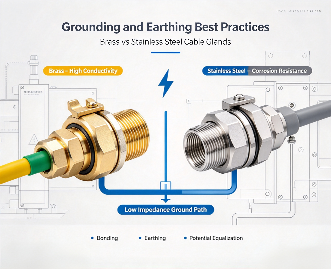
Grounding and earthing connect exposed conductive parts to the main earthing terminal so that fault current can flow safely to earth and operate protective devices. For a cable gland, this splits into protective earthing and functional bonding. Protective earthing uses the gland body as part of the path between cable armour or screen and the earthed enclosure wall. Functional bonding keeps a low-impedance connection for the cable shield so that electromagnetic interference is drained away rather than entering the cabinet.
A metal-bodied gland does not automatically guarantee either function. The current must pass through the gland body, locknut, enclosure wall, and panel earthing bar without interruption, and every interface is a potential failure point. Paint, non-conductive thread sealant, loose fittings, or corrosion can each raise resistance enough that the path no longer qualifies as a protective earth bond. Understanding these interfaces is the starting point for every best-practice checklist.
Why Brass and Stainless Steel Glands Are Chosen for Grounding
Metal cable glands are specified where electrical continuity is required because their bodies provide a conductive path that plastic glands cannot match. Brass is favoured when low electrical resistance and easy machining are priorities. Nickel-plated brass resists atmospheric corrosion while retaining conductivity, which makes it common in control cabinets, switchgear, and industrial machinery where the gland doubles as an earthing point. Stainless steel is specified where the environment attacks the metal more aggressively, such as coastal plants, food-processing washdown areas, or chemical sites, because its chromium oxide passive film resists pitting and crevice corrosion. The trade-off is higher bulk resistivity, which is why stainless glands are usually acceptable for protective bonding but may need closer attention in high-frequency screen-bonding applications.
Best Practices for Cable Gland Grounding and Earthing
Reliable earthing depends on surface preparation, metal compatibility, torque discipline, and verification. The following practices apply to both brass and stainless steel glands.
- Remove non-conductive finishes at the contact points. Enclosure paint, powder coat, anodise, and thick oxide layers can insulate the gland flange from the panel. The entry hole should be free of coating around the gland seating face, and serrated or conical locknuts should bite into clean metal rather than paint.
- locking compounds are often non-conductive. If a sealant is needed for environmental sealing, apply it to the thread outside the electrical path, or use a conductive compound on the joint that carries earth current.
- Match or isolate dissimilar metals. Brass and stainless steel are more noble than aluminium, zinc-plated steel, and mild steel, so they can accelerate corrosion of a less noble enclosure in the presence of moisture. In mixed-metal panels, use insulating washers, separation sleeves, or conductive grease to break the galvanic cell while preserving the earth path.
- Use an external earth tag where required. Many standards require a dedicated external earth tag on the gland thread when the cable armour or screen is terminated to a separate earth terminal. The tag should sit between the gland locknut and a plain washer, with the earth conductor terminated in a suitable clamp.
- Torque to a repeatable value. A loose locknut increases joint resistance and can vibrate free over time, while over-tightening deforms serrated washers, cracks plating, and can cold-weld stainless threads. Tighten to the manufacturer’s torque value with a calibrated wrench and recheck after the first thermal cycle or transport vibration.
- Verify with a continuity tester. A visual inspection cannot prove a low-resistance earth path. Measure the resistance between the cable armour or screen and the main earthing terminal, and compare the value to the project specification. The governing limit is always the one written into the design.
| Practice | What it prevents | Common failure if skipped |
| Clean metal-to-metal contact | High contact resistance | Paint or oxide insulates the gland flange |
| Conductive or controlled sealant use | Thread compound blocking current | Earth path depends on unpredictable thread contact |
| Galvanic isolation or matching | Corrosion of the enclosure | Panel material corrodes around the gland entry |
| External earth tag | Inadequate termination point | Armour or screen cannot be bonded to the earth bar |
| Calibrated torque | Loose or damaged joint | Resistance rises under vibration or thermal cycling |
| Continuity measurement | Unseen open circuit | Fault current cannot trip protection |
Brass vs Stainless Steel for Grounding Applications
Both materials can form a reliable earth path, but the right choice depends on the environment and the electrical requirement.
| Parameter | Nickel-Plated Brass Cable Glands | 304 Stainless Steel Cable Glands |
| Bulk electrical conductivity | Higher; lower resistance path | Lower; still adequate for protective bonding |
| Corrosion resistance in chloride environments | Moderate; plating must remain intact | High; passive film repairs itself |
| Typical earth application | Control cabinets, switchgear, general industrial | Marine, food, chemical, coastal |
| Galvanic coupling with steel or aluminium enclosure | More noble; can accelerate panel corrosion | More noble; can accelerate panel corrosion |
| Thread galling risk | Low | Higher; anti-seize is advisable |
| Appearance | Silver nickel finish | Natural stainless finish |
For most protective earthing duties, both materials perform well if the joint is clean and tight. Where the cable shield carries high-frequency interference currents, such as near variable frequency drives, brass or a dedicated EMC gland is usually preferred because of its lower impedance, as discussed in our article on EMC brass cable glands for VFD motor shield grounding.
Common Mistakes That Break the Earth Path
The most frequent errors are mechanical rather than material. Installers sometimes tighten the gland against painted steel without exposing bare metal, rely on thread contact alone for earth continuity, or use non-conductive thread sealant across the whole fitting. Others mix brass glands with aluminium panels without isolation, or fail to retorque after the first few weeks of service. Each mistake raises bond resistance and can leave the installation non-compliant.
Another common oversight is assuming that a metal gland body alone satisfies the earthing requirement. The body only helps if the current can reach the enclosure and the enclosure is itself earthed. A gland screwed into an uncoated, earthed panel is very different from the same gland screwed into a powder-coated, unearthed bracket. The test is always the measured continuity value, not the appearance of the fitting.
Conclusion
Cable gland grounding and earthing are not automatic benefits of choosing a metal-bodied gland. They depend on correct surface preparation, compatible metals, controlled torque, and verification with a continuity tester, checked against EN/IEC 62444 and IEC 60529 where the gland rating is part of the assembly specification. Brass glands give a low-resistance path that suits general industrial and switchgear work, while stainless steel glands extend that protection into corrosive environments at the cost of slightly higher bulk resistance. Following the same installation discipline with both materials gives a bond that remains reliable across temperature cycles, vibration, and years of service.
Niuli Electric manufactures Brass Cable Glands and Stainless Steel Cable Glands from nickel-plated brass and 304 stainless steel with NBR seals, rated IP68 and UL 94V-2 from -40°C to 100°C.
FAQs
Does a brass or stainless steel gland provide automatic earthing?
No. The gland provides a conductive path, but the earthing function depends on clean metal-to-metal contact with an earthed enclosure and a verified low-resistance bond. Paint, sealant, corrosion, or loose fittings can each break the path.
Is brass better than stainless steel for grounding?
Brass has higher conductivity, so it gives a lower resistance path for the same geometry. Stainless steel is usually chosen for corrosion resistance rather than electrical performance, and it remains adequate for protective bonding in most installations.
Can I use thread sealant and still maintain earth continuity?
Only if the sealant is conductive or is kept away from the current-carrying interface. Standard PTFE thread sealants are typically non-conductive and can create an insulating layer between the gland and the enclosure.
Do I need an external earth tag on every metal gland?
Not always. Standards and project specifications determine when an external earth tag is required. A common rule is to use one when the cable armour, braid, or screen needs a dedicated bond to the main earthing terminal rather than relying on the gland body alone.
How do I test cable gland grounding in the field?
Use a low-resistance ohmmeter or a dedicated continuity tester to measure between the cable armour or screen and the main earthing terminal. Compare the reading to the project specification and record the result. A high reading indicates a poor joint that needs inspection.
