


Picking between a ratchet and a hydraulic crimping tool is less about which is “better” and more about matching the tool to the cable size, the lug type, and how many terminations you make per shift. A ratchet crimper is the right call for field service and control-panel wiring; a hydraulic unit earns its place the moment you start crimping battery lugs, 120 mm² conductors, or tinned copper cable lugs in volume. This comparison breaks down the mechanism, the force, and the real-world decision factors so you can specify the correct tool instead of over- or under-buying.
How Each Tool Generates Force
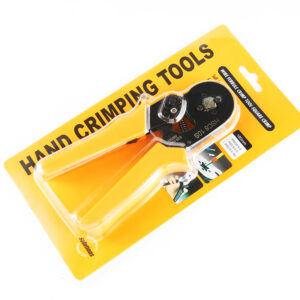
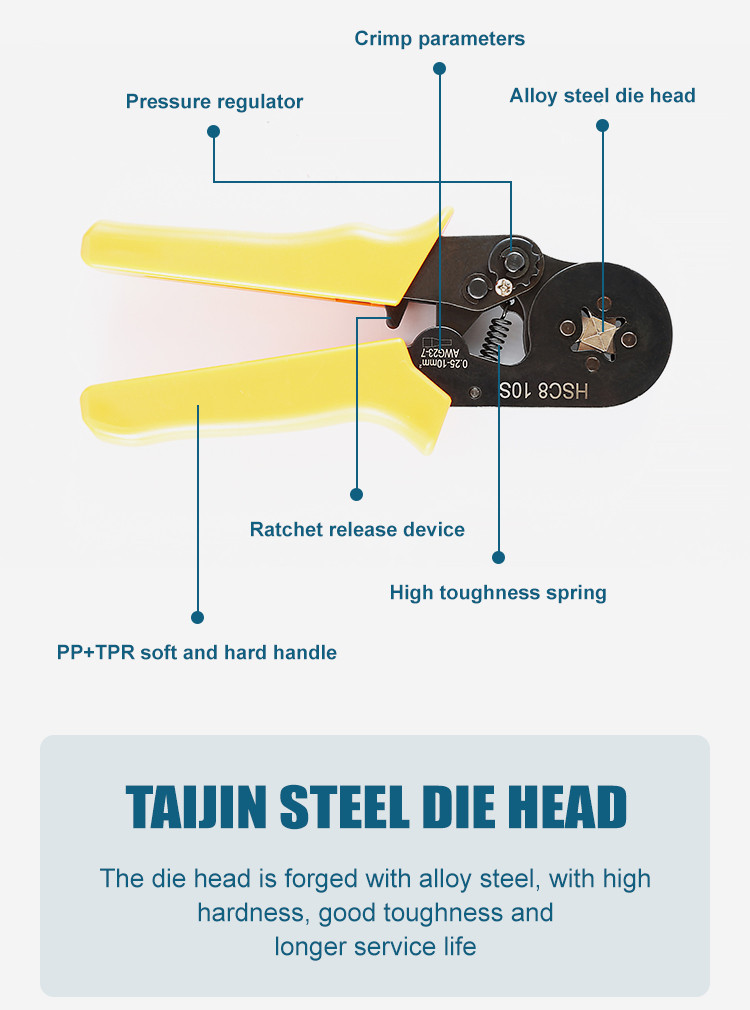
A ratchet crimping tool uses a compound lever and a mechanical ratchet that locks the jaws closed until the crimp cycle completes. You squeeze the handles; the ratchet prevents release mid-cycle, and a preset stops the jaw travel at the correct indentation depth. The result is a repeatable, consistent crimp with no guesswork — and it tops out around the force a human hand can sustain through the lever, typically enough for wires and lugs up to roughly 6–10 mm² with the right die.
A hydraulic crimping tool replaces muscle with fluid pressure. A hand pump (or battery/mains pump) drives a piston that forces the die together with several tonnes of force. Because the pressure is generated by the pump, not your grip, hydraulic tools handle very large conductors — 35 mm², 120 mm², even 300 mm² and above — and heavy non-insulated terminals that a ratchet simply cannot close.
Force and Cable Size: The Deciding Line
The single most useful rule of thumb: ratchet for wire and small terminals, hydraulic for large lugs and high-volume crimping.
| Cable / lug range | Recommended tool | Why |
|---|---|---|
| 0.5–6 mm² wire ferrules, bootlace | Ratchet (quadruple-roll) | Precise, light, cheap, controlled profile |
| 1.5–35 mm² terminals and lugs | Ratchet (hex) or small hydraulic | Ratchet fine up to ~10 mm²; beyond that force drops off |
| 35–300+ mm² lugs, battery cables | Hydraulic | Tonnes of force needed for full barrel compression |
| High-volume production runs | Hydraulic (battery) or bench press | Fatigue-free, fast cycle, consistent depth |
Ratchet Crimping Tools: Strengths and Limits
Strengths: low cost, light weight, no power source, and the ratchet mechanism guarantees the cycle finishes. The interchangeable dies (hex, trapezoidal, open-barrel) cover most panel and automotive terminals. For an electrician terminating crimping tool jobs up to a few mm² all day, it is the default.
Limits: human force caps the achievable compression. Above ~10 mm² the indent may not fully close the barrel, leaving a soft crimp that heats under load. Ratchets also tire the hand on long runs, and the jaw opening is physically too small for big lugs.
Hydraulic Crimping Tools: Strengths and Limits
Strengths: effortless force, repeatable depth, and the ability to seat very large lugs. A 10-tonne hydraulic head compresses a 120 mm² lug as easily as a ratchet closes a 2.5 mm² terminal. Battery models are fast enough for production lines, and the crimp quality is uniform across the whole shift.
Limits: higher purchase price, heavier heads, and maintenance (seals, oil, pump). For a one-off 2.5 mm² termination, a hydraulic tool is overkill and slower to set up than a ratchet.
Crimp Profile Matters as Much as Force
The tool family is only half the story. The die profile must match the terminal:
- Hexagonal (hex) — common for non-insulated lugs and many terminals; six-point compression.
- Trapezoidal / indent — used for insulated terminals and bootlace ferrules.
- U-die / sectional — heavy lugs where the barrel wraps the conductor in a C-shape.
Using a ratchet die on a lug meant for a hydraulic hex, or vice versa, produces a poor interface regardless of force. Always match the die to the terminal manufacturer’s recommendation.

Decision Factors Beyond Cable Size
- Volume. A few terminations a week — ratchet. Hundreds a day — hydraulic or bench press.
- Portability. Field service in a cabinet with no power favors a manual ratchet or a battery hydraulic.
- Consistency requirement. Audit-heavy industries (rail, EV, data centers) prefer hydraulic for the documented, uniform crimp depth.
- Budget and training. Ratchets need almost no training; hydraulic heads need die selection and pressure awareness.
Verification: Don’t Trust the Tool Alone
Whichever tool you choose, a proper crimp is verified, not assumed. Pull-test samples, check the indentation depth against the terminal spec, and inspect for cracked barrels or exposed strands. A crimp that looks tidy but fails a pull test is a latent failure. The broader debate of crimp vs solder terminal connections covers why a good mechanical crimp generally beats solder for vibration and thermal-cycle resistance.
Battery and Hydraulic Hybrid Options
The ratchet-versus-hydraulic split is no longer strictly manual-versus-pumped. Battery-powered hydraulic crimpers have closed the portability gap: they deliver tonnes of force with a trigger pull, which makes them the default for field crews terminating large lugs where a manual ratchet simply cannot generate the compression. The trade-off is weight, battery management, and a higher capital cost. A bench-mounted hydraulic press, by contrast, is the production-line choice where speed and repeatability beat portability.
Die Sets and the Standards Behind Them
The dies are where the real specification lives. Terminal and lug standards such as DIN 46234, DIN 46235, and IEC 60352-2 define the crimp geometry, and the die must match the terminal the standard expects. A mismatch — for example a die meant for a DIN 46234 lug applied to a different-profile terminal — produces a non-compliant indent even at the correct force. Professional kits therefore ship with indexed die sets and a lookup table; the operator matches the terminal part number to the die code rather than eyeballing the jaw.
For ferrules specifically, the quadruple-roll (trapezoidal) profile per DIN 46228 is the requirement. Using a hexagonal lug die on a ferrule crushes it unevenly and can crack the collar. The profile is part of the tool decision, not an afterthought.
Total Cost of Ownership
Buyers focused only on the sticker price often mis-specify. A ratchet crimper is cheap and needs no service, but if your work is mostly 50–300 mm² lugs, the time and rejected crimps from fighting the tool cost more than the hydraulic unit. Conversely, a hydraulic head on a bench doing 2.5 mm² sensor wires is wasted capital plus slower setup. Factor in die sets, seals, calibration, and operator fatigue over a year of use, not just the purchase order.
Calibration and Safety
Hydraulic tools should be recalibrated on a schedule, because seal wear slowly drops the delivered force and the crimps get softer without anyone noticing. A force-test gauge or a periodic pull-test on samples catches drift before it reaches the field. Ratchets, with no hydraulics, are largely self-consistent but should still be checked for jaw wear. Either way, the discipline of verifying the crimp — not trusting the tool — is what protects the installation.
Field Troubleshooting: Reading a Bad Crimp
Even with the right tool, crimps fail, and the failure mode tells you which tool decision was wrong. A barrel that splits along the seam means the die over-compressed a small terminal — usually a ratchet die closed too far on an undersized barrel, or the wrong profile entirely. A barrel that slides off the wire under pull test means under-compression: the tool lacked force (ratchet on too-large a lug) or the die was not fully closed. A crimp that looks right but heats in service usually has trapped insulation or a strand gap inside the barrel. Reading these signs lets you correct the ratchet-versus-hydraulic choice before a whole batch is committed, which is cheaper than reworking a finished harness.
The broader reliability picture also depends on the connection philosophy. Our guide to crimp vs solder terminal connections explains why a correct mechanical crimp generally outperforms solder under vibration and thermal cycling, which reinforces the case for investing in the proper crimping tool rather than reaching for a soldering iron as a shortcut.
Warranty, Support, and Training
The tool you buy is only as good as the support behind it. Ratchet crimpers are largely maintenance-free but benefit from spare die sets and occasional jaw inspection. Hydraulic units need seal kits, oil checks, and recalibration, so confirm the supplier stocks parts and offers recalibration service. Operator training is often overlooked: a half-day session on die selection, cycle completion, and pull-test verification pays back quickly in rejected-crimp reduction. When specifying for a team, factor training and spare-die availability into the purchase, not just the headline price, because a tool nobody is trained to use correctly is a tool that produces failures.
Choose the Right Crimping Tool for the Job
Matching ratchet versus hydraulic crimping to your cable size, lug type, and production volume is the difference between a clean termination and a rework loop.
Need Help Specifying a Crimping Tool?
Send us your cable sizes and daily termination count. We will recommend the right tool and the matching die set.
Frequently Asked Questions
Can a ratchet crimper handle large lugs such as 120 mm²?
No. Ratchet crimpers top out around 6–70 mm² depending on the model, which covers most control and panel terminals. For 70 mm² and above — battery lugs, switchgear, and heavy feeder connectors — you need a hydraulic tool that can generate the much higher closing force those lugs require.
Why won’t my ratchet crimper open halfway through a crimp?
That is the built-in safety ratchet: it stays locked until the jaws reach full compression, so you cannot produce a partial, weak crimp. If it will not complete the stroke, the die or terminal is wrong, worn, or inserted incorrectly — never force it open, as that defeats the mechanism.
Do hydraulic crimpers use the same dies as ratchet tools?
Generally no. Hydraulic tools take hexagonal or indent die sets sized to the conductor and lug, and most brands use proprietary die holders. Match the die to both the tool and the lug’s specified crimp profile; mixing them risks an out-of-spec joint.
How do I know I’ve used the right die?
Match the die marking to the conductor cross-section and the lug manufacturer’s specified crimp profile. After crimping, the mark of the die should be clearly formed and the joint should pass a tug or pull test — a loose or misshapen crimp means the wrong die or a worn tool.
Which tool suits field work versus workshop use?
A ratchet crimper is portable, light, and ideal for low-volume on-site work on small terminals. Hydraulic (often battery-powered) crimpers are the better choice for heavy lugs, high-volume production, or tight spaces where hand force is not enough.
