


Key Takeaways
Push mount cable ties (also known as fir-tree or arrowhead cable ties) are self-locking nylon zip ties with an integrated mounting head that pushes into a pre-drilled round hole in a panel or chassis. They eliminate screws, adhesives and rivets from wire harness installation and are standard in automotive interiors, appliances, control panels and electronics enclosures.
Cable Tie Technical Guide
A practical explainer for procurement engineers, OEMs and designers specifying panel-mounted wire management without fasteners.
By Niuli Electric (NLZD) · Technical Content Team · 8 min read
About the author: Niuli Electric is a China-based Nylon 66 cable ties manufacturer with 10+ years of production, UL/CE/RoHS/REACH/SGS certifications, 32 automatic production lines and 100+ employees serving 100+ countries.
What Are Push Mount Cable Ties?
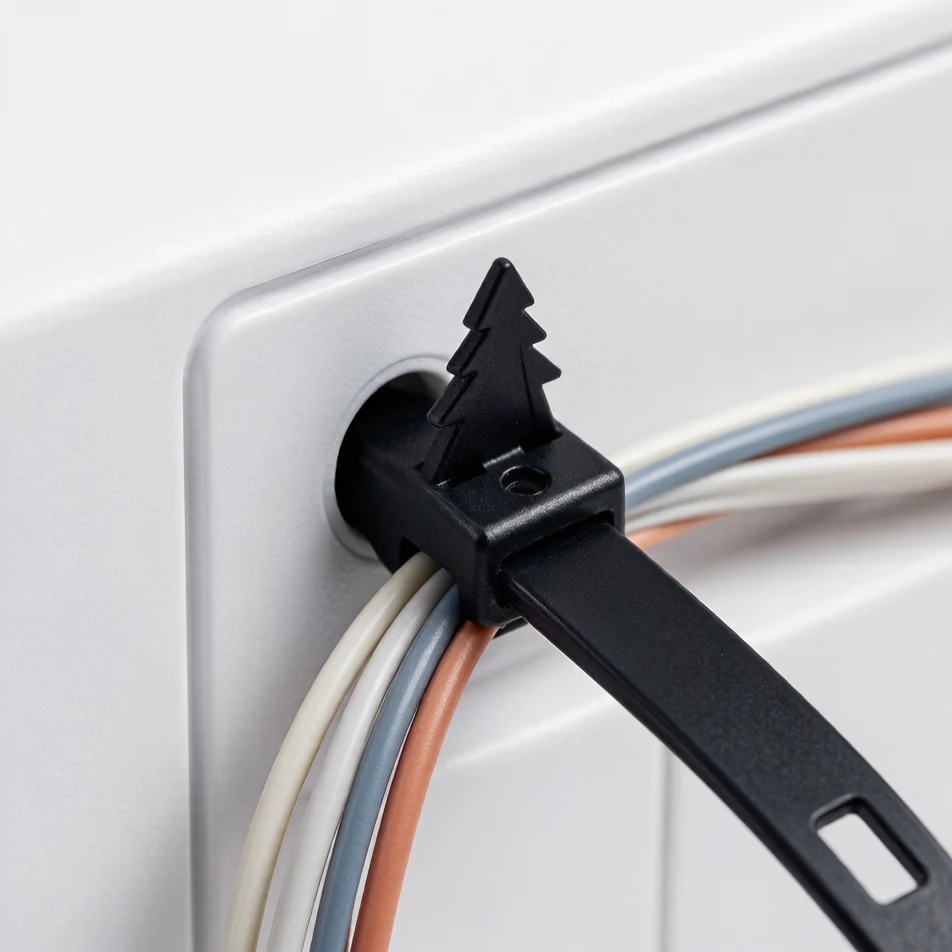
A push mount cable tie is a self-locking nylon zip tie with an integrated mounting head—usually shaped like a fir tree or arrowhead—that pushes into a pre-drilled round hole in a metal or plastic panel. Once inserted, angled barbs on the head grip the inside of the hole, locking the tie (and any bundled wires it holds) firmly in place without screws, adhesives, rivets or additional hardware.
In plain terms: imagine a regular cable tie, but instead of wrapping it around something and cutting off the tail, you push its built-in “anchor” into a hole and it stays put. This makes push mount ties one of the fastest ways to route and secure wire harnesses inside automotive door panels, appliance chassis, electrical cabinets and electronics enclosures where drilling and tapping screw threads would be too slow or too costly at scale.
Types & Fir-Tree Head Design
The defining feature of any push mount tie is its mounting head. The most common design—and the one most B2B buyers encounter—is the fir-tree (or Christmas tree) head. It gets its name from the tapered, multi-barbed profile that resembles a pine tree when viewed from the side. When pushed into a round hole, each barb flexes inward then springs back outward behind the panel edge, creating a mechanical lock that resists pull-out force.
Other head variants include:
- Arrowhead / spear head: a simpler two-barb design for lighter-duty applications and softer panels (plastic housings).
- Carpet clip style: wider, low-profile heads used under automotive carpet and interior trim panels.
- Screw-mount hybrid: a push mount head combined with a screw boss for secondary retention in high-vibration environments.
Regardless of head shape, all push mount ties share the same body as a standard self-locking nylon cable tie—a flexible strap with an integrated locking pawl in the head. After pushing the anchor into the panel hole, you bundle your wires, wrap the strap around them and thread it through the locking channel exactly like a conventional tie.
Hole Size Reference Table
The single most important design rule for push mount ties is matching the panel hole diameter to the tie’s head size. Too loose and the tie pulls out under vibration; too tight and you risk cracking the panel or making insertion difficult. Below is a general reference based on common industry sizes:
| Tie Width × Max Bundle Dia. | Recommended Hole Diameter | Typical Pull-Out Force | Common Use |
|---|---|---|---|
| 3.6 mm × 50 mm | Ø 4.8 – 5.0 mm | ~35 N | Small wire bundles, consumer electronics |
| 4.8 mm × 80–120 mm | Ø 6.0 – 6.3 mm | ~50 N | Appliance wiring, HVAC controls |
| 7.6 mm × 150–200 mm | Ø 7.8 – 8.0 mm | ~80 N | Automotive harnesses, industrial panels |
| 9.0+ mm × 200+ mm | Ø 9.5 – 10.0 mm | ~120 N | Heavy-duty harnesses, machinery |
Note: actual dimensions vary by manufacturer. Always request the specific technical drawing and test data from your supplier before finalizing panel tooling.
Push Mount vs Screw Mount vs Adhesive
Not every panel mounting method fits every application. Here is how push mount compares with the two most common alternatives:
| Factor | Push Mount Tie | Screw + Cable Tie Mount | Adhesive Tie Base |
|---|---|---|---|
| Installation speed | Fastest — push, bundle, lock | Slow — drill, tap, drive screw | Fast — peel, stick, wait cure |
| Tool required | None (hand-push) | Screwdriver / power driver | None |
| Pull-out strength | Good (barb-dependent) | Highest (mechanical thread) | Lowest (adhesion-limited) |
| Removable? | Difficult (destructive) | Yes (unscrew) | Difficult (residue) |
| Best for | High-volume assembly, plastic/metal panels | Heavy loads, high vibration | Smooth surfaces, no holes allowed |
For B2B buyers weighing options: if your production line runs at high volume and panels can accommodate punched or molded holes, push mount ties usually win on cycle time and piece cost. For extreme vibration or very heavy harnesses, cable tie mount screws remain the stronger choice. Where no holes can be drilled, adhesive cable tie bases offer a clean alternative—though bond strength depends heavily on surface preparation and temperature.
Need push mount cable ties for your next production run? Niuli supplies fir-tree and arrowhead push mount ties in multiple sizes with UL-approved Nylon 66, custom colors and OEM/ODM support.
Industrial Applications
Push mount ties shine wherever wire routing meets high-volume panel assembly:
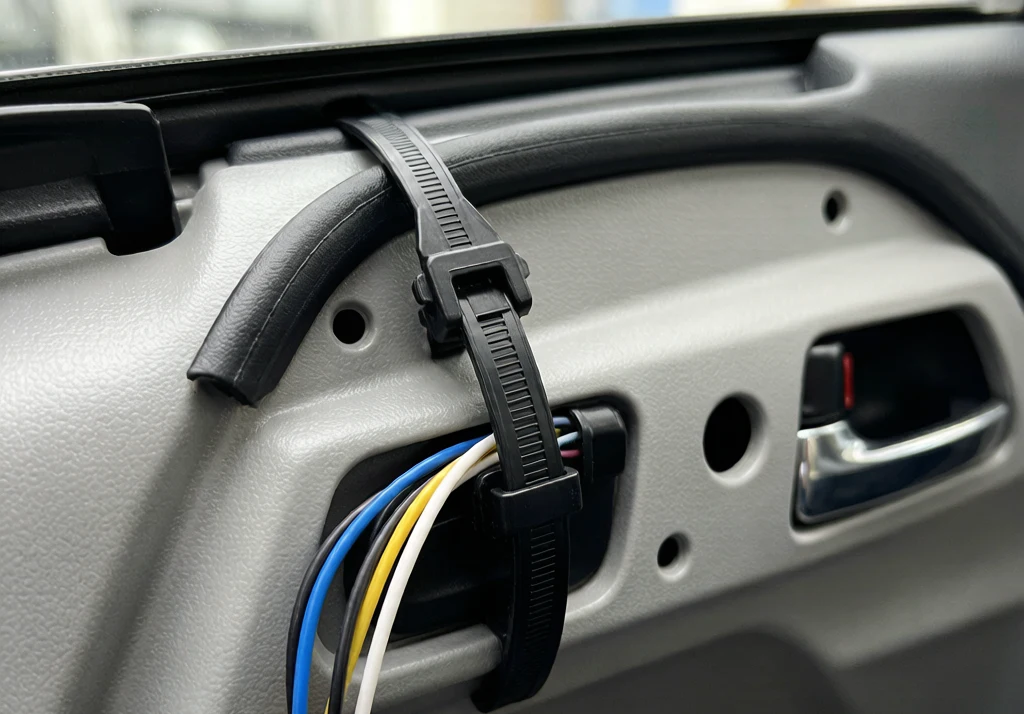
- Automotive interior & dashboard: door panel harnesses, instrument cluster wiring, center console looms. The fir-tree head locks into injection-molded plastic holes at rates of several ties per minute per operator.
- Appliances & white goods: refrigerator back-panel wiring, washing machine control boards, oven internal harnesses. Push mounts replace hand-driven staples and reduce assembly scrap.
- Electronics & enclosures: server rack cable management, junction box internal routing, PCB harness retention inside sheet-metal housings.
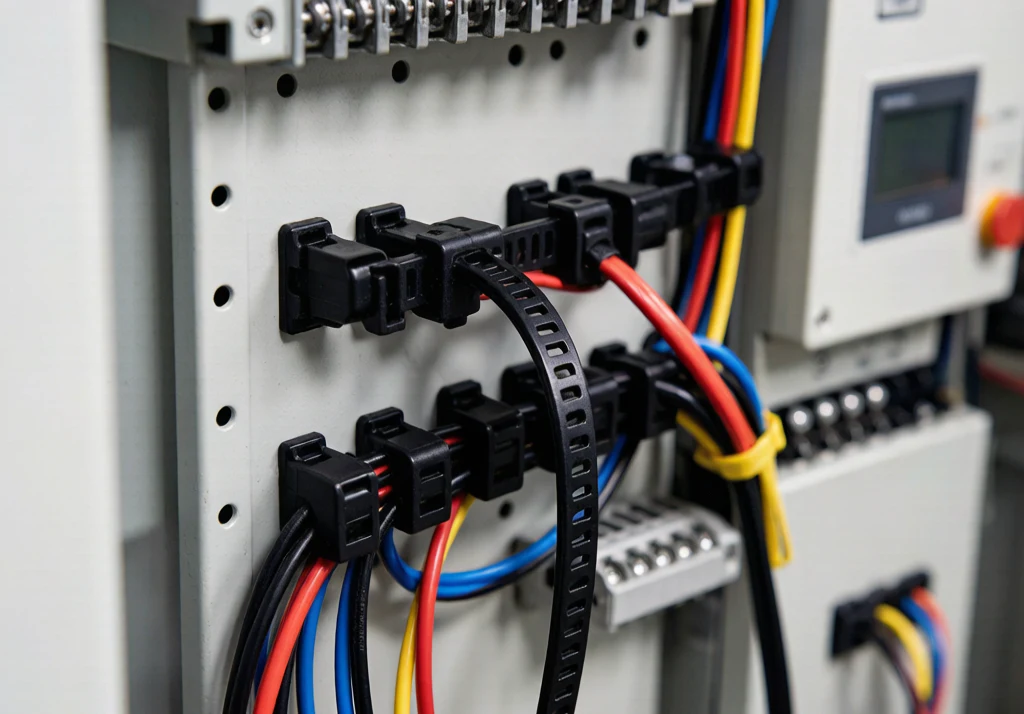
- Industrial control panels: DIN-rail cabinet wire dressing, PLC I/O harness organization, motor control center internal bundling.
Material & Certifications
Most push mount cable ties are molded from UL-recognized Nylon 66 (PA66) resin—the same material as standard self-locking ties. The mounting head and strap are typically co-molded as a single piece for maximum strength at the head-body junction. For B2B procurement, verify these specs on the supplier’s data sheet:
- Base material: Nylon 66 (PA66), preferably UL-recognized grades such as INVISTA U482L, DuPont 101L or ASCEND 21SPC.
- Flammability: UL 94V-2 minimum (required for most automotive and appliance applications).
- Temperature range: -40°C to 85°C continuous working temperature (standard grade); higher-temperature grades available for under-hood use.
- Pull-out force: Supplier should provide tested values in Newtons (N) or pounds-force (lbf) for each head size.
- Certifications: UL recognition, CE, RoHS, REACH, SGS for export markets. Niuli’s full Nylon 66 cable ties range carries all of these.
How to Choose — B2B Buyer Checklist
- Confirm the panel material and thickness. Plastic panels need a slightly undersized hole for interference fit; metal panels may require chamfered edges to avoid shearing the barbs during insertion.
- Match hole diameter to head size. Use the supplier’s recommended tolerance band (typically ±0.1 mm). Request a sample batch and test insertion/pull-out force on your actual panel material before committing to tooling.
- Check the bundle diameter and tensile requirement. The strap portion follows standard cable tie sizing rules—ensure the tie length wraps around your largest expected bundle with room for the locking tail.
- Verify environmental conditions. If the application involves sustained heat above 85°C, outdoor UV exposure, or chemical contact, specify stabilized or coated grades accordingly.
- Request certifications matching your market (UL for North America, CE/RoHS for EU, REACH for chemical compliance).
- Ask about customization. Head shape, strap length, color and packaging can often be tailored for volume orders—Niuli supports OEM/ODM across its push mount lineup.
Frequently Asked Questions
What are push mount cable ties?
Push mount cable ties are self-locking nylon zip ties with an integrated mounting head (typically shaped like a fir tree or arrowhead) that pushes into a pre-drilled round hole in a panel. The head’s angled barbs lock behind the panel edge, holding the tie and bundled wires securely without screws, adhesives or rivets.
How do push mount cable ties work?
Installation takes three steps: (1) push the fir-tree head into a matched-diameter hole until the barbs fully engage behind the panel; (2) bundle your wires against the mounted head; (3) wrap the strap around the bundle, thread it through the locking channel and trim the excess tail. No tools are needed for the mounting step—hand pressure suffices for standard panel materials.
What size hole do push mount cable ties need?
The required hole diameter depends on the tie width and head design. As a rough guide: 3.6 mm-wide ties typically need a Ø 4.8–5.0 mm hole; 4.8 mm ties need Ø 6.0–6.3 mm; 7.6 mm ties need Ø 7.8–8.0 mm; and 9.0+ mm ties need Ø 9.5–10.0 mm. Always confirm with your supplier’s technical drawing before finalizing panel tooling.
Push mount vs screw mount vs adhesive — which is best?
It depends on your priority. Push mount wins on installation speed and piece cost for high-volume assembly where panels accept holes. Screw mount offers the highest pull-out strength for heavy or high-vibration loads. Adhesive bases work where no holes can be drilled but depend on surface condition and temperature. Many B2B buyers use a mix of all three across different stations on the same assembly line.
Can push mount cable ties be removed once installed?
Removing a push mount tie without damaging the panel is difficult. The barbs are designed to resist backward pull, so extraction usually requires cutting the strap and either prying or drilling out the head. If service access is needed, consider designing removable access covers over the wire run, or using releasable-style straps on the tie body while keeping the push mount head permanent.
Are Niuli push mount cable ties UL listed?
Niuli’s push mount cable ties are made from UL-recognized Nylon 66 resin, carry UL 94V-2 flammability rating, and are certified to CE, RoHS, REACH and SGS standards. Full certification documentation and test reports are available on request for your compliance file.
Where are push mount cable ties commonly used?
They are ubiquitous in automotive interior and dashboard wiring, appliance back-panel harnesses (refrigerators, washing machines, ovens), electronics enclosure management (servers, junction boxes, PLC cabinets), and industrial control panel wire dressing. Anywhere a high-volume assembly line needs to secure wire bundles to a paneled surface is a candidate for push mount.
Conclusion
Push mount cable ties turn a normally two-step operation (fasten a mount, then attach a tie) into a single push-and-lock action. For B2B buyers managing high-volume wire harness assembly—whether in automotive plants, appliance factories or electronics contract manufacturing—that translates directly into lower labor cost per unit, fewer line-side SKUs and cleaner panel designs. By confirming hole tolerances, testing pull-out force on your actual panel material, and verifying UL/CE/RoHS certifications, you can specify push mount ties with confidence. Niuli Electric manufactures fir-tree and arrowhead push mount ties in-house with full OEM/ODM flexibility and global export experience.
Need Push Mount Cable Ties for Your Production Line?
Get a quote on UL-listed fir-tree push mount ties with custom sizes, colors and OEM/ODM support from Niuli Electric.
Related Resources
- How to Distinguish the Quality of Nylon Cable Tie — practical QC checks for buyers.
- Setting Standards for the Injection Molding Process of Nylon Cable Tie Production — how Niuli controls tie quality.
- Coming soon: Heat-Stabilized Cable Ties Guide · Standard Cable Ties Selection Guide · Releasable Cable Ties Overview.
Niuli Electric (NLZD) is a China-based manufacturer of nylon cable ties, cable glands, clips and soldering accessories. This article is for technical reference; specifications should be verified against the current product data sheet before procurement.
