


Key Takeaways
Heat-stabilized cable ties are Nylon 66 zip ties engineered with heat stabilizers so they keep their strength and flexibility at continuous temperatures up to 105–120°C (221–248°F)—far above the 85°C limit of standard ties. They are built for automotive engine bays, HVAC, lighting and solar environments where ordinary ties would embrittle and fail.
Cable Tie Technical Guide
A practical explainer for procurement engineers, OEMs and distributors specifying cable management that must survive heat.
By Niuli Electric (NLZD) · Technical Content Team · 8 min read
About the author: Niuli Electric is a China-based Nylon 66 cable ties manufacturer with 10+ years of production, UL/CE/RoHS/REACH/SGS certifications, 32 automatic production lines and 100+ employees serving 100+ countries.
What Are Heat-Stabilized Cable Ties?
A heat-stabilized cable tie is a nylon cable tie (zip tie) that has been compounded with thermal stabilizer additives during manufacturing. Standard Nylon 66 begins to lose toughness and turns brittle once it sits above roughly 85°C (185°F) for long periods. Heat stabilizers slow that aging, letting the tie hold its tensile strength, flexibility and locking force at continuous operating temperatures of 105°C (221°F) and, in upgraded grades, up to 120°C (248°F).
In plain terms: it is the same self-locking nylon tie you already use, reformulated so it does not crack, loosen or snap when mounted near engines, heaters, ballasts or direct sun-load. For B2B buyers, that means fewer field failures, lower warranty claims and compliance with higher-temperature specifications from automotive and industrial OEMs.
Temperature Ratings & Comparison
The number that matters most is the continuous working temperature. Here is how a heat-stabilized tie compares with a standard tie and Niuli’s high-temperature product grade:
| Property | Standard Nylon 66 Tie | Heat-Stabilized Tie | Niuli High-Temp Tie |
|---|---|---|---|
| Working temperature | -40°C to 85°C | -40°C to 105°C | -40°C to 120°C |
| Installation temp. | -10°C to 85°C | -10°C to 105°C | -10°C to 120°C |
| Material | Nylon 66 | Nylon 66 + heat stabilizer | UL-approved Nylon 66 |
| Flammability | UL 94V-2 | UL 94V-2 | UL 94V-2 |
| Best for | Indoor, ambient use | Warm enclosures, lighting | Engine bays, HVAC, solar |
Note: figures for “Niuli High-Temp Tie” reflect the published specification of Niuli’s high temperature resistant cable ties (-40°C to 120°C working range, UL 94V-2).
Heat-Stabilized vs Standard Cable Ties
The two ties look identical and install the same way, but they are not interchangeable in heat. Standard ties are fine for bundling cables in a cool office or server room. The moment the tie sits in a heat soak—behind a car dashboard, inside a roof-mounted HVAC unit, or beside an LED driver—standard nylon oxidizes and becomes brittle within months.
- Heat retention: heat-stabilized compounds resist thermal oxidation, keeping ductility where standard ties stiffen.
- Service life: in elevated-temperature duty cycles, heat-stabilized ties last significantly longer before cracking.
- Cost: heat-stabilized ties carry a small material premium—usually worth it wherever a failure is expensive or unsafe to reach.
Specifying ties for a heated environment? Niuli supplies high temperature resistant cable ties rated to 120°C with full UL/CE/RoHS/REACH certification and OEM/ODM support.
Industrial Applications
Heat-stabilized ties earn their place wherever bundled wires share space with heat sources:
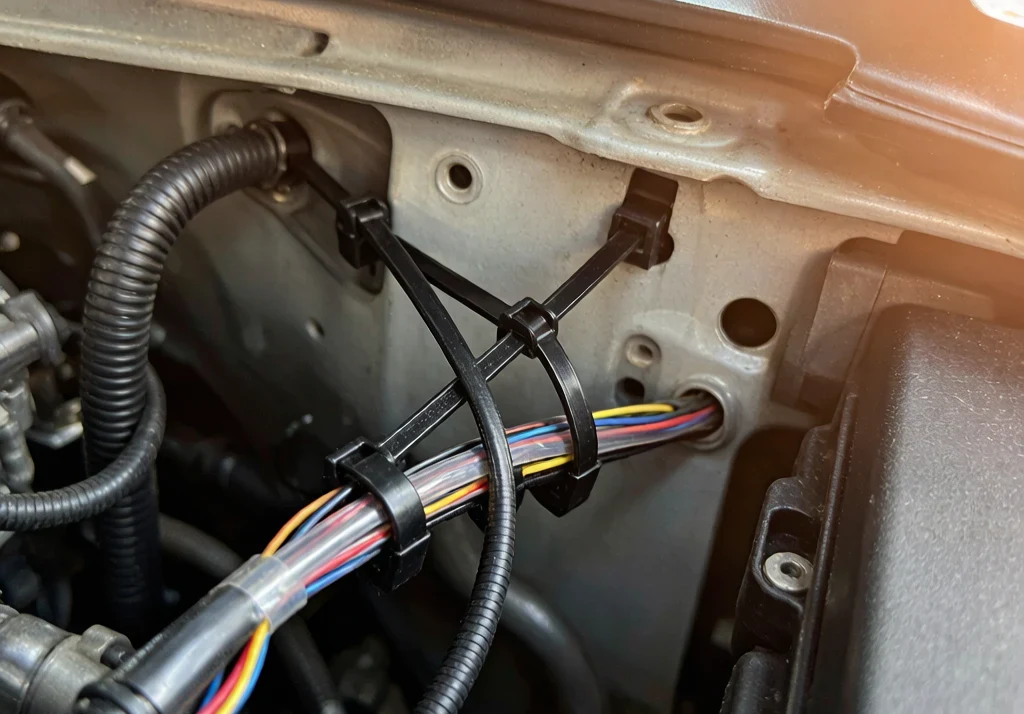
- Automotive: engine bay harnesses, battery packs, under-hood looms where under-bonnet temperatures routinely exceed 100°C.
- HVAC & appliances: HVAC cable ties secure wiring inside furnaces, air handlers and compressors.
- Lighting & LED: drivers and ballasts run hot; stabilized ties prevent drooping and cracking.
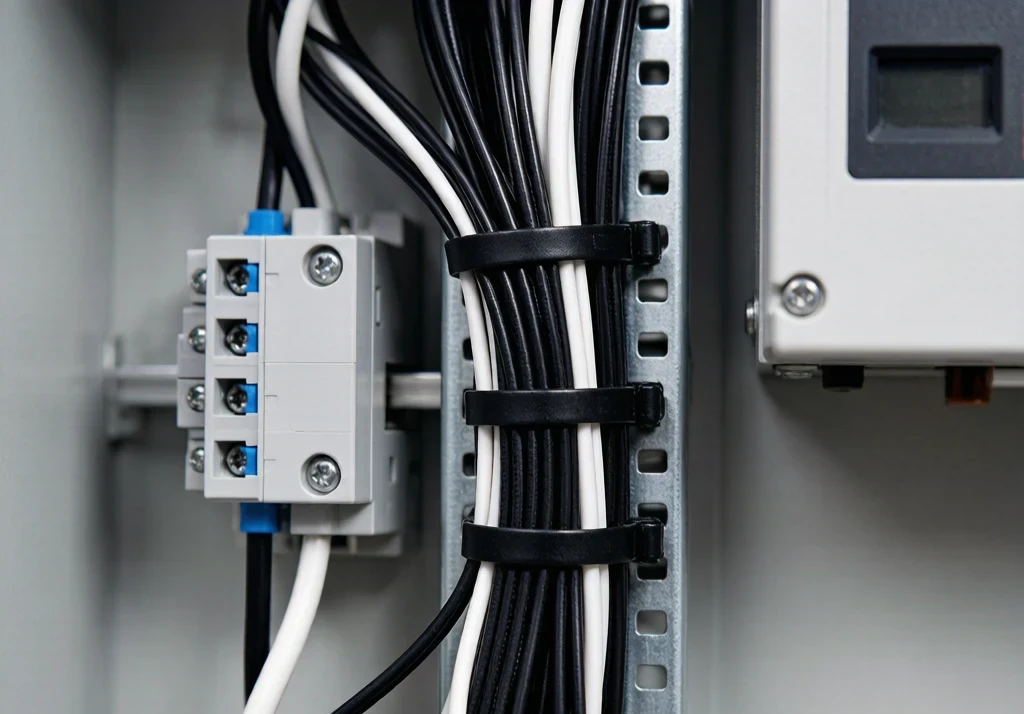
- Solar & inverters: combiner boxes and inverter cabinets accumulate heat in sealed outdoor enclosures.
Material & Certifications
Heat-stabilized ties are made from Nylon 66 cable ties compound (often UL-recognized grades such as INVISTA U4820L, DuPont 101L or ASCEND 21SPC) with a heat-stabilizer package added before extrusion. For B2B procurement, look for:
- UL recognition on the Nylon 66 resin and UL 94V-2 flammability rating.
- CE, RoHS, REACH, SGS compliance for export and regulated markets.
- Stable working-temperature data on the spec sheet, not just a marketing claim.
Niuli’s high-temperature ties are UL-approved Nylon 66, UL 94V-2, certified to CE/RoHS/REACH/SGS, and available in black or natural with custom sizes and colors on request.
How to Choose — B2B Buyer Checklist
- Confirm the duty temperature. Read the continuous (not peak) temperature at the tie’s location; pick a tie rated at least 10–15°C above it.
- Match the environment. Add UV stabilizer for outdoor sun exposure—see anti-UV cable ties—or low-temperature grade for freezers.
- Verify certifications needed for your market (UL, CE, RoHS, REACH).
- Size for the bundle. Choose width and length for the bundle diameter and tensile requirement (Niuli offers 2.5–12 mm widths, up to 250 lb / 110 kg strength).
- Request samples and validate in your actual thermal cycle before volume ordering.
Frequently Asked Questions
What temperature can heat-stabilized cable ties withstand?
Typical heat-stabilized Nylon 66 ties are rated for continuous service around 105°C (221°F). Upgraded grades—such as Niuli’s high temperature resistant ties—reach a working range of -40°C to 120°C (248°F). Always use the manufacturer’s published continuous rating, not the short-term peak.
What is the difference between heat-stabilized and standard cable ties?
Both use Nylon 66 and install identically, but heat-stabilized ties include thermal stabilizers that resist oxidation and embrittlement above 85°C. Standard ties stiffen and crack in sustained heat; heat-stabilized ties keep flexibility and locking force. The trade-off is a small material premium.
Are heat-stabilized cable ties the same as high-temperature cable ties?
They describe the same goal. “Heat-stabilized” refers to the stabilized Nylon 66 compound; “high-temperature” describes the resulting rating. Some suppliers (including Niuli) label the product “high temperature resistant cable ties” with a stated -40°C to 120°C range. Check the spec, not just the name.
What material are heat-stabilized cable ties made of?
They are made from Nylon 66 (PA66) resin—often UL-recognized grades—with a heat-stabilizer additive blended in before extrusion. The base polymer is the same as standard ties; the stabilizer package is what extends the thermal service life.
Where are heat-stabilized cable ties used in industry?
Primarily in hot duty cycles: automotive engine bays and EV battery harnesses, HVAC units and appliances, LED and ballast lighting, and solar inverter or combiner-box wiring. Anywhere wires sit near a sustained heat source is a candidate.
Are Niuli heat-stabilized cable ties UL listed?
Niuli’s high temperature resistant cable ties use UL-approved Nylon 66, carry UL 94V-2 flammability, and are certified to CE, RoHS, REACH and SGS. Documentation and certifications are available on request for your compliance file.
Can heat-stabilized cable ties be used outdoors?
Yes for heat, but UV is a separate stressor. For outdoor sun exposure, choose a UV-stabilized grade—Niuli’s anti-UV cable ties are formulated for ultraviolet resistance. For combined heat + sun, ask about a dual-stabilized (heat + UV) specification.
Conclusion
Heat-stabilized cable ties are a small component with a large impact on reliability in hot environments. By specifying the right Nylon 66 grade, verifying the continuous temperature rating, and confirming certifications, B2B buyers avoid premature failures in automotive, HVAC, lighting and solar applications. Niuli Electric manufactures these ties in-house with full UL/CE/RoHS/REACH certification and OEM/ODM flexibility.
Need Heat-Stabilized Cable Ties for Your Project?
Get a quote on UL-listed, 120°C-rated ties with custom sizes and OEM/ODM support from Niuli Electric.
Related Resources
- How to Distinguish the Quality of Nylon Cable Tie — practical QC checks for buyers.
- Setting Standards for the Injection Molding Process of Nylon Cable Tie Production — how Niuli controls tie quality.
- Coming soon: Nylon 6 vs Nylon 66 Cable Ties · UV Resistant vs Standard Cable Ties · How to Choose the Right Cable Tie Size.
Niuli Electric (NLZD) is a China-based manufacturer of nylon cable ties, cable glands, clips and soldering accessories. This article is for technical reference; specifications should be verified against the current product data sheet before procurement.
