


Key Takeaways
- Over-tightening is the #1 cause of cable tie breakage during installation — stay within the rated tensile strength.
- Match cable tie size and tensile rating to your bundle diameter and weight; undersized ties snap under load.
- Temperature extremes (below -40°C or above 85°C) reduce nylon flexibility and tensile strength significantly.
- Use a dedicated flush-cut tool instead of pliers to avoid stress cracks at the cut point.
- For heavy-duty applications, upgrade to super-strong or double-locking grades with higher loop tensile ratings.
Nylon cable ties snapping mid-installation is one of the most frustrating problems on the assembly line and job site. You pull the tail, feel resistance, and then — crack — the head shears off or the strap fractures, leaving you fishing broken plastic out of a wire harness. It wastes time, creates rework, and in worst cases leaves bundles unsecured.
This guide breaks down the 7 most common reasons nylon cable ties break during installation, explains the mechanics behind each failure mode, and gives you actionable prevention steps — so you can select the right tie grade, install correctly, and stop losing product to preventable breakage.
Table of Contents
7 Common Causes of Cable Tie Breakage During Installation
1. Over-Tightening Beyond Rated Tensile Strength
This is by far the most common cause. Every cable tie has a minimum loop tensile strength (MLTS) — the maximum pulling force it can withstand before the locking mechanism fails or the strap fractures. When an installer pulls “until it feels tight,” they routinely exceed this rating, especially on smaller ties where the break point can be as low as 18 lbs (80 N) for a 2.5″ (100 mm) standard tie.
The failure typically occurs at one of two points: the locking head/pawl interface (the pawl shears through the strap teeth) or the strap itself near the head where stress concentration is highest. Once the pawl disengages or the strap tears, the tie cannot be recovered — it must be replaced entirely.
2. Wrong Size Selection (Undersized for Bundle Diameter)
A tie that’s too short for your bundle forces you to stretch it to its limit just to reach the locking slot. At that point, you’re already near the tensile limit before any real securing force is applied. The rule of thumb: add 15–20% to your bundle circumference when selecting tie length. If your bundle measures 40 mm in diameter (~126 mm circumference), don’t reach for a 100 mm (4″) tie — step up to at least 150 mm (6″).
Niuli’s standard nylon cable ties are available in lengths from 2.5″ (100 mm) to 36″ (900+ mm). Matching length to bundle diameter is the single easiest way to eliminate size-related breakage.
3. Low-Quality Material or Degraded Stock
Not all Nylon 66 compounds are equal. Budget-grade ties use recycled content, lower molecular weight resin, or insufficient heat stabilizer — all of which reduce tensile strength by 30–50% compared to UL-recognized virgin Nylon 66 (such as INVISTA U4820L or DuPont 101L). If your stock has been sitting in a hot warehouse for months, UV exposure and thermal aging may have already degraded the polymer chains before you even open the bag.
For B2B procurement, always verify that ties are made from UL-recognized Nylon 66 and check the manufacturing date code. Niuli’s full Nylon 66 cable tie range uses certified virgin compound with full traceability.
4. Temperature Extremes (Cold Brittleness or Heat Softening)
Nylon 66 performs best between -40°C and +85°C. Below -40°C, the polymer transitions to a brittle state — the tie can shatter like glass from a minor impact or a normal tightening pull. Above 85°C (especially approaching 105–120°C), the material softens: the tensile strength drops, the strap stretches under load (“cold flow”), and the locking teeth can strip under far less force than the rated specification.
For high-temperature environments (engine compartments, solar inverters, industrial ovens), consider heat-stabilized grades rated to 105°C continuous, or Niuli’s high temperature resistant cable ties (-40°C to 120°C).
5. Improper Cutting Technique (Stress Riser at Cut Point)
After tightening, the excess tail must be trimmed flush. Using diagonal cutters, side-cutting pliers, or a utility knife creates a sharp, angled cut surface that becomes a stress concentration point. Over time — sometimes within hours — a crack propagates from that cut edge into the locked portion of the strap, causing delayed failure.
The correct approach: use a dedicated cable tie cutting tool with a flush-cut blade that leaves a smooth, perpendicular surface. This eliminates the stress riser and prevents post-cut cracking.
6. Sharp Edges on Bundle or Mounting Surface
If the cable tie rubs against a sharp metal edge, panel burr, or rough mounting surface, the strap experiences abrasion plus point-loading. Even if the initial installation seems fine, vibration or thermal cycling causes the tie to saw against the sharp edge until it severs. This is especially common in automotive wiring harnesses and sheet-metal enclosures.
Solution: deburr all holes and edges, use protective sleeves (spiral wrapping bands or heat shrink), or choose double-locking cable ties with a reinforced stainless steel pawl for critical applications.
7. Vibration and Dynamic Loading
In moving equipment (motors, vehicles, conveyor systems), the cable tie isn’t just holding a static load — it’s experiencing cyclic stress. Standard all-plastic ties can develop fatigue fractures at the locking head after thousands of vibration cycles, even if the static load is well below the tensile rating. This is why automotive OEMs often specify metal-pawl or stainless steel ties for engine bay and underbody applications.
How the Locking Mechanism Works (and Where It Fails)
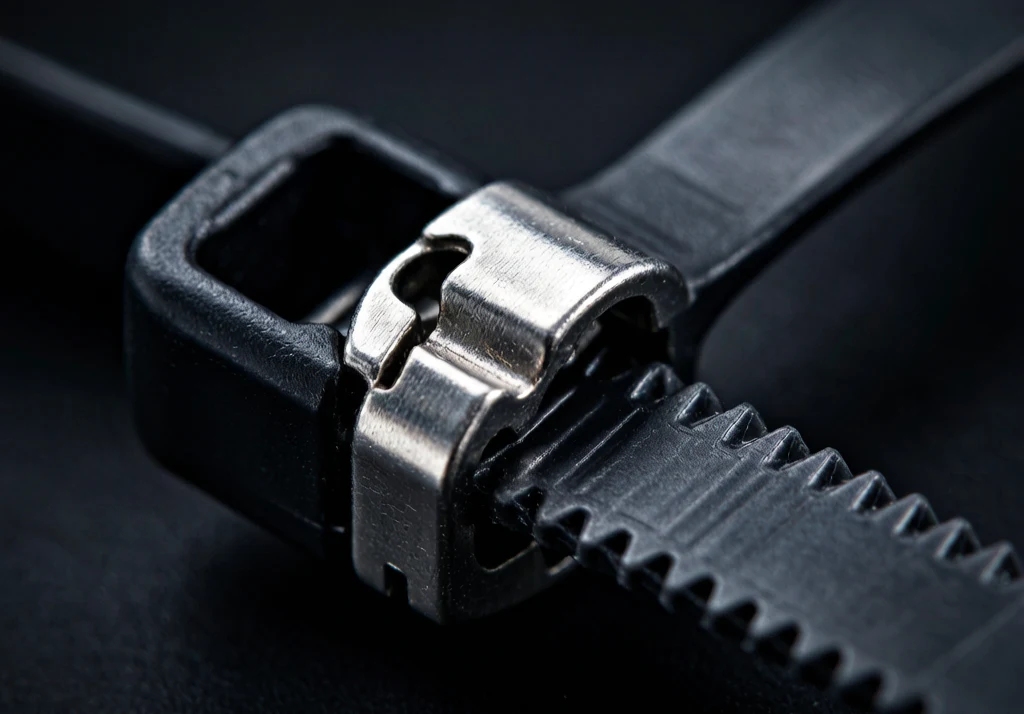
Understanding the internal mechanics helps you see exactly why breakage happens. A standard nylon cable tie has four components:
- The Strap: A flexible Nylon 66 band with molded serrations (teeth) along one surface.
- The Head/Body: A rigid molded housing that contains the locking mechanism.
- The Pawl (locking tang): A flexible metal or plastic finger inside the head that engages the strap serrations.
- The Stop: A ramped feature that prevents the pawl from backing off once engaged.
When you pull the tail, the strap slides through the head. Each tooth pushes the pawl up the ramp; once past the tooth tip, the pawl springs back into the valley between teeth — ratcheting forward but unable to slide backward. This is the self-locking action that makes cable ties so effective.
Failure modes at the mechanism level:
- Pawl shear-through: Excessive tension forces the pawl to cut through the strap teeth (most common in low-quality ties).
- Pawl fracture: The pawl itself snaps (common in cold temperatures with plastic pawls).
- Head separation: The strap pulls completely out of the head because the pawl disengaged.
- Strap tear: The strap material ruptures near the head due to stress concentration.
Tensile Strength Quick Reference Table
Use this table to match cable tie size to your application’s load requirements. Values are typical minimum loop tensile strength (MLTS) for standard Nylon 66 UL-rated ties.
| Tie Length | Max Bundle Ø | Typical MLTS | Duty Class | Common Use |
|---|---|---|---|---|
| 2.5″ (100 mm) | Ø 25 mm | 18 lb (80 N) | Light | Wire management, small bundles |
| 4″ (150 mm) | Ø 40 mm | 25 lb (110 N) | Medium | General purpose, electronics |
| 8″ (200 mm) | Ø 60 mm | 40 lb (175 N) | Medium | Appliance, HVAC, control panels |
| 11.8″ (300 mm) | Ø 90 mm | 50 lb (220 N) | Medium-Heavy | Industrial cable harnesses |
| Super-Strong (various) | Ø 50–120 mm | 120–250 lb (540–1110 N) | Heavy | Automotive, solar, heavy industrial |
Note: Actual values vary by manufacturer and specific grade. Always consult the manufacturer’s datasheet before specifying for safety-critical applications.
Prevention: Step-by-Step Installation Best Practices
- Select the right size: Measure bundle diameter × 3.14 = circumference. Add 20%. Pick the next standard size up.
- Check material condition: Inspect for UV yellowing, brittleness, or out-of-spec date codes. Discard degraded stock.
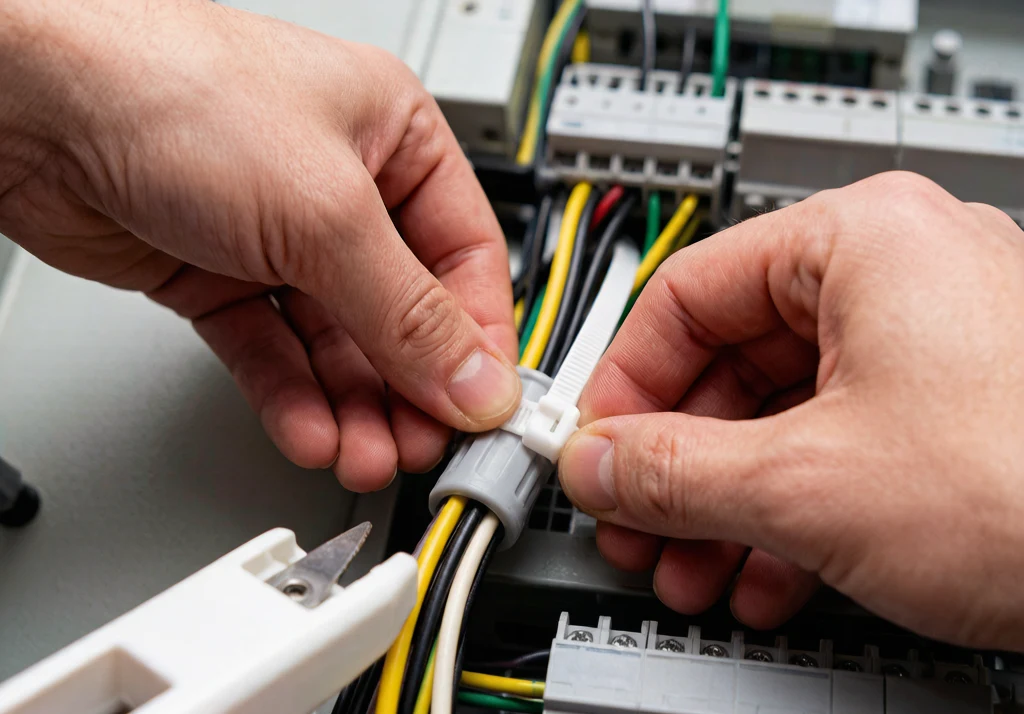
- Wrap without over-stretching: Loop the tie around the bundle and insert the tail into the head. Pull until the bundle is snug — not until your arm shakes.
- Cut flush with proper tool: Use a dedicated flush-cut cable tie tool. Cut perpendicular to the strap, leaving 2–3 mm tail minimum.
- Inspect the cut edge: Run a fingernail across the cut. If it feels sharp or jagged, recut with the proper tool.
- Document for repeat jobs: Once you find the right size/tensile combination for a given bundle, record it in your work instruction to prevent future trial-and-error breakage.
When to Upgrade to Heavy-Duty Grades
If standard ties keep breaking despite correct installation technique, it’s likely an application mismatch — not user error. Here’s when to step up:
| Symptom | Likely Cause | Upgrade To |
|---|---|---|
| Snaps at 30–40 lbs consistently | Bundle too heavy for standard tie | Super-strong cable ties (120–250 lb MLTS) |
| Head pops open under vibration | All-plastic pawl fatiguing | Double-locking / metal-pawl ties |
| Strap cracks in cold storage | Below -40°C operating temp | Low-temp rated or stainless steel ties |
| Tie softens near engine/exhaust | Exceeds 85°C continuous | Heat-stabilized or high-temp ties (to 120°C) |
Specifying Cable Ties That Won’t Break on the Job?
Niuli supplies standard, super-strong, double-locking, and heat-stabilized nylon cable ties — all UL-recognized Nylon 66 with full certification. OEM & ODM support available.
Frequently Asked Questions
Why does my cable tie snap when I pull it tight?
The most common reason is exceeding the tie’s rated tensile strength. When you pull hard enough to make the bundle feel “rock solid,” you’re often applying 2–3× the necessary securing force — which exceeds what the locking pawl and strap are designed to handle. Pull until the bundle is snug and the tie doesn’t rotate freely, then stop. Don’t use the tie as a handle to lift the bundle.
What is the tensile strength of a standard nylon cable tie?
It depends on the size and grade. A standard 4″ (150 mm) UL-rated Nylon 66 tie typically has a minimum loop tensile strength of about 25 lb (110 N). An 8″ (200 mm) tie rates around 40 lb (175 N). Super-strong grades range from 120 lb to 250 lb (540–1110 N). See the reference table above for a complete size-to-strength mapping.
Can I reuse a cable tie that partially cracked?
No. Any visible crack, partial fracture, or whitening (stress whitening = micro-fractures) means the structural integrity is compromised. The tie will fail completely under the next load cycle — possibly at the worst moment. Always remove and replace damaged ties immediately. The cost of a new tie is negligible compared to downtime, rework, or a safety incident.
What’s the difference between standard and super-strong cable ties?
Super-strong ties use either a thicker cross-section strap, a reinforced locking head with a stainless steel pawl, or both. This gives them 3–5× the tensile strength of a standard tie of the same length. They’re designed for heavy-bundle applications like automotive wire harnesses, solar panel cabling, and industrial machinery where vibration and high static loads are expected. See Niuli’s super-strong cable tie lineup for specifications.
Do temperature changes make cable ties more brittle?
Yes, significantly. Below -40°C, Nylon 66 undergoes a glass transition that makes it brittle — ties can shatter from minor impacts or normal tightening pulls. Above 85°C, the material softens: tensile strength drops, and the tie can stretch permanently under load (cold flow). For extreme environments, use heat-stabilized grades (rated to 105°C), low-temperature formulations, or switch to stainless steel ties.
How do I choose the right cable tie size for my bundle?
Measure the bundle diameter (or calculate from the sum of wire/cable diameters). Multiply by π (3.14) to get the circumference. Add 15–20% for comfortable locking. Select the next standard size up from that number. Example: a 30 mm diameter bundle needs ~110 mm circumference + 20% = 132 mm minimum → choose a 150 mm (6″) tie.
Should I cut cable ties with pliers or a dedicated tool?
Always use a dedicated flush-cut cable tie tool. Pliers, wire cutters, and knives leave a sharp, angled cut that acts as a stress riser — a starting point for crack propagation. A proper flush-cut tool slices perpendicular to the strap, leaving a smooth surface that won’t initiate fractures. The small investment in a quality tool pays for itself quickly in reduced rework and fewer field failures.
Are metal-pawl cable ties more resistant to breaking?
Yes. In a standard all-plastic tie, the pawl is molded Nylon 66 — the same material as the strap. Under extreme loads or vibration cycles, the plastic pawl can wear, deform, or fracture. Metal-pawl (stainless steel) ties replace the plastic pawl with a steel locking tang that resists far higher loads and doesn’t fatigue the same way. They cost 2–3× more than standard ties but are essential for automotive underhood, aerospace, and critical industrial applications.
Related Resources
- How to Distinguish the Quality of Nylon Cable Tie — Learn to spot low-grade material before it causes failures
- What Are Heat-Stabilized Cable Ties? — Temperature-related breakage solutions
- What Are Push Mount Cable Ties? — Panel-mounting alternatives for clean installations
- Nylon 6 vs Nylon 66 Cable Ties: Complete Material Comparison Guide (coming soon)
- Standard vs Releasable Cable Ties: When to Use Each Type (coming soon)
