



- A push-mount tie locks by spring fingers that bite the back of the panel hole.
- Hole diameter must sit in the tie maker range; too big and it pulls through, too small and it will not seat.
- Panel thickness sets how far the fingers can open; thin panels give less bite and lower retention.
- Retention force is the pull the tie withstands before the head walks out of the hole.
- Verify with a pull test on the actual panel, not just the catalogue number.
A push-mount cable tie is the cleanest way to anchor a bundle to a panel: you punch or drill a hole, push the tie’s arrow-head in from the front, and spring fingers lock it behind the metal. But that lock only works inside a window of hole diameter and panel thickness. Step outside it and the tie either will not seat or pulls out under load. Retention force is the number that tells you which side of the window you are on.
How a Push-Mount Tie Locks
The head of a push-mount tie has barbed or angled fingers. Pushed through the hole, the fingers compress, pass the panel, then spring open on the far side and bite the back face. The tie is held by those fingers hooking the panel, not by friction in the hole. The bundle tension then tries to pull the head back through, and the fingers must be far enough open to resist that pull.
Mounting Hole Diameter
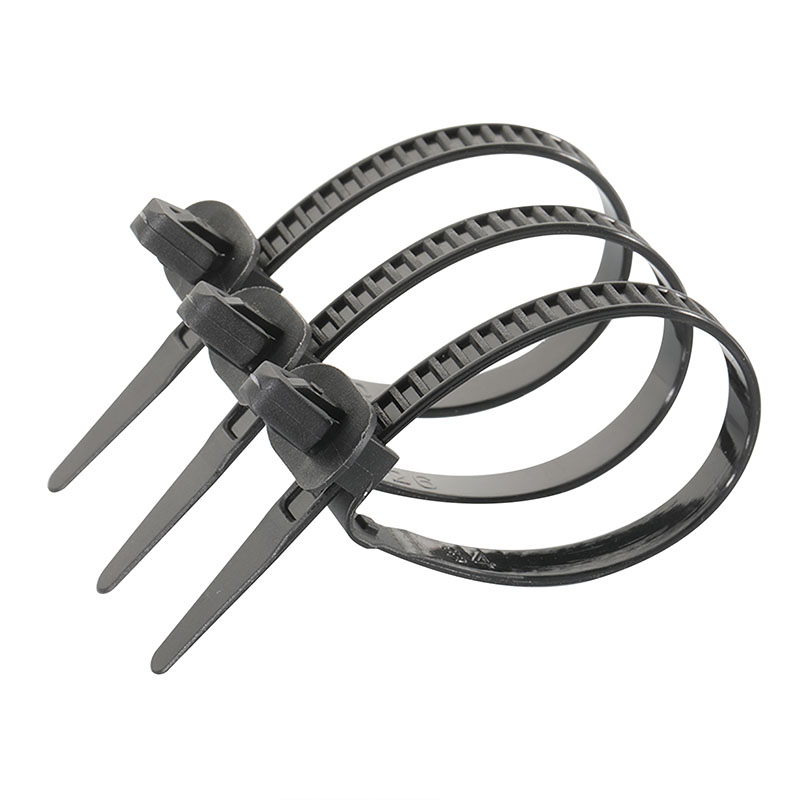
The hole must be large enough for the fingers to pass but small enough that the head’s shoulder cannot follow. Each tie size quotes a hole-diameter range (for example 6.0 to 6.5 mm for a common 6.3 mm panel fasTie). Drill above the range and the whole head pulls through; drill below it and the fingers cannot compress to pass, so the tie never locks. Use the specified drill bit, not a near-size one.
Panel Thickness
Panel thickness decides how far the fingers can open behind the hole. A thick panel lets the fingers spring fully open and bite hard; a thin panel (say 0.8 mm sheet) leaves little room, so the fingers open only slightly and the bite is shallow. Below the tie’s minimum panel thickness the fingers may not engage at all, and retention drops sharply. For thin sheet, choose a tie rated for thin panels or add a washer/plate.
What Retention Force Means
Retention force is the axial pull the mounted tie withstands before the head walks back out of the hole. It rises with how far the fingers open (panel thickness) and how well the hole matches the head (diameter). A tie rated at 25 lb retention in a 1.5 mm panel may hold only 10 lb in 0.8 mm sheet with an oversize hole. The catalogue figure is for the rated hole and thickness — your panel may differ.
Hole and Thickness Table
| Condition | Effect on retention | Action |
|---|---|---|
| Hole in range | Full rated force | Use specified drill |
| Hole too large | Head pulls through | Re-drill or use bigger head |
| Hole too small | Will not seat | Open hole to spec |
| Thin panel | Low finger bite | Use thin-panel tie or plate |
| Thick panel | Full bite | Standard tie OK |
Table 1. How fit affects push-mount retention.
When in doubt, prototype on a off-cut of the real panel. A retention problem found on the bench costs nothing; found in the field it means a dropped harness. Match the hole to the drill chart and confirm the panel sits inside the tie’s thickness range before you specify the part number.
Verify on the Panel
Do a simple pull test: mount the tie in a sample of the actual panel material and hole, then pull the free end with a spring scale until the head walks out. That measured force is your real retention, accounting for your hole tolerance and panel. If it is below the bundle load, step up the tie size, tighten the hole spec, or add a backing plate.
Worked Example: A Control-Panel Door Loom
A loom was push-mounted to a 1.2 mm control-panel door with a 6.5 mm hole. On the bench the tie seated and a pull test showed a solid 22 lb retention. A second panel used a 7.5 mm hole punched oversize, and the same tie pulled straight through. Closing the hole to the rated 6.0-6.5 mm range restored the bite. The retention number was real only for the rated hole and thickness, so the panel spec, not the part number, decided the result.
Common Pitfalls
- Do not drill the hole oversize; the head pulls through.
- Check panel thickness against the tie minimum.
- Pull-test on a sample of the real panel before spec.
- Use a backing plate on thin sheet to restore bite.
Niuli Push-Mount Ties
Niuli Electric supplies push-mount cable ties, plus mountable-head ties and adhesive cable tie bases for panels where a hole is not possible, with sizes and hole ranges documented for the panel you are fixing.
Quick Selection Checklist
- A push-mount tie locks by spring fingers that bite the back of the panel hole.
- Hole diameter must sit in the tie maker range; too big and it pulls through, too small and it will not seat.
- Panel thickness sets how far the fingers can open; thin panels give less bite and lower retention.
- Retention force is the pull the tie withstands before the head walks out of the hole.
- Verify with a pull test on the actual panel, not just the catalogue number.
Frequently Asked Questions
What sets push-mount retention?
Hole diameter and panel thickness, which set how far the fingers bite.
Hole too big — what happens?
The head pulls through; the tie never retains load.
Hole too small?
The fingers cannot compress; the tie will not lock.
Thin panel problem?
Little finger opening, shallow bite, low retention.
How do I measure retention?
Pull-test the tie in a sample of the real panel and hole.
Can I use a washer?
Yes, a backing plate restores bite on thin sheet.
What if I cannot drill?
Use adhesive or screw-mount tie bases instead.
Does bundle tension matter?
Yes, it is the pull trying to walk the head out.
Are mountable-head ties different?
They screw or stick; no hole needed, good for thin panels.
Are Niuli push-mount specs documented?
Yes, hole ranges and panel thickness are listed per size.
Related Resources
Size the hole and panel for push-mount ties — send the panel thickness and we will spec the tie and drill.
