


- A cable gland seals the gap where a cable enters an enclosure and carries strain relief, grounding and IP rating.
- Single-hole glands seal exactly one cable per entry point — simplest, cheapest, easiest to torque.
- Multi-hole (splitter) glands pass two to many cables through one compression seal, saving panel space and holes.
- Choose multi-hole when many small cables share one enclosure wall; choose single-hole when each cable needs its own certified seal.
- Wrong hole sizing is the top failure: too tight crushes the jacket, too loose breaks the IP seal.
A cable gland is the small but critical fitting that locks a cable where it passes through the wall of an enclosure, junction box or panel. Its job is threefold: seal the opening against dust and water, relieve mechanical strain on the conductor termination, and — for metal glands — provide a continuous ground path. The number of cable holes in the sealing insert is the first decision an installer faces, and it changes everything about panel layout, cost and certification.
What a Cable Gland Actually Seals
The seal does not clamp the copper wires; it clamps the cable jacket (the outer insulation). When you tighten the compression nut, a rubber or TPE elastomer insert is squeezed inward and grips the jacket uniformly. That grip is what stops the cable from being pulled out and what blocks moisture tracking along the cable into the enclosure. A single-hole gland has one moulded bore sized to one cable diameter; a multi-hole gland has a splitter insert with two or more bores, each sized to its own cable.
Single-Hole Glands: One Cable, One Seal
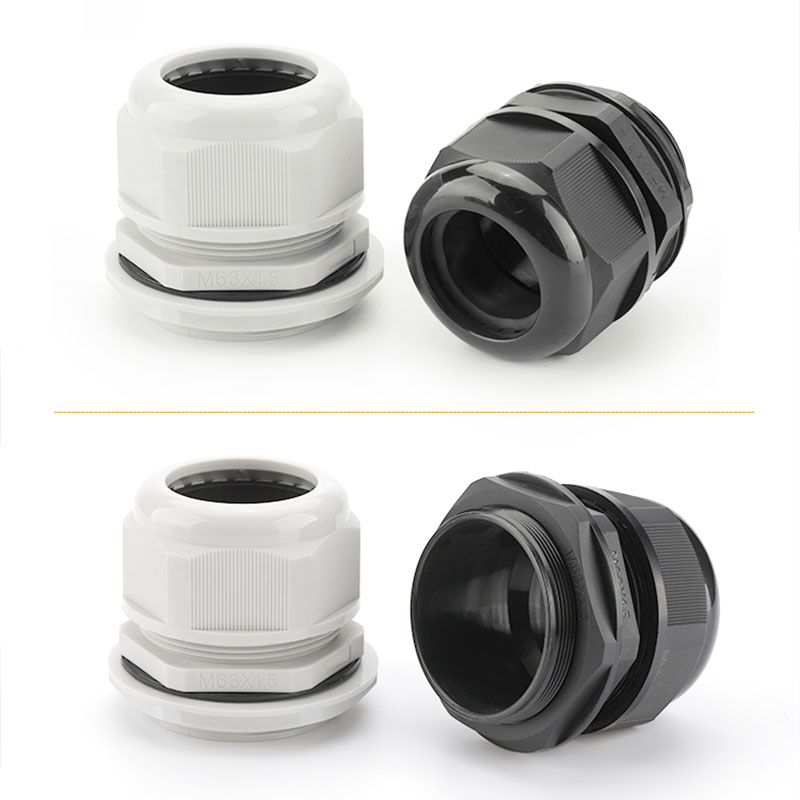
The single-hole gland is the workhorse of industrial wiring. Every cable gets its own gland and its own certified seal, so the IP rating and pull-out resistance are predictable and easy to document. Because there is only one bore, the insert can be tuned to a tight tolerance around the jacket, giving the best water seal for that cable. For panels where cables arrive one at a time and spacing is not tight, single-hole glands are the lowest-risk choice and the cheapest to stock — one insert size covers one cable range.
Multi-Hole Glands: Several Cables, One Entry
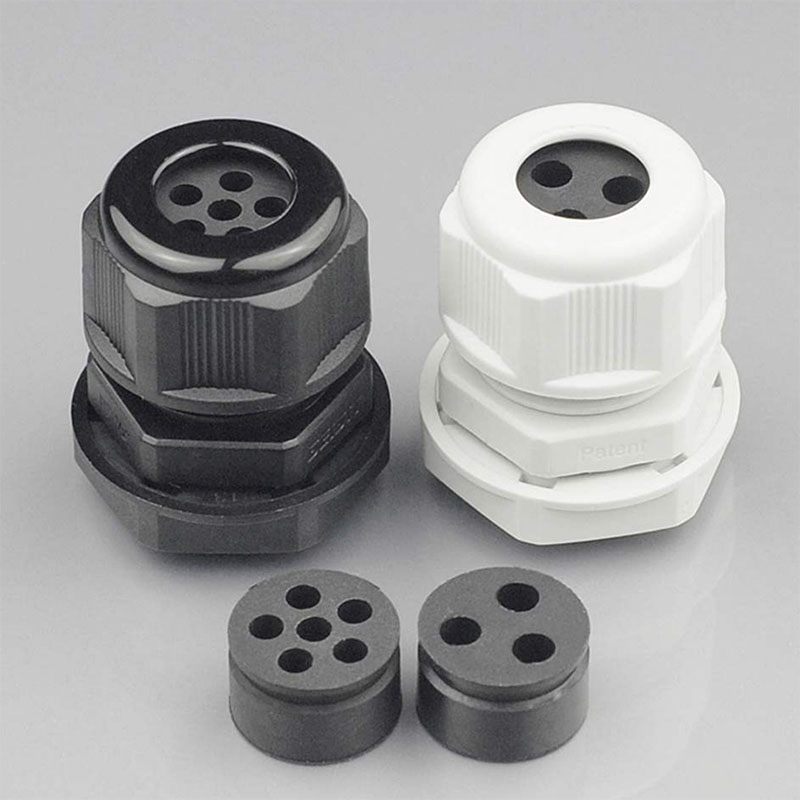
A multi-hole gland (sometimes called a splitter or multiple-entry gland) uses a single compression body but a splitter insert that carries several cables at once. Instead of drilling five holes and fitting five single glands, you drill one hole and fit one multi-hole gland that seals three or four cables together. This is a major space and labour saver on dense enclosures — sensor bundles, fieldbus drops, and small-signal wiring where many thin cables converge on one wall. The trade-off is that each bore must be sized to its specific cable, so a mixed-bundle layout needs a custom splitter insert.
Side-by-Side Comparison
| Factor | Single-Hole Gland | Multi-Hole Gland |
|---|---|---|
| Cables per entry | 1 | 2 to many |
| Enclosure holes needed | One per cable | One for the whole bundle |
| Seal predictability | Highest (one bore) | Good, if each bore sized right |
| Stock complexity | Low (standard inserts) | Higher (splitter inserts) |
| Best for | Mixed, spaced, large cables | Dense small-signal bundles |
| Certification ease | Per-cable simple | Whole-bundle, needs correct bores |
| Cost per cable | Low | Lower when many cables share entry |
Table 1. Decision factors between the two gland styles.
When to Choose Multi-Hole
- Many thin signal, sensor or communication cables leave one enclosure wall and panel space is limited.
- You want to minimise the number of drilled holes and the weight of fittings on a lightweight panel.
- Cables in the bundle share similar environmental exposure and the same target IP rating.
- Labour cost to fit and torque many individual glands outweighs the saving of a single splitter.
When Single-Hole Wins
- Each cable has a different diameter and a custom splitter would be expensive or unavailable.
- One cable carries high power or needs its own verified strain relief and ground path.
- You must certify or inspect seals cable-by-cable (common in hazardous-area work).
- Cables enter from different walls or at different times during build-out.
Sizing the Holes Correctly
Sizing is where installs go wrong. The bore must match the cable outer diameter, not the conductor size. A bore 1–2 mm under the jacket crushes the insulation and can nick the conductors; a bore too large never seals and the IP rating is lost. For multi-hole inserts, measure every cable in the bundle and order the splitter with each bore cut to its cable. Niuli supplies both standard metric inserts and custom multi-bore splitters machined to your cable list, so the seal is right the first time.
Material and Environment
Material follows the environment, not the hole count. Indoor dry panels are fine with nickel-plated brass or a reinforced thermoplastic; coastal, chemical or washdown areas need 316 stainless steel or a sealed plastic body with an FKM (Viton) elastomer. The elastomer matters as much as the metal: NBR suits oil and mild heat, EPDM resists ozone and weathering, silicone survives very high temperature. Pick the elastomer for the worst condition in the bundle, because a multi-hole gland seals them all with one insert.
Common Installation Mistakes
- Mixing cable diameters in one bore — the smaller cable never seals.
- Re-using a splitter insert after a cable change without re-machining the bore.
- Over-tightening the compression nut and cracking a plastic body.
- Forgetting to seal unused bores in a multi-hole insert (blank them or the IP fails).
Worked Example: A Sensor Cabinet on a Machine
Picture a small enclosure on a packaging machine where eight 4 mm sensor and encoder cables and two 10 mm power cables all leave one wall. With single-hole glands you drill ten holes, fit ten bodies and torque ten nuts, and the wall is now mostly holes. With a multi-hole gland you drill one hole, fit one splitter insert bored for eight small bores plus two larger bores, and torque once. The panel is stronger, the install is faster, and every cable still has its own sized seal. The trade-off is that you must measure all ten cables first; if a cable is later swapped for a different diameter, that one bore needs re-machining rather than a simple gland change.
How Niuli Builds Both
Niuli Electric manufactures the full gland range — metric-cable-glands-m, pg-standard-cable-glands-pg, usa-standard-cable-glands-npt, multi-hole-cable-glands and spiral-cable-glands — in brass, nickel-plated brass, stainless steel and engineering plastic, with NBR/EPDM/FKM inserts. Because the same factory makes both single and multi-hole bodies, you can standardise tooling and inserts across a project and only swap the sealing insert.
Quick Selection Checklist
- A cable gland seals the gap where a cable enters an enclosure and carries strain relief, grounding and IP rating.
- Single-hole glands seal exactly one cable per entry point — simplest, cheapest, easiest to torque.
- Multi-hole (splitter) glands pass two to many cables through one compression seal, saving panel space and holes.
- Choose multi-hole when many small cables share one enclosure wall; choose single-hole when each cable needs its own certified seal.
- Wrong hole sizing is the top failure: too tight crushes the jacket, too loose breaks the IP seal.
Frequently Asked Questions
Can a multi-hole gland keep the same IP rating as a single-hole one?
Yes — provided every bore is sized to its cable and unused bores are blanked. The IP rating is set by the seal quality at each bore, not by the number of cables.
Do I need a different gland body for a custom splitter?
No. The splitter is an insert that drops into the same compression body. Order the insert bored to your cable list; the body stays standard.
Is a multi-hole gland cheaper overall?
Per fitting it can cost more, but it removes several holes, several single glands and the labour to fit them — on dense bundles the total installed cost is usually lower.
Which elastomer should I pick for outdoor use?
EPDM resists ozone and weathering best for long outdoor life; FKM (Viton) is the choice for heat and aggressive chemicals. Match the worst cable condition in the bundle.
Can I add a cable later to a multi-hole gland?
Only if a spare bored position exists. Otherwise the insert must be replaced. Plan the bundle before ordering the splitter.
Are brass glands OK in wet coastal areas?
Bare brass can dezincify in seawater spray; use nickel-plated brass or 316 stainless steel for coastal and marine service.
Do plastic glands ground the cable?
A plastic (non-conductive) gland does not provide a ground path. Use a metal gland with a continuity shield or run a separate bond wire for grounding.
How tight should the compression nut be?
Hand-tight plus a fraction with a spanner to seat the elastomer — over-torquing cracks plastic bodies and can distort the seal. Follow the torque the manufacturer lists.
What size range do Niuli metric glands cover?
The Metric M series spans roughly M12 through M63, covering cable diameters from a few millimetres to about 50 mm outer diameter.
Can one multi-hole gland mix power and signal cables?
Physically yes, but keep separation and shielding discipline in mind; do not let a metal gland short adjacent cables. Many designers still prefer separate entries for high-power runs.
Related Resources
- Metric Cable Glands (M Series)
- Multi-Hole Cable Glands
- Stainless Steel Cable Glands
- Spiral Cable Glands
Need a gland that fits your exact cable bundle? Send us the cable list and we will machine the splitter insert.
