


Introduction
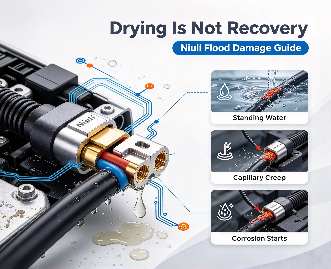
A car comes out of waist-deep water with its engine bay full. The owner wants to know if the wiring will work once it dries. The short answer is that drying is not the same as recovering, and the clock starts the moment the water drops. This article explains what floodwater actually does to a terminal, why a standing puddle is far worse than a drive through one, where the corrosion begins, and the steps that decide whether the connectors can be saved.
What Really Happens to a Terminal When Flood Water Hits
Floodwater is a contaminant cocktail, not the clean rain people imagine. It carries road salt, dissolved minerals, silt, fuel traces, and often sewage. That mix is conductive, so it bridges contacts that should stay separate, and it is chemically active enough to attack metal while it sits there.
The tin plating on a copper terminal is the first line of defense. Tin resists corrosion well, but the plating is thin and it ends at an edge, and edges are where it thins first. Water also wicks under the insulation and into the connector cavity, where it is trapped by the very seal it defeated on the way in. Once it is inside, the water sets up a galvanic cell between the tin, the copper beneath any scratch, and whatever dissimilar metal the connector mates with. The terminal does not need to be submerged for long to start changing.
Why Standing Water Is Worse Than a Splash
Time multipliers
A splash on a connector dries in minutes and the harness goes back to normal. Standing water in a flooded car can sit for days while the vehicle waits for a tow or an assessor. Corrosion is a function of time as much as chemistry. Every extra hour the metal stays wet is an hour the attack continues, and the difference between a connector that recovers and one that is scrapped is often two or three days of sitting.
Biological growth accelerates attack
Warm, dirty, standing water grows biofilms. Microbes form colonies on the metal and create tiny local cells where oxygen levels differ from one spot to the next. Those differences are exactly what drives crevice and pitting corrosion, so a biologically active puddle can eat a terminal faster than clean water would. The slime you see later is not just dirty, it is part of the attack.
Safety
Before anyone touches a flooded harness, treat the vehicle as live. Floodwater reaches batteries, airbag modules, and on hybrids and EVs the high-voltage system. Disconnect the 12-volt battery first, and do not power the car up to “test it” until the wiring has been opened and inspected. A wet 12-volt system can still arc, short, and injure, and a hybrid pack can injure far worse.
Where Corrosion Begins on a Flooded Harness
Corrosion rarely starts where you can see it. The damage shows up first at the points the water reached and then trapped.
| Site | First sign | Why it goes first |
| Contact interface (male and female mating face) | Green or white powder on the contact | The thinnest tin, the tightest gap, and the last place to dry |
| Crimp joint | Stiff or brittle crimp, discolouration under the barrel | Water entered with the stranded wire and sat against bare copper |
| Wire entry seal | Dark ring at the insulation entry | The seal was defeated on entry and water pooled behind it |
| Unsealed connectors | Fogging inside the housing | No barrier, so the whole cavity filled |
48 Hours to Save Your Terminals: Flood Triage Basics
The window is short. Move in this order:
- Disconnect the 12-volt battery and tag the high-voltage system as do-not-touch on hybrids and EVs.
- Do not power the vehicle on to check anything.
- Photograph and label each connector before you open it, so reassembly is possible.
- Pull the connectors apart while still wet, because dried silt and corrosion bond the mating faces.
- Rinse the exposed terminals with clean running water immediately. This flushes the salt and sewage out before they dry and lock in.
- Keep the harness open and move to controlled drying.
- A connector rinsed and opened within the first day or two has a real chance. One left closed and wet for a week usually does not.
How to Protect Terminals from Corrosion After Flood Exposure
Once the immediate recovery is done, the goal is to stop the next event. Several moves matter.
Specify sealed terminations for any flood-prone or low-lying service. Heat-shrink butt connectors and solder-ring connectors form a waterproof, dust-proof joint that keeps water out of the crimp in the first place, and they are the right call where the harness may sit in water. We cover the choice between sealed and standard crimp in our guide on heat-shrink versus standard crimp terminals.
Use dielectric grease on exposed contacts as a barrier, and keep it clear of the mating surfaces where the connector design requires a metal-to-metal path.
Enclose and elevate the harness where you can, and read our notes on installing a waterproof junction box for enclosures that sit low.
Hold dry spares. The storage discipline that applies here is simple: keep sealed terminals, heat-shrink tubing, and a crimp tool in stock and stored dry, so a flood recovery is a swap, not a wait. Our heat-shrink tube guide covers what the tubing adds to a joint.
| Storage or site risk | Control |
| Spares stored in the same damp shop | Keep sealed terminals and tubing in a sealed, dry cabinet |
| Plain crimp terminals on a flood-prone harness | Upgrade to heat-shrink or solder-ring sealed terminations |
| Grease washes out of the connector | Re-apply dielectric grease at each service |
| Enclosure sits low and collects water | Elevate and use a waterproof junction box |
How to Clean and Dry Flood-Exposed Terminals
Work the recovery in order, and decide as you go:
- Disassemble the connector and lift the terminals out if the design allows.
- Rinse with clean water, then a mild electrical cleaner or isopropyl alcohol on a soft brush to lift silt from the contact face. Do not scrub the plating off.
- Dry with warm air from a fan or a low-heat gun. Never use an open flame on a connector, and never bake the insulation.
- Inspect each terminal. Use the table below as the verdict rule.
- Test continuity and, on critical circuits, insulation resistance with a megger before the harness goes back.
- Replace any terminal that fails the verdict. A pitted contact will not carry current reliably, and it will keep corroding.
| What you see | Verdict | Action |
| Bright tin, no stain, passes continuity | Reuse | Re-grease and reassemble |
| Light surface film, wipes clean, passes the test | Reuse with caution | Clean, dry, re-grease, re-test |
| Green or white powder at the contact or crimp | Replace | Cut back to clean wire and re-terminate with a sealed connector |
| Pitting, swelling, or a stiff brittle crimp | Replace | Do not reuse, the joint is already weakened |
Conclusion
The terminals are not saved by the water leaving. They are saved by what you do in the first two days: disconnect, open while wet, rinse the contaminant out, dry without heat damage, and replace what the inspection table tells you to replace. Get those steps right and a flooded harness is a recovery job, not a replacement job.
Secure Your Electrical Box Fixings with Niuli Electric:Niuli Electric is a China-based manufacturer of nylon cable ties, cable glands, cable clips, wall plugs, terminals, and soldering accessories, serving distributors, private-label brands, and industrial buyers worldwide.
FAQs
Can automotive wiring terminals survive being submerged in floodwater?
Sometimes. Tin-plated copper terminals resist corrosion, but submersion in dirty, salty, biologically active water is a different load case from normal humidity. If you open, rinse, and dry the connectors within about 48 hours, many survive. Left sealed and wet for days, most will need replacement at the contact face.
How quickly must I act after a vehicle is flooded?
Within the first 48 hours. Rinse and open the connectors while still wet, before silt and corrosion bond the mating faces. The longer the harness sits closed and wet, the more the attack advances, and after about a week recovery is rarely worth the risk.
Is tin plating enough to protect terminals from flood corrosion?
Tin plating protects the copper well in normal service, but it is thin and ends at an edge, and floodwater is far more aggressive than humidity. Plating slows the attack, it does not stop it under standing contaminated water. Sealed terminations and prompt drying do more than the plating alone.
What terminal type should I specify for flood-prone or low-lying service?
Specify sealed terminations: heat-shrink butt connectors or solder-ring connectors that form a waterproof, dust-proof joint at the crimp. They keep water out of the stranded wire where plain crimp terminals let it in. Our guide on heat-shrink versus standard crimp terminals walks through the choice, and our solder-ring piece covers the sealed option in detail.
Can I apply dielectric grease to protect terminals from future flooding?
Yes, dielectric grease is a useful barrier on exposed contacts and at the wire seal, and it slows water entry. It is not a seal by itself, so pair it with sealed connectors and good enclosure for any harness that may sit in water. Keep it clear of surfaces where the connector design requires a metal-to-metal contact path.
