


The choice between insulated and non-insulated terminals looks trivial until a live wire touches the panel wall and trips the whole line. Insulated terminals wrap the metal in a vinyl or nylon sleeve; non-insulated terminals are bare copper or tinned copper. Both crimp onto the same conductor, but they behave differently under vibration, heat, and accidental contact. For buyers specifying non-insulated terminals or ring terminals, this guide explains when each is the right call rather than a default habit.
What “Insulated” Actually Means
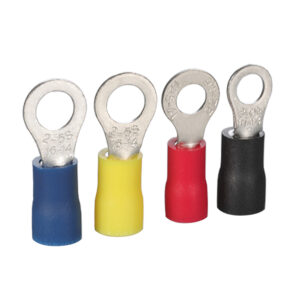
An insulated terminal has a colored sleeve (typically vinyl/PVC or nylon) moulded over the barrel. The color codes the wire size — red for ~0.5–1.5 mm², blue for ~1.5–2.5 mm², yellow for ~4–6 mm² — so the installer matches sleeve to conductor at a glance. The sleeve does three jobs: it insulates the exposed metal, it funnels the wire into the barrel, and on nylon versions it provides a strain relief collar that supports the cable just behind the crimp.
Non-Insulated Terminals: Bare Metal, Maximum Crimp
A non-insulated terminal is just the metal barrel and tongue. With no sleeve in the way, the crimp die closes fully on the barrel, giving the tightest possible compression and the highest pull-out strength. That is why non-insulated terminals dominate high-vibration and high-current joints — starter motors, battery links, busbars — where the mechanical integrity of the crimp matters more than finger safety at the point of termination.
Side-by-Side Comparison
| Factor | Insulated | Non-insulated |
|---|---|---|
| Crimp compression | Good (die closes on barrel + sleeve) | Best (full barrel closure) |
| Pull-out strength | High | Highest |
| Touch safety | Excellent at the terminal | None (needs spacing/cover) |
| Heat resistance | Limited by sleeve (PVC ~75 °C) | Higher (metal only) |
| Vibration use | Good (nylon strain relief) | Best |
| Cost | Slightly higher | Lower |
When to Choose Insulated Terminals
- General panel wiring where adjacent live terminals are close and accidental contact is a real risk.
- Low-to-medium current signal and control circuits where the sleeve’s insulation is adequate.
- Field service where the installer benefits from color-coded sizing and the funnel entry speeds up termination.
- Where local code or OEM spec requires insulated terminals at the point of connection.
For sealed joints, the insulated heat-shrinkable butt connectors add a dual-wall adhesive seal over the crimp, giving both insulation and environmental protection in one step.
When to Choose Non-Insulated Terminals
- High-current and high-vibration joints — battery cables, starter circuits, alternator lugs — where maximum crimp integrity is non-negotiable.
- Elevated temperature environments where a PVC sleeve would soften or melt.
- Crimped then covered installations, where the joint is later sleeved, taped, or enclosed in a connector boot.
- Bulk, cost-sensitive production where the terminal sits well clear of other conductors.

The Crimp Quality Trade-Off
Insulated terminals are crimped with a die that simultaneously closes the barrel and the sleeve. That is convenient, but the sleeve adds a layer the die must compress, so the pure metal-to-metal bond is marginally less dense than a non-insulated crimp. For the vast majority of control and signal work this is irrelevant. For a 200 A battery lug, it is the reason professionals reach for the bare terminal. The deeper question of mechanical versus soldered joints is covered in our crimp vs solder terminal connections guide.
Galvanic and Corrosion Considerations
Neither terminal type is immune to corrosion where dissimilar metals meet. Tinned copper terminals reduce galvanic attack against aluminum conductors and against stainless hardware, which is why tinned versions are common in marine and outdoor gear. The same logic applies at the terminal block: mixing brass, copper, and aluminum without consideration is a slow failure path, detailed in our article on preventing galvanic corrosion in terminal blocks and ring/fork terminals.
Insulation Sleeve Materials: PVC vs Nylon vs Heat-Shrink
Not all insulated terminals use the same sleeve. PVC (vinyl) is the cheapest and most common; it is flexible and color-codes well but softens around 75 °C and is not oil-resistant. Nylon sleeves tolerate higher temperatures (around 105 °C) and provide a better funnel entry plus a strain-relief collar, which is why they dominate professional ranges. Heat-shrink insulated terminals take it further: the sleeve is a heat-shrink tube that, once warmed, grips the wire and seals the crimp from moisture. For sealed outdoor or underground joints, the insulated heat-shrinkable butt connectors are the right insulated choice rather than a standard PVC sleeve.
Standards and Compliance
Terminals are covered by standards such as IEC 61238 (crimped connections) and UL 486 (North American wire connectors). A compliant terminal is manufactured to a defined barrel wall thickness, plating, and crimp profile so that a matched die produces a repeatable, qualified joint. Specifying terminals “to drawing” without a standard reference leaves the crimp quality to chance. For export or regulated industries, confirm the plating (tinned copper is the default for corrosion resistance) and any RoHS/REACH declarations.
Installation Best Practices
- Strip to the barrel. The conductor should fill the barrel with no strand gap and no bare wire showing beyond it.
- Match the die. Use the crimp die sized for the terminal’s mm² and profile; do not “make do” with a close-size jaw.
- Seat fully. The insulation should butt the barrel mouth so the sleeve (on insulated types) provides the strain relief collar.
- Verify. Pull-test a sample from each batch; the wire should break before the barrel releases.
Cost vs Risk: A Practical View
Non-insulated terminals are marginally cheaper and give the strongest crimp, but they shift the burden of touch-safety onto spacing, covers, and shrink tubing. Insulated terminals cost a little more and simplify that burden while speeding bench work through color coding. The right answer is rarely “always insulated” or “always bare” — it is per-joint, based on current, temperature, and exposure. A mixed panel using non-insulated lugs for high-current links and insulated terminals for signal wiring is a normal, correct configuration.
Terminal Tongue Types and When They Pair With Each Family
The insulated-or-not decision is independent of the tongue shape, and the two choices combine. The common tongues are:
- Ring — fully captive on the stud; the secure default for permanent joints. Available insulated or non-insulated.
- Fork (spade) — side slot for quick disconnect without removing the nut; common in panels with frequent changes. Offered in both families.
- Hook — front-opening semicircle for studs that stay semi-tightened; convenient but relies on the nut staying snug.
- Spade/blade and butt — for push-on receptacles and inline splices respectively; butt connectors are where heat-shrink sealing shines.
In practice you often pair a non-insulated ring for the high-current battery link and an insulated fork for the signal wire next to it, all in the same panel. The family choice (insulated vs non-insulated) follows the joint’s current, temperature, and exposure; the tongue follows the mechanical access. Keeping the two decisions separate avoids the common mistake of specifying “all insulated forks” by habit when a non-insulated ring would have been the correct permanent landing.
Buying in Volume: Kits vs Bulk
For production and service teams, the purchase format affects both cost and error rate. Pre-assorted kits with the common sizes in separate, labeled compartments reduce the chance of grabbing the wrong terminal on a busy bench, at a small per-piece premium. Bulk bags are cheaper per piece for a known, high-volume size but invite mixing if not re-housed properly. A practical setup pairs a few high-turnover sizes in bulk with a labeled kit for the occasional sizes, plus a crimp die set indexed to the terminal part numbers. Whichever you choose, keep the original labels with the mm² and standard reference so the compliance trail stays intact from supplier to panel.
Insulated vs Non-Insulated: A Quick Decision Checklist
If you want a fast rule of thumb at the bench: choose non-insulated when the joint is high-current, high-vibration, high-temperature, or will be covered anyway; choose insulated when the terminal sits exposed near other live parts, carries signal or control current, and benefits from color-coded sizing. When in doubt on a permanent, safety-critical landing, default to a non-insulated terminal inside a covered, properly torqued connection — it gives the strongest crimp and you add insulation externally if needed. This simple split resolves most specification debates without over-thinking, while the detailed comparison above covers the edge cases.
Finally, document the choice. A short note on the panel drawing stating which terminals are insulated and which are not, and why, saves the next technician from “standardizing” the panel the wrong way during maintenance. Good specification is not just the initial build; it is the record that keeps the joint correct for the life of the equipment.
Choose the Right Terminal for the Joint
Insulated or non-insulated is a function of the joint’s current, temperature, and exposure — not a default.
Need Help Choosing Terminals?
Share your current, temperature, and environment. We will recommend insulated or non-insulated terminals and the correct crimp tool.
Frequently Asked Questions
When should I use non-insulated terminals?
Use them where space is tight, in high-temperature areas, or when the joint will be covered by a heat-shrink sleeve or sit inside an enclosed block. They are also the cheaper option for high-volume crimping where touch protection is not required at the terminal itself.
What is the difference between vinyl and nylon insulated terminals?
Vinyl is softer and economical, fine for general indoor use. Nylon is tougher, more temperature-resistant, and far less likely to crack, which makes it the better choice in vibration, moisture, or wider temperature ranges.
Do insulated terminals need a different crimp die?
Yes. Insulated terminals are crimped with a die that forms both the metal barrel and the insulation support (typically a stepped or double crimp), whereas non-insulated terminals use a plain barrel die. Using the wrong die leaves the insulation unsupported.
Can I put an insulated terminal on an uninsulated stud?
Yes. The insulation surrounds only the wire barrel; the stud opening stays bare like any other terminal, so it does not insulate the fixing point. The screw or nut still makes a metal-to-metal connection.
Are insulated terminals safe in high vibration?
The insulation support reduces wire fatigue right at the crimp, so they are often preferred in automotive and other vibrating environments. Make sure you achieve a proper double crimp so the connection is not relying on the sleeve alone.
