


A practical quality-control checklist for procurement engineers, distributors, and OEM buyers who need proof before committing to a large cable tie order.
Key Takeaways
- To test cable tie tensile strength before bulk purchase, combine three checks: visual inspection, dimensional measurement with a caliper, and a tensile test on a statistically sampled batch.
- Always request the supplier’s third-party test report (UL 62275 / ISO loop-tensile method) and verify it against your own random samples.
- A universal tensile testing machine gives the most accurate loop tensile strength; a simple hand-pull jig is enough for a pass/fail screen on-site.
- Sample size matters: test at least 5–10 ties per batch size using an AQL-based sampling plan before releasing a full purchase order.
- Work with a manufacturer that provides certified materials (UL, CE, RoHS, REACH) and free pre-shipment samples so you can validate strength independently.
Placing a bulk cable tie order without verifying tensile strength is a costly gamble. A weak batch can loosen harnesses on a production line, fail in the field, or trigger a recall. The good news: you do not need a full lab to get reliable evidence. This guide walks through a repeatable cable tie tensile strength test workflow you can run before—and after—you commit volume.
Why Tensile Strength Is the First Thing to Verify in Bulk
When you buy a few dozen ties, one weak piece is an annoyance. When you buy 50,000, a systemic material or molding defect becomes a line-down event. Tensile strength (officially loop tensile strength) is the single number that predicts whether a tie holds its rated load. It is also the spec most often inflated by low-grade recycled nylon or short-shot molding.
Testing before purchase protects you three ways: it validates the supplier’s claims, it catches batch-to-batch drift, and it gives you a paper trail if a dispute arises. If you are choosing between vendors, start from our complete cable tie manufacturer buyers guide.
What “Tensile Strength” Actually Means for a Cable Tie
There are two related numbers buyers confuse:
- Loop tensile strength – the force at which a tied loop breaks when pulled. This is the rated specification on a datasheet and the value you should test.
- Single-tie (linear) strength – the breaking force of the strap material alone, rarely published and not what matters in service.
Reputable standards (UL 62275, IEC 62275) define the loop method: form a loop with the tie, secure it in two grips, and pull at a controlled crosshead speed until failure. The peak load is the tensile strength. Our cable tie strength selection guide maps common sizes to the loop values you should expect.
The 5-Step Cable Tie Tensile Strength Test
Step 1 – Sample Using an AQL Plan
Never test a single tie and call it proof. Use an acceptable-quality-limit (AQL) sampling table based on order quantity. For a 50k-piece order, pull at least 5–10 ties spread across multiple inner bags and cartons. Randomize so you are not silently testing only the “good” carton.
Step 2 – Visual & Material Inspection
Before any machine, look for red flags: surface burrs, off-color or cloudy nylon (recycled material), uneven teeth, and a head that feels light. Fresh PA66 has a consistent matte sheen. Cloudiness or glossy “plastic” smell often signals filler or regrind that will fail strength.
Step 3 – Dimensional Check With a Caliper
Measure width, thickness, and length against the spec. A tie that is 0.2 mm narrow is not a cosmetic issue—cross-sectional area drives strength. A digital caliper is enough; record the average of three readings per tie. This is also where you catch “down-gauged” cost-cutting.
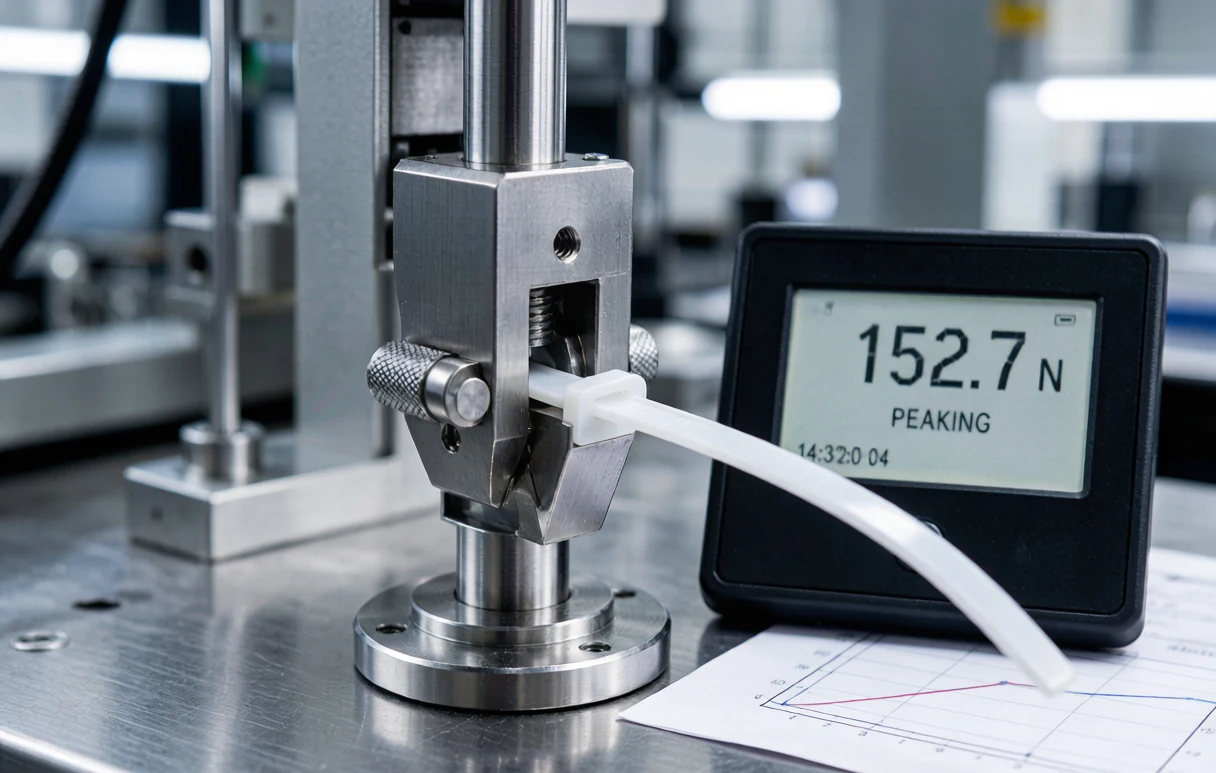
Step 4 – Run the Tensile Test
Use a universal testing machine set to the standard crosshead speed (commonly 100–150 mm/min). Loop the tie, clamp both ends, and pull to break. Record the peak force in Newtons (or lbf). For an on-site screen without a lab machine, a calibrated hand-pull jig or even a hanging-weight method gives a directional pass/fail—just label it as indicative, not certified.
Step 5 – Compare to the Datasheet and Third-Party Report
Your measured value should meet or exceed the published rating, with a safety margin for lot variation. Cross-check it against the supplier’s independent test report. If the numbers diverge by more than ~10%, pause the order and ask why. Certifications matter here—read our guide to cable tie certifications buyers should require.

Lab Tester vs On-Site Screen: Which Do You Need?
| Method | Accuracy | Best for |
|---|---|---|
| Universal testing machine | ±2–3% (certified) | Final validation, disputes, incoming QC |
| Calibrated hand-pull jig | ±10–15% (indicative) | Warehouse pre-screen, field checks |
| Hanging-weight method | Directional only | Quick reject of obviously weak lots |
Common Mistakes That Invalidate the Test
- Testing only one carton – you miss intra-batch variation.
- Pulling the strap, not the loop – that measures material, not the assembled tie.
- Wrong crosshead speed – too fast overstates, too slow understates strength.
- Ignoring humidity – nylon absorbs moisture; dry nylon reads stronger. Condition samples per standard before testing.
- Trusting the PDF only – a certificate is a claim until your own samples confirm it.
Niuli Electric’s Approach to Verified Strength
Niuli Electric manufactures ties from 100% fresh PA66 (INVISTA, DuPont, ASCEND grades) and validates every production lot against UL 62275 loop-tensile method. Our Super Strong Cable Ties use a thickened three-tooth lock for higher sustained load, and our Double-Side Teeth Cable Ties increase tensile performance by 20%+ through anti-release teeth on both sides. Standard volumes are covered by our Standard Cable Ties line, all UL/CE/RoHS/REACH certified.
Before any bulk order, we provide free pre-shipment samples so your team can run the tensile test independently—no surprises on delivery.
FAQs
What is the standard test for cable tie tensile strength?
The recognized method is the loop tensile test per UL 62275 / IEC 62275: form a loop, clamp both ends in a universal testing machine, and pull at a controlled speed (typically 100–150 mm/min) until break. The peak load is the rated tensile strength. Always condition nylon samples for humidity first, since dry PA reads artificially high.
Can I test tensile strength without a tensile testing machine?
Yes, for a directional screen. A calibrated hand-pull jig or a hanging-weight rig tells you whether a lot is obviously weak versus acceptable. It will not give certified numbers, so use it for incoming pre-screening and reserve a lab machine—or our free samples—for final validation. See expected strengths by size here.
How many samples should I test before a bulk order?
Use an AQL sampling plan scaled to order size. For a 50,000-piece order, test at least 5–10 ties pulled randomly from multiple inner bags and cartons. Small sample counts hide batch drift, so never validate a full PO on a single tie. Document each result for traceability.
What tensile strength should a standard 4.8 mm cable tie have?
A standard 4.8 mm (width) nylon 66 tie typically rates around 18–22 kgf (40–50 lbf) loop tensile strength. Width drives cross-sectional area, so a 7.6 mm tie jumps to ~50 kgf and a 12 mm heavy-duty tie reaches ~110 kgf. Confirm the exact figure on the datasheet and test against it.
Does nylon 66 have higher tensile strength than nylon 6?
Generally yes. Nylon 66 offers higher tensile and heat performance than nylon 6 at similar gauge, which is why most industrial ties use fresh PA66. Recycled or filled compounds can undercut either, so material certificate matters more than the “nylon” label alone. Request the resin grade from your supplier.
Should I rely on the supplier’s test report alone?
No. A third-party or supplier report is a useful claim, but independent sampling is what protects you. Test your own randomly pulled samples and compare to the report; a >10% gap is a reason to pause the order. Working with a certified, transparent manufacturer makes this easy.
Validate Strength Before You Commit Volume
Request free pre-shipment samples and a certified tensile test report from Niuli Electric. Test them your way—then order with confidence.
Conclusion
Testing cable tie tensile strength before bulk purchase is not over-engineering—it is basic incoming quality control. Sample by AQL, inspect and measure, run a loop tensile test, and confirm against an independent report. The small time investment prevents line failures and recall risk downstream. Niuli Electric backs every lot with certified PA66 material and free samples so your validation is simple and independent.
Niuli Electric is a China-based manufacturer of nylon cable ties, wire clips, solder, and cable connectors, certified to UL, CE, RoHS, and REACH. Specifications above are typical values—confirm exact ratings on the product datasheet before purchase.
