

Introduction
Cable ties are widely used in electrical installations, lighting systems, automotive applications, industrial equipment, and hardware assembly. Although they are small components, their quality and reliability can directly affect the safety and durability of the final application.
For distributors and industrial buyers, certifications help verify that cable ties meet required safety, quality, and market compliance standards before bulk purchasing.
When purchasing nylon cable ties, many buyers focus on price, size, and tensile strength. However, certifications and compliance standards are equally important because they help verify product safety, material quality, and manufacturing reliability.
So, what certifications should cable ties have?
The answer depends on the application, market requirements, and industry standards. Common certifications and compliance requirements include:
- UL certification
- RoHS compliance
- REACH compliance
- CE marking
- SGS testing reports
- ISO 9001 quality management certification
Understanding these certifications helps buyers select reliable nylon cable ties and work with professional manufacturers.、
Why Are Certifications Important for Cable Ties?
Certifications provide independent verification that cable ties meet specific quality, safety, or environmental requirements.
For buyers, certified cable ties offer several benefits:
Ensure Product Reliability
Certifications indicate that products have passed specific testing requirements related to:
- Material performance
- Mechanical strength
- Safety characteristics
- Environmental compliance
Reduce Quality Risks
Certified products help reduce risks such as:
- Premature breakage
- Material inconsistency
- Non-compliance issues
Meet Market Requirements
Different countries and industries may require specific compliance standards before products can be imported or used.
For example:
- Electrical applications may require UL-related standards.
- European markets often require RoHS and REACH compliance.
- Industrial buyers may request quality management certifications.
Key Certifications and Standards for Cable Ties
UL Certification for Nylon Cable Ties
UL certification is one of the most recognized standards for nylon cable ties, especially in electrical and industrial applications.
UL certification evaluates product safety and performance based on specific testing requirements.
For nylon cable ties, buyers often pay attention to:
- Material safety
- Flame performance
- Mechanical properties
- Product consistency
UL-certified nylon cable ties are commonly preferred for:
- Electrical installations
- Control panels
- Industrial equipment
- Professional cable management applications
RoHS Compliance for Hazardous Substance Control
RoHS stands for Restriction of Hazardous Substances.
RoHS compliance ensures that products do not contain restricted levels of certain hazardous materials.
For cable ties, RoHS compliance helps confirm that materials meet environmental requirements regarding substances such as:
- Lead
- Mercury
- Cadmium
- Other restricted substances
RoHS-compliant nylon cable ties are widely accepted in international markets, especially for electrical and electronic applications.
REACH Compliance for Chemical Safety
REACH is a European regulation focused on chemical safety.
REACH compliance ensures that products meet requirements related to:
- Chemical substance management
- Material safety
- Environmental protection
For nylon cable ties, REACH compliance helps buyers confirm that the materials used during manufacturing meet European chemical safety requirements.
CE Marking for European Market Requirements
CE marking indicates that a product complies with applicable European Union requirements.
For cable ties, CE requirements may depend on the specific product category and application.
While not every cable tie product requires CE marking, buyers should understand whether their target market or application requires relevant European compliance documentation.
SGS Testing and Inspection Reports
SGS is a globally recognized testing, inspection, and certification organization.
SGS testing reports can provide verification of product performance, including:
- Material testing
- Tensile strength testing
- Environmental performance testing
- Quality inspection
For international purchasing, SGS reports can help buyers evaluate product reliability before large-volume orders.
ISO Quality Management Certifications (ISO 9001)
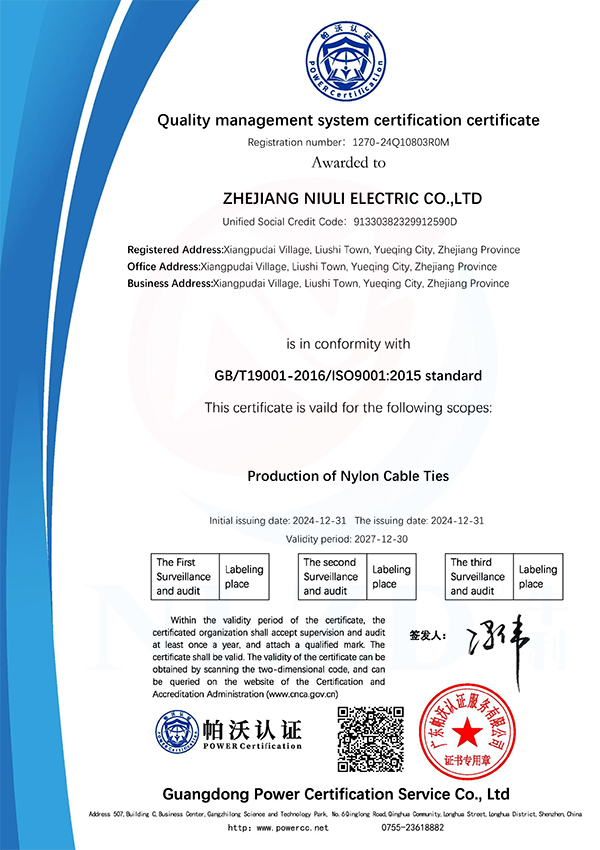
ISO 9001 is a quality management system certification that focuses on manufacturing processes and quality control systems.
For cable tie manufacturers, ISO 9001 demonstrates that the company has established procedures for:
- Production management
- Quality control
- Continuous improvement
- Customer requirements management
Working with an ISO-certified manufacturer can provide greater confidence in consistent product quality.
Important Performance Standards Related to Cable Tie Quality
Besides certifications, buyers should also consider technical performance standards.
UL 94 Flammability Rating
UL 94 is a flammability testing standard used to evaluate how plastic materials respond to fire.
For nylon cable ties used in electrical applications, flame performance can be an important consideration.
Common ratings include:
- UL 94 V-2
- UL 94 V-0
A higher flame rating indicates better resistance to flame propagation.

Tensile Strength Testing
Tensile strength testing measures the maximum pulling force a cable tie can withstand before breaking.
This is one of the most important performance indicators for nylon cable ties.
Testing helps evaluate:
- Strap strength
- Locking head performance
- Product durability
Different applications require different tensile strength levels.
Temperature Resistance Testing
Temperature changes can affect nylon material performance.
Temperature resistance testing evaluates whether cable ties can maintain performance under different conditions.
Applications requiring temperature-resistant cable ties include:
- Industrial equipment
- Automotive environments
- Outdoor installations
UV Resistance Testing
For outdoor applications, UV resistance is an important performance factor.
Long-term exposure to sunlight may cause nylon materials to:
- Lose strength
- Become brittle
- Degrade over time
UV-resistant nylon cable ties are specially designed to provide better outdoor durability.
Which Certifications Should You Look for When Buying Nylon Cable Ties?
The required certifications for nylon cable ties depend on the application, industry requirements, and target market. Different applications have different priorities, from electrical safety and flame resistance to environmental compliance and mechanical performance.
Below are the recommended certification combinations for common cable tie applications.
Electrical Cable and Control Cabinet Applications
For electrical wiring, cable management systems, and control cabinet applications, buyers should prioritize certifications related to electrical safety, flame performance, and product reliability.
Recommended certifications and standards:
- UL 62275
- UL 94 V-2 / V-0 Flammability Rating
- CE Compliance
Why These Certifications Matter:
UL 62275
UL 62275 is a widely recognized standard for cable ties and cable fixing devices, covering requirements related to mechanical performance, safety, and product reliability.
UL 94 V-2/V-0
The UL 94 flammability rating evaluates the flame resistance of plastic materials. It is especially important for nylon cable ties used near electrical components.
CE Compliance
CE compliance helps ensure products meet applicable European market requirements.
Suitable applications include:
- Electrical wiring organization
- Control cabinets
- Power distribution equipment
- Industrial electrical installations
Lighting Applications and Export Markets (North America and Europe)
For lighting systems, decorative lighting, and products exported to North America or Europe, buyers should focus on environmental compliance, safety standards, and international market acceptance.
Recommended certifications and standards:
- RoHS Compliance
- REACH Compliance
- CE Compliance
- UL Certification
Why These Certifications Matter:
RoHS Compliance
Ensures that cable tie materials meet restrictions on hazardous substances and environmental requirements.
REACH Compliance
Confirms compliance with European chemical safety regulations.
CE Compliance
Supports access to European markets by demonstrating compliance with relevant EU requirements.
UL Certification
Provides additional safety assurance for products used in North American markets.
Suitable applications include:
- LED lighting installation
- Decorative lighting projects
- Commercial lighting systems
- Export-oriented lighting products
Automotive Parts and Heavy Industrial Applications
For automotive components and heavy industrial applications, buyers should pay more attention to manufacturing quality systems and mechanical performance testing.
Recommended certifications and standards:
- ISO 9001 Quality Management System
- IATF 16949 Automotive Quality Management SystemSGS Tensile Strength Testing
- High and Low Temperature Resistance Testing
Why These Certifications Matter:
Automotive customers may request ISO 9001, IATF 16949-related supply chain requirements, or additional product testing depending on their program requirements.
SGS Testing Reports
Independent testing reports can verify:
- Tensile strength
- Material performance
- Product durability
Temperature Resistance Testing
Automotive and industrial environments often involve extreme temperature changes. Testing ensures nylon cable ties maintain performance under demanding conditions.
Suitable applications include:
- Automotive wiring
- Motorcycle components
- Industrial equipment
- Heavy-duty assembly
Certifications vs Testing Reports: What Is the Difference?
| Type | Purpose |
| UL | Product safety recognition |
| ISO 9001 | Manufacturing quality system |
| RoHS | Restricted substances compliance |
| REACH | Chemical compliance |
| SGS Report | Product testing verification |
International Wholesale and Distribution Purchasing
For distributors, importers, and wholesale buyers, certifications should demonstrate both product reliability and supplier capability.
Recommended certifications and documents:
- ISO 9001
- RoHS
- REACH
- SGS Test Reports
- Product Specification Sheets
These documents help buyers evaluate:
- Supplier reliability
- Product consistency
- Market compliance
How to Verify Cable Tie Certifications Before Purchase?
Before purchasing nylon cable ties, buyers should verify certification information carefully.
Recommended steps include:
Check Certification Documents
Ask the manufacturer for:
- Certification numbers
- Test reports
- Compliance documents
Confirm Product Information
Make sure certifications apply to:
- The actual product model
- The correct material
- The specific manufacturer
Evaluate Manufacturer Transparency
Reliable manufacturers should provide clear documentation and technical support.
A professional supplier should be able to explain:
- Material specifications
- Testing procedures
- Product performance
Why Choose Niuli Certified Cable Ties?
Quality Documentation
Niuli supports customers with essential quality documents, including:
- UL certification documents
- RoHS and REACH compliance documentation
- Product test reports
These documents help customers verify product safety, material compliance, and performance requirements.
Manufacturing Control
Niuli maintains strict control over the production process, including:
- PA66 raw material management for stable product performance
- Tensile strength testing to ensure reliable fastening strength
- Batch inspections to maintain consistent quality
Custom Supply Solutions
To meet different market and application needs, Niuli offers:
- OEM services
- Custom packaging options
- Special material formulations for specific environments
With reliable manufacturing capabilities and quality management, Niuli Electric provides durable nylon cable tie solutions for electrical, lighting, automotive, and industrial applications.
Conclusion
So, what certifications should cable ties have?
The answer depends on the application and market requirements. For most professional applications, buyers should consider certifications and standards such as:
- UL certification
- RoHS compliance
- REACH compliance
- SGS testing reports
- ISO 9001 quality management certification
Certifications help verify product quality, safety, and manufacturing reliability.
By choosing a certified nylon cable tie manufacturer, businesses can reduce purchasing risks and ensure better long-term product performance.
FAQs
- What certifications should nylon cable ties have?
Common certifications for nylon cable ties include UL certification, RoHS, REACH, CE, SGS testing reports, and ISO 9001. The required certifications depend on the application and target market.
- Are UL-certified cable ties necessary for electrical applications?
UL-certified cable ties are recommended for electrical and industrial applications because they help verify product safety, mechanical performance, and reliability.
- What is UL 62275 for cable ties?
UL 62275 is a standard related to cable management systems and cable fixing devices, covering performance and safety requirements for cable ties.
- Do cable ties need RoHS and REACH compliance?
RoHS and REACH compliance help ensure that cable ties meet environmental and chemical safety requirements, especially for international markets.
- What certifications are recommended for automotive cable ties?
Automotive applications typically require quality management systems such as ISO 9001 or IATF 16949, along with performance testing such as tensile strength and temperature resistance tests.
- How can I verify cable tie certifications?
Buyers should request certification documents, test reports, and product specifications from the manufacturer before purchase.
7.What is the difference between UL listed and RoHS compliant cable ties?
UL listed cable ties focus on product safety, performance, and compliance with electrical and mechanical standards, such as flame resistance and tensile strength. RoHS compliant cable ties focus on restricting hazardous substances and ensuring environmental safety.
