


Introduction
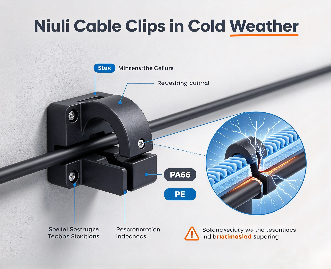
A cable clip is a small part with a big job. It holds a cable or a conduit flat against a wall with a single driven nail and it does that through a thin sprung arch of moulded plastic. Many clips sold under that label are polyethylene, and the resin in the body, not the word on the box, decides whether the part snaps at minus ten. This article explains why clips break in the cold, why a clip fails for different reasons than a cable tie on the same run, and how to specify one that survives the winter.
Why Cable Clips Go Brittle in Cold Weather
Cold weather clip failures share a look. The arch cracks across the crown, or the nail punches through the plastic instead of pulling it tight, or the clip shatters the moment the hammer lands. None of these mean the clip was poorly made. They mean the plastic lost its ability to bend before it broke, and a cold surface turned a normal installation hit into an impact the material could not absorb.
What Makes a Cable Clip a Different Failure Problem from a Cable Tie
A tie and a clip sit on the same wall but fail by different physics. A tie works in tension: you pull it tight and it holds by clamping force along its length. A clip works in bending and impact. The arch is a lever, and the nail drives a local, high-speed load into it. So a clip does not slowly creep like an over-tightened tie. It either springs back or it cracks on the spot.
The clip also brings a third material into the joint, the substrate, and a steel nail that the tie does not have. Treat the two as separate problems and the cold-weather advice changes. For ties you watch tensile rating and moisture. For clips you watch impact strength and the resin’s transition temperature.
Why Cable Clips Go Brittle
The mechanism is the brittle-ductile transition. Every polymer has a temperature below which it stops stretching and starts cracking. Three things decide where that line sits and whether your clip crosses it.
- The resin itself. PE sits very low on that scale, PP sits close to or above freezing, and PA66 sits between the two and shifts with its moisture content.
- The strain rate. A fast blow at a low temperature is far harder on the part than a slow bend at the same temperature. The hammer is the real test, not the thermostat.
- The resin history. Regrind, off-spec colour batches and UV-aged stock raise the transition and add weak spots. A clip made from virgin PE and stored well behaves nothing like a mixed batch left in the sun.
The impact of cold on the clip body and the lack thereof
Here is the part buyers get backwards. Cold is the trigger, not the cause. A correctly specified PE clip stays ductile well below 0°C, so in a mild winter the body itself is not the weak link. What cold actually does is remove the margin. It makes an already marginal part, one moulded from PP or from regrind, fail where it would have survived at room temperature.
The lack thereof, the thing missing in most cold-weather failures, is impact-resistance thinking. The clip did not go brittle because the air was cold. It went brittle because the wrong resin met a high-speed nail at the worst possible moment. Call the box nylon if you like. The resin is what broke.
The measures to Prevent Cold-Weather Clip Breakage
Specify the body polymer for the lowest service temperature
Pick the resin by the coldest temperature the clip will see in service, not by the word on the package. PE is the safe default. PP is the one to keep out of any cold-exposed fixing. PA66 can work but only with its moisture held in range, which is harder to guarantee in the field.
- Polymer Brittle-ductile transition Cold-weather verdict
- PE (polyethylene) Far below freezing Safe default for cold
- PP (polypropylene) Near or above 0°C Avoid for cold-exposed fixing
- PA66 (polyamide) Between, shifts with moisture Works only if moisture controlled
Confirm virgin resin and batch traceability
Ask the supplier for 100% virgin PE, not regrind, and for batch traceability so a failed lot can be traced back. A consistent virgin resin is what gives the arch its designed spring-back, and spring-back is exactly the property cold weather attacks. Niuli moulds its clips from 100% fresh PE for this reason.
Match the clip to the cable
Size the clip bore to the cable so the arch closes without being forced open, and do not oversize to the point it rattles. Match the model to the load. Use Super Strong where the conduit is heavy, and Double Nail where wind or vibration works the fixing. A clip asked to do more than its size allows will show it first in the cold.
Installing Clips in Cold Conditions
Install cold the right way. Store clips above freezing until use, because a box left in a frozen van is already at its weakest. Pre-drill the nail hole in hard or frozen substrates so the nail seats without a full-force blow, or use a low-impact setting rather than a full hammer swing. Drive the nail square so the load spreads across the arch instead of punching one point. Use Double Nail where the substrate is brittle or the run takes wind load. Bend-test a sample clip before the job: if it cracks rather than flexes, stop and change the batch.
Conclusion
Cable clips do not fail in the cold because they are nylon. They fail because the wrong resin met a fast nail with no margin. Pick a virgin PE body, match the clip to the cable and the load, and install without a full-force blow, and the arch will spring back at minus twenty just as it did at twenty. The cold is only a test of the choices you made earlier.
Specify Cold-Ready Cable Clips with Niuli Electric:Niuli Electric offers cable clips from 100% virgin PE with the nail pre-inserted in the clip, in Super Strong, Circle, Flat and Double Nail models, all certified to CE and RoHS. Supplied worldwide with CE, RoHS, REACH, SGS and custom material documentation.
FAQs
Why do cable clips crack in cold weather when the cable ties on the same run are fine?
Because the two parts fail by different physics. A tie holds in tension and its rating barely moves with a small temperature drop. A clip holds through a sprung arch that takes a high-speed nail blow, and impact strength is what drops in the cold. The tie also has no nail and no substrate lever. So the clip meets a harder local load than the tie does, and it shows the weakness first.
Which polymer should a cold-weather cable clip be made from, PE, PP or polyamide?
PE is the safe default. Its brittle-ductile transition sits far below freezing, so a virgin PE clip stays tough through a normal winter. PP is the one to avoid, because its transition is near or above 0°C and it goes brittle in a cold store or a freezer. Polyamide, PA66, can work but only with controlled moisture, since dry nylon turns brittle below about -40°C. If the box says nylon, check what the body is actually made from.
Can standard cable clips be used in a freezer or cold store?
Only if the body is PE and you install without a hard impact. In a freezer the air is cold but the load is the same, so a virgin PE clip holds. The risk is the installation: driving a nail into a frozen substrate at full force can still crack even a good clip. Pre-drill and use a light setting, and keep PP-bodied clips out of that environment entirely.
How should clips be stored and handled on a winter site?
Keep them above freezing until use. A box that sits in a frozen vehicle overnight is already at its weakest before the first nail goes in. Handle the clips so the arches are not bent or stacked under weight, and bend-test a sample before the run. Virgin PE shrugs off cold storage better than regrind, which is another reason to specify the resin.
Is it the cold or the nail driving that breaks the clip?
Both, and they stack. Cold lowers the impact strength, and the nail driving supplies the impact. A clip that would flex at room temperature can crack in the cold because the same hammer blow now exceeds what the resin can absorb. The fix is to remove one of the two: choose a low-transition resin like PE and soften the blow with a pre-drilled hole and a lighter strike.
