



-
Introduction
Steam pipe insulation has to survive conditions that ordinary pipe insulation never sees. The line is installed at room temperature, then hit with steam well over 100°C. The steel pipe expands as it heats up and shrinks again when the system cools.
On a single short section, that movement is small. Over a long run it adds up. A 10 m steel steam pipe heated from 20°C to around 180°C, for example, can expand by roughly 24 mm under a typical carbon-steel expansion estimate. The exact figure depends on the pipe material and temperature range, but the basic point is simple: once the pipe reaches operating temperature, it does not stay the same size.
The insulation system has to accommodate that movement.
Spring-loaded stainless steel ties — sometimes called spring-form or zig-zag ties — exist for this reason. Where a rigid strap simply tightens around the insulation, a spring-type tie holds tension while allowing a certain amount of movement.
They are not required on every insulated steam pipe. They earn their place when the jacketing needs to stay firmly secured while the pipe and insulation underneath it move through repeated heat-up and cool-down cycles.
-
Why Does Thermal Expansion Cause Problems for Steam Pipe Insulation?
A steam pipe is more than a static support for insulation.
When steam enters the line, the pipe heats up and expands. At shutdown the temperature drops and it contracts again. The pipe-support system has to handle that movement without pushing excessive stress into joints, supports, or connected equipment. Spirax Sarco notes that steam systems need sufficient support while also allowing thermal expansion and flexibility.
The insulation covering faces the same movement.
A typical insulated pipe may include:
Hot steel pipe → insulation material → metal or fabric jacketing → straps/ties
The steel pipe can move relative to the outer insulation jacket. If the fastening system is completely rigid, that movement gets transferred straight into the insulation system.
Over time, this may result in:
- Gaps developing at insulation joints
- Jacketing movement
- Localized compression of the insulation
- Loose or distorted bands
- Damage around fittings and pipe supports
- Loss of weather protection
Large hot pipes are particularly sensitive here. The insulation industry has long used expansion springs with strapping to let jacketing move on hot vessels and large hot piping — the spring holds tension without forcing the jacket to stay completely rigid.
The basic engineering idea is straightforward:
The pipe needs room to move, but the insulation jacket still needs to stay in place.
-
How Do Spring-Loaded Stainless Steel Ties Accommodate Pipe Movement?
Maintaining Controlled Compression on Insulation
A fastening system around pipe insulation needs enough tension to keep the jacket and insulation in position.
The problem starts when that tension is treated as a fixed number.
As the pipe changes temperature, its diameter and length change. A rigid fastening element cannot adapt to that. Local pressure around the insulation can rise or fall as a result.
A spring-form stainless steel tie puts some compliance into the fastening system. Commercial spring-form ties are designed with a spring-like body that maintains tension as the secured object changes size, and some manufacturers describe them as intended for hard, non-elastic objects where holding tension matters.
On an insulated steam pipe, that spring action keeps the fastening system applying pressure without behaving like an immovable band.
The goal is controlled compression, not maximum tightening.
Allowing Thermal Expansion and Contraction
The need for movement gets clearer on longer pipe runs.
Thermal expansion can be estimated from:
ΔL = α × L × ΔT
where:
- ΔL = change in length
- α = coefficient of thermal expansion
- L = original pipe length
- ΔT = temperature change
The formula is simple, but the resulting movement can be surprisingly large. A carbon-steel pipe at steam temperature can expand by several millimeters per meter as it heats from ambient conditions.
The insulation does not have to prevent that movement. It has to stay functional while the movement happens.
Spring-loaded fastening helps because the spring section extends and contracts instead of pushing all of the dimensional change into the strap or the insulation. That matters most where the pipe sees frequent start-stop cycles.
Reducing Stress and Damage to Insulation
Insulation materials are not built to absorb unlimited mechanical compression.
Tighten a rigid strap too hard and the insulation gets locally compressed. Once thermal cycling starts, the compressed area behaves differently from the surrounding insulation. The outer jacketing can buckle or develop stress concentrations.
Spring-type fastening is more forgiving. Instead of locking the jacketing to one fixed circumference, the spring element absorbs some change while keeping the system under tension.
To be clear about what the spring does not do: it does not make the pipe “flexible.” The pipe still expands according to its own thermal properties. The spring just stops the insulation fastening system from fighting that movement unnecessarily.
Maintaining Secure Fastening During Thermal Cycling
Steam systems rarely sit at one temperature forever.
A plant heats a line during startup, runs it continuously, shuts it down for maintenance, then brings it back online. Each cycle adds another round of expansion and contraction.
This repeated cycling is where a fastening system that looked perfectly adequate at installation can start to loosen or damage the insulation.
A spring-form tie keeps applying tension as the secured assembly changes size.
The same principle shows up commercially in expandable stainless steel cable ties. McMaster-Carr describes these ties as having a spring-like ripple that keeps the tie snug as bundles expand and retract with temperature changes and helps prevent overtightening.
-
Spring-Loaded vs. Standard Stainless Steel Ties for Steam Pipe Insulation
The two designs solve slightly different problems.
| Feature | Standard Stainless Steel Tie | Spring-Loaded Stainless Steel Tie |
| Basic Function | Fixed fastening | Fastening with controlled movement |
| Thermal Movement | Limited accommodation | Designed to accommodate movement |
| Tension During Cycling | Relatively fixed | Maintains tension as dimensions change |
| Insulation Compression | Depends strongly on installation tension | More forgiving |
| Risk of Overtightening | Higher if installed too tightly | Lower by design |
| Typical Use | Fixed cable, pipe, equipment bundling | Thermally expanding assemblies |
| Best Fit | Static or low-movement installation | Hot pipes, heat-traced lines, thermal cycling |
Standard stainless steel ties still make sense when the insulation fastening points are effectively stationary, or when the system design already provides adequate movement accommodation elsewhere.
A hot pipe does not automatically mean a spring tie is required.
The question is whether relative movement between the pipe, insulation, and fastening system is large enough to make a rigid tie undesirable.

-
Why Choose Niuli Electric Stainless Steel Cable Ties?
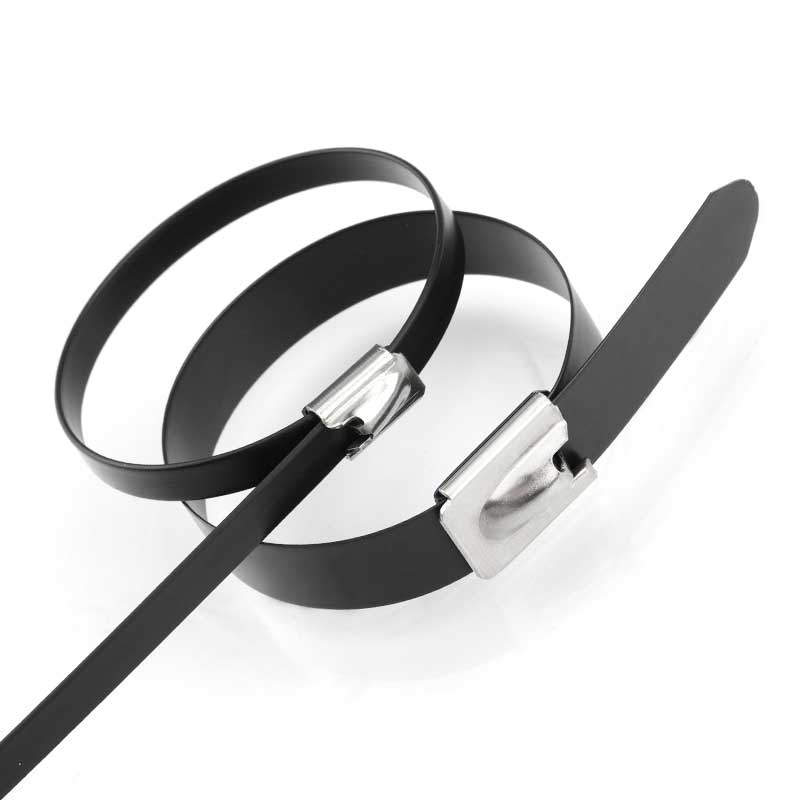
Niuli Electric offers stainless steel cable ties in 201, 304, and 316 stainless steel, with ball-lock designs, low-profile construction, and smooth rounded edges. Its published working-temperature range for the stainless steel tie series is -60°C to 550°C, which puts the material in range for a wide variety of high-temperature industrial environments.
The standard stainless steel ties are particularly useful when a fixed, high-temperature fastening point is required.
The ball-lock construction gives secure mechanical engagement, and the rounded edges reduce the chance of sharp metal contact with surrounding components. Niuli also offers different widths and lengths and states that customized dimensions are available.
For steam and process-piping work, match the material to the environment:
- 304 stainless steel: suitable for many general industrial and hot-water/steam applications.
- 316 stainless steel: more suitable where corrosion and chloride exposure are significant.
- Coated stainless steel: useful where an additional protective layer or surface isolation is required.
Niuli’s stainless steel range includes both bare-metal and coated options.
One distinction matters for this specific application. Niuli’s current standard product pages do not identify a dedicated spring-loaded stainless steel tie. Where the insulation system specifically needs spring action to accommodate thermal movement, the fastening system should be specified accordingly — a conventional stainless steel tie is not an equivalent substitute.
For fixed sections of the installation, Niuli stainless steel ties can still be useful as part of the overall pipe and equipment cable-management system.
-
FAQs
Q1. Are spring-loaded stainless steel ties required for every steam pipe?
No. They are most useful where thermal expansion and contraction create enough movement to affect the insulation jacketing or fastening system. The piping and insulation design should determine whether movement accommodation is needed.
Q2. Why does a steam pipe expand when it heats up?
Steel expands as its temperature rises. How much it expands depends on the pipe material, original length, and temperature change. The basic engineering relationship is ΔL = αLΔT.
Q3. What happens if a rigid tie is overtightened around pipe insulation?
It can locally compress the insulation and create unnecessary stress in the jacketing. During thermal cycling, that stress can contribute to deformation or damage.
Q4. How does a spring-loaded tie work?
The spring-form section lets the fastening element extend or contract while holding tension. Commercial spring-form stainless steel ties are marketed specifically for applications where the secured object changes size with temperature.
Q5. Can standard stainless steel cable ties be used on steam pipe insulation?
They can, where the fastening point is relatively fixed and the system does not need continuous accommodation of thermal movement. They are not automatically a substitute for a spring-loaded design.
Q6. What stainless steel grade should be used around steam piping?
It depends on the environment. 304 is common for general industrial applications, while 316 offers higher corrosion resistance where chloride or marine exposure is involved. Check temperature and chemical exposure as well.
Q7. What temperature can Niuli stainless steel cable ties withstand?
Niuli lists a working-temperature range of -60°C to 550°C for its self-locking stainless steel cable ties.
Q8. Does Niuli make spring-loaded stainless steel ties?
Niuli’s current stainless steel product range includes self-locking/ball-lock stainless steel ties in 201, 304, and 316 grades, but its standard product page does not currently list a dedicated spring-loaded model.
-
Conclusion
Thermal expansion is a normal part of steam-piping operation. The pipe heats up, expands, cools down, and contracts again. The insulation system has to stay secure through those changes — it cannot stop the pipe from moving.
Spring-loaded stainless steel ties are one way to deal with this. Their spring action lets the fastening system hold tension while accommodating dimensional changes, which reduces unnecessary stress on insulation and jacketing and keeps fastening force more stable through repeated thermal cycles.
They are not automatically required on every steam pipe. The deciding factors are the pipe length, operating temperature, expected thermal movement, insulation construction, jacketing system, and fastening design.
For fixed high-temperature fastening requirements, Niuli’s 304/316 stainless steel cable ties provide a high-temperature, corrosion-resistant option with a published working range of -60°C to 550°C.
Where a project specifically requires spring action, the spring-loaded fastening itself should be specified and validated as part of the insulation system. Don’t assume a conventional stainless steel tie does the same job.
Explore the Niuli Stainless Steel Cable Tie Range for 201, 304, and 316 options, or Request Free Samples for evaluation before a bulk order.
For steam-pipe or high-temperature industrial applications, provide the pipe temperature, insulation type, fastening method, and expected thermal movement when contacting Niuli so the appropriate stainless steel fastening solution can be evaluated.
