


Introduction
The air carries sodium chloride, the sun drives the surface temperature up and down every day, and salt crystals settle into every thread. When people tell me cable glands fail salt spray environment conditions after only a year or two, the failure is rarely where they expect. The body is usually fine. The seal has gone hard, or the metal has pitted, or the joint at the enclosure has opened. This article works through why that happens, what salt actually does to each material, and how to specify a gland that lasts.
Why Cable Glands Fail in Salt-Spray Environments
The seal ages out first
The NBR seal is the part most likely to let you down. NBR shrugs off oil and weather, but it is a thermoset rubber and it changes with heat. Sun-load on a dark enclosure can push the gland surface past 80°C on a summer afternoon, then it cools at night. Repeat that cycle for a year and the seal takes a permanent compression set, which means it no longer springs back to fill the gap. Salt that has washed into the seat makes the surface rougher and speeds the wear. The body can be perfect and the gland still leaks because the soft part gave up first.
Galvanic coupling at the enclosure
A metal gland mounted on the wrong enclosure creates a battery. Put a 316 stainless body against an aluminium panel and the seawater film closes the circuit. The aluminium, being less noble, corrodes and the thread seat erodes until the seal path breaks. Even two stainless grades can couple if their surface finishes differ. The fix is to match the metals or add an isolating washer.
UV plus salt on the polymer variant
Nylon PA66 is not a metal and it does not rust, but it is not immune. UV breaks polymer chains on the surface, which shows up as chalking and a slow loss of flexibility. Salt makes this worse in two quiet ways. It sits as a gritty film that abrades the surface every time something moves, and it holds a thin film of moisture against the part so the UV damage keeps progressing. The body stays solid while the surface ages, and the seal seat, being the tightest corner, ages fastest.
The influence and effect of salt spray on cable connectors
It helps to be precise about what salt spray does and does not do, because the obvious suspect is often the wrong one.
It does not corrode the polymer
Salt spray is sodium chloride dissolved in water. It does nothing chemically to nylon or NBR. Those materials do not oxidise. If your gland body is virgin PA66, chloride ions are not eating it. The damage to a polymer gland comes from the physical and thermal side, the UV, the heat cycling and the abrasive salt film, not from corrosion. That distinction matters when you choose the body material, because it tells you the polymer is the safe part of the joint.
Chloride stress corrosion cracking is a real limit for 304
Stainless steel relies on a passive chromium oxide film. Chloride ions punch through that film in spots, and where a tensile stress is already present, 304 austenitic stainless can crack rather than simply pit. Stress corrosion cracking shows up at thread roots and under the nut where stress concentrates. It needs three things at once: chloride, sustained tensile stress and a temperature high enough to move the reaction. Coastal installations with tightened stainless glands in sun-warmed enclosures meet all three, so 304 is not a safe default near the sea if the joint is heavily loaded.
304 vs 316
Molybdenum is the difference that counts. 304 has none to speak of. 316 carries roughly 2 to 3 percent molybdenum, which strengthens the passive film against chloride. Compare them with the pitting resistance equivalent number, PREN = %Cr + 3.3×%Mo + 16×%N. Typical 304 lands near 17.5 to 20.8, while 316 or 316L sits around 23.1 to 28.5. Higher is better, but PREN alone does not decide the job, and a salt-spray test hour count is a laboratory number, not a promise of years of service. Ask for the test method, the duration and the acceptance criteria instead of trusting a headline figure.
| Property | 304 stainless | 316 stainless |
| Molybdenum content | None intentional | ~2 to 3% |
| Typical PREN | 17.5 to 20.8 | 23.1 to 28.5 |
| Chloride pitting resistance | Moderate | High |
| Stress corrosion cracking risk | Real in loaded joints | Lower, not zero |
| Best coastal use | Sheltered, limited exposure | Splash zone, direct marine |
How to Prevent Salt-Spray Gland Failure
Prevention is mostly material choice and a few installation habits. The body, the seal and the thread each need attention.
Select the body material by exposure zone
Distance from the water and the kind of exposure decide the material. A gland a few kilometres inland behind a building sees little direct spray, and a nylon PA66 body with an NBR seal is often enough. Within a kilometre of the shore, or anywhere the enclosure gets splash, move to 316 stainless. Keep bare brass for indoor or sheltered dry spots; near the sea its plating is the only barrier to the copper alloy. Coated 304 is a middle option where budget is tight and exposure is moderate.
| Exposure zone | Recommended body | Why |
| Inland, sheltered coastal | Nylon PA66 or 304 SS | Low direct chloride load |
| Near-shore, occasional splash | 316 SS or coated 304 | Molybdenum resists pitting |
| Direct marine, constant spray | 316 SS | Highest PREN, lowest SCC risk |
| Harsh industrial plus salt | Epoxy-coated metal or 316 | Coating plus noble base |
Specify the seal compound explicitly
Do not accept a gland sold only as rubber sealed. Ask for the compound by name. NBR is the common choice and it handles oil and weather, but it hardens sooner under heat. EPDM resists ozone and UV better, and silicone stays flexible across a wider temperature band. For a sun-exposed coastal run, the seal compound and its rated compression set matter more than the body grade. Give the supplier your peak temperature and your ozone exposure and let them name the seal.
Use anti-seize on metallic threads
Stainless threads gall. 316 in particular work-hardens under friction and the mating threads can weld themselves together on the next removal. A film of anti-seize, ideally a nickel or non-metallic grade, keeps the threads free and makes maintenance possible years later. It also evens out the torque so you do not over-tighten and crack the seat. Skip it on nylon threads, where it is unnecessary, but use it on every metal gland you install near the sea.
Installing a Gland for Salt-Spray Service
Installation is where good specifications turn into a working seal. Start by confirming the thread family matches the enclosure, because a PG gland in a metric hole is a leak waiting to happen. Clean both threads, fit the supplied sealing washer, and tighten to the maker’s torque rather than by feel. Add anti-seize to metal threads before assembly. Route the cable so it enters straight with no side load, and form a short drip loop below the gland so water never tracks along the cable into the seal. Finish by checking the enclosure IP with a continuity or pressure test, not by eyeballing it.
What to Ask a Supplier Before Specifying
A specification sheet full of numbers is only useful if you asked the right questions first. Put these on your inquiry:
- Body and seal material by trade name, with the flame rating and the IP rating tested to IEC 60529.
- The salt-spray test method, duration and acceptance criteria, stated plainly.
- A material certificate for any stainless body, showing chromium, molybdenum and nitrogen so you can check PREN.
- The working temperature range and whether the polymer is UV stabilised.
- The thread standard, because PG, metric, G and NPT do not interchange.
- The supplier’s anti-seize recommendation and whether free samples are available.
Conclusion
Cable glands do not fail in salt spray because the polymer rots. They fail because the seal hardens, the metal pits or cracks, or the joint at the enclosure turns into a galvanic cell. Pick the body by how close you are to the water, name the seal compound instead of hoping, and treat the threads so they can be opened again. Do those three things and a gland rated IP68 will keep that rating for years instead of seasons.
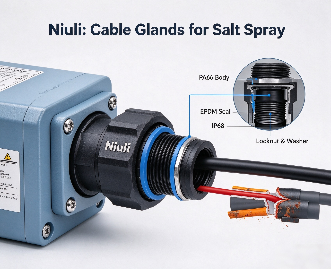
Niuli Electric builds cable glands from virgin UL-approved Nylon PA66 with an NBR seal, rated IP68 and UL 94V-2 across a working range of -40°C to 100°C, with body and nut options in 304 or 316 stainless .
FAQs
Do nylon cable glands corrode in coastal environments?
No. Nylon PA66 is a polymer and it does not corrode. Chloride ions do not attack it chemically. What changes over time is surface ageing from UV and the abrasive salt film, plus the NBR seal hardening with heat. The body stays intact longer than the seal, so inspect the seal, not the plastic.
Should I use 304 or 316 stainless steel cable glands near the sea?
Within roughly a kilometre of open water, or anywhere you get splash, choose 316. Its molybdenum content pushes PREN well above 304 and resists chloride pitting and stress corrosion cracking. Use 304 only for sheltered, limited-exposure locations a few kilometres inland. Where the consequence of failure is high, 316 is the cheaper option over the life of the job.
Are nickel-plated brass cable glands suitable for coastal use?
Brass with nickel plating works in sheltered or indoor coastal locations, and the plating slows corrosion. The risk is the plating itself: a scratch, a pore or edge wear exposes brass to chloride, and dezincification follows. For direct marine or splash-zone service, 316 stainless is the safer call. If you run brass near the sea, our guide to preventing brass gland oxidation outdoors covers what to watch for.
Does IP68 mean a cable gland will survive salt spray?
No. IP68 certifies protection against dust and continuous immersion under defined test conditions. It says nothing about how the metal or seal behaves after months of chloride exposure and daily heat cycling. A gland can be IP68 on the day it is tested and still fail a year later from seal compression set or pitting. Treat IP as a sealing specification, not a corrosion warranty.
Why do stainless steel cable gland threads seize?
Stainless work-hardens under sliding friction, and 316 does it aggressively. Without a lubricant, the male and female threads can cold-weld during assembly, so the next removal tears the threads. A nickel or non-metallic anti-seize film prevents this and gives a more even torque. Nylon glands do not have this problem, which is one reason they suit maintenance-light installations.
