



Introduction
High-voltage cables with XLPE insulation are built for demanding electrical and mechanical service. During installation, though, the cable faces a different kind of risk that’s easy to miss: too much pressure from cable ties.
Cable ties do a lot of routine work around power-cable installations — organizing auxiliary wiring, grounding conductors, control cables, and other components. When a tie gun applies tension, that setting decides how hard the tie grips the bundle. Too little tension and the bundle can move. Too much, and you get localized compression.
The problem gets worse when the tie sits directly on a cable jacket, or when a sharp edge, narrow band, or heavy hand concentrates the pressure onto a small area.
For XLPE-insulated high-voltage cables, the objective is not to pull the tie as tight as it will go. The goal is a bundle that stays put, with no unnecessary deformation or mechanical stress on the cable.
So what tension setting should be used on a cut-off tool?
No single setting fits every high-voltage XLPE cable. The right value depends on the cable construction, jacket material and thickness, cable-tie dimensions, bundle geometry, installation temperature, and the manufacturer’s requirements. The safest approach: use the lowest tension that gives adequate retention, then verify the result on the actual cable assembly.
Why Can Cable-Tie Cut-Off Tools Damage High-Voltage XLPE Cable Jackets?
A cable-tie installation tool normally does two jobs: it applies tension to the tie, then cuts off the excess tail.
When the tension setting is too high, the tie gets pulled hard around the cable before the tail is cut. That leaves a compressive load wrapped around the jacket.
A flexible jacket can tolerate some deformation. A highly concentrated load, though, can leave a small indentation — especially with a narrow tie or a relatively soft outer sheath.
It also matters whether you’re tightening a tie around a group of small wires or directly around a large power cable. With small control wiring, the bundle spreads the pressure across several individual conductors. A high-voltage cable has a much larger, more structured build, so localized external pressure can interact with the outer jacket and the layers underneath.
That’s why cable-tie installation deserves treatment as a mechanical design decision, not simply a matter of pulling the tie as tight as possible.
How Does Tool Tension Affect XLPE Cable Jackets?
The tension displayed or adjusted on a cable-tie tool is not the same thing as the pressure the jacket actually experiences.
The final pressure depends on several factors:
- Cable-tie width and thickness
- Tie material
- Cable diameter
- Jacket hardness and thickness
- Contact area between the tie and cable
- Installation tension
- Bundle geometry
- Temperature
- Whether the tie sits directly on the cable or on a protective support
A higher tool setting generally means more tension in the tie, which raises the clamping force around the bundle.
But the relationship between tool tension and local jacket pressure is not necessarily linear. A narrow tie concentrates the load over a small area; a wider tie spreads it out.
This is why a numerical tension value should never be treated as a universal safe limit for XLPE cable jackets.
Excessive Tension and Localized Compression
The first risk from over-tightening is localized compression.
Picture a cable tie wrapped around a large cable. As the tool ramps up tension, the tie pulls inward and compresses the jacket under the band.
If the tie is significantly tighter than it needs to be, the indentation can still be visible after installation.
A little surface deformation doesn’t automatically mean the insulation is damaged. Still, visible deformation is a useful warning that the installation force may be too high.
For high-voltage cable systems, avoiding unnecessary deformation beats relying on the maximum tension the tool can deliver. The tie should hold the components in position — it shouldn’t act like a clamp around the cable.
Stress Concentration Around Cable Ties
Stress concentration is the second issue worth watching.
Pressure is rarely spread perfectly evenly around a tie. The locking head, the tie edges, cable curvature, and nearby components all create spots where local stress runs higher.
The situation gets worse when a narrow tie is pulled very tight against a relatively soft jacket.
A wider tie distributes the force over a larger contact area. That doesn’t make excessive tension safe by itself, but it does reduce how much load gets concentrated along one narrow line.
Installation geometry matters too. If a tie crosses a sharp edge, sits against an existing clamp, or is tightened over an irregular surface, local pressure can come out higher than expected.
For high-voltage XLPE work, cable routing and support design should be considered together with cable-tie selection.
Delayed Stress Cracking and Insulation Damage
The harder problem: excessive mechanical stress doesn’t always show up as immediate, visible damage.
Polymeric cable materials can suffer long-term effects under sustained mechanical stress, temperature changes, environmental exposure, or incompatible chemicals.
Depending on the actual jacket construction, excessive local stress can contribute to deformation or cracking over time. So an installation that looks fine right after assembly isn’t automatically fit for long-term service.
Keep in mind the distinction between the XLPE insulation and the outer cable jacket. In many power cables, XLPE is the primary insulation layer, while the outer jacket or sheath is a different polymeric material. When you’re talking about cable-tie damage, the exact cable construction matters.
That’s also why no cable-tie manufacturer should claim that one tension value protects every “XLPE cable.” The relevant material properties need to be assessed for the actual cable being installed.
Choosing the Right Tension Setting
The most practical approach: start with the cable manufacturer’s installation requirements and the cable-tie manufacturer’s recommendations.
If neither specifies a tool setting, run a controlled trial on the actual cable assembly. Start at a relatively low tension. Tighten the tie until it holds the bundle securely, then inspect the contact area.
Look for:
- Visible indentation
- Jacket deformation
- Sharp impressions from the tie edges
- Excessive compression
- Difficulty moving the cable tie slightly after installation
- Damage around the locking head
If the tie holds securely without significant deformation, there’s little reason to increase the setting.
For critical high-voltage installations, the final procedure should be validated by the cable manufacturer, system designer, or responsible engineering team.
Recommended Tension Settings for Different Cable-Tie Applications
Rather than assigning one universal numerical setting, it’s more useful to split applications by their mechanical requirements.
Light-Duty Wiring
Small control wires, sensor cables, and auxiliary wiring generally need relatively low installation tension.
The tie just has to keep the wires organized. There’s usually no benefit in pulling it to its maximum possible tension.
A lower setting reduces the risk of crushing small cables or creating unnecessary deformation. For light-duty wiring, the correct setting is typically the one that provides adequate retention without visibly compressing the bundle.
Heavy-Duty Cable Bundling
Larger bundles may call for higher tensile-strength ties, but that doesn’t mean the tool should be set to maximum tension.
The tensile rating describes the tie’s mechanical strength. It says nothing about how much pressure should end up on the cables inside the bundle.
For heavy-duty applications, first pick a tie with an appropriate minimum loop tensile strength and sufficient dimensions. Then adjust the installation tension according to how sensitive the cables are and what retention force the job requires.
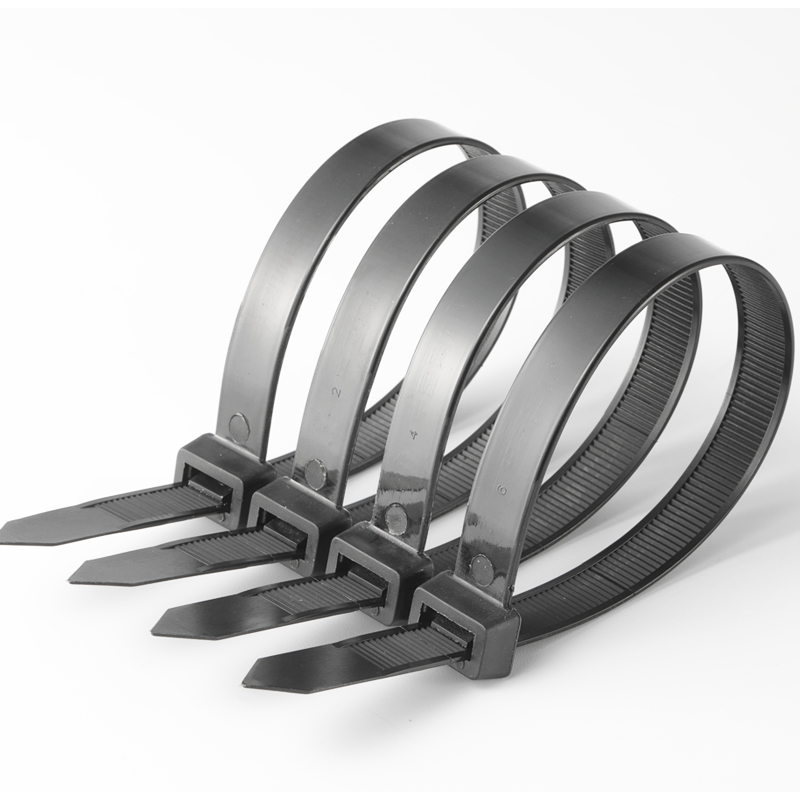
Niuli offers standard cable ties in a range of sizes and tensile-strength levels. Its published products include smaller ties around 18 lb and larger heavy-duty ties in the 120–250 lb range. These ratings describe cable-tie strength — not a recommended clamping force for high-voltage cables.
High-Voltage XLPE Cable Applications
High-voltage XLPE installations deserve a more conservative approach.
The objective: prevent movement and keep cables organized while minimizing concentrated mechanical pressure on the cable.
If ties are going directly against the cable jacket, consider:
- Using a sufficiently wide tie.
- Selecting a tie with adequate — not excessive — tensile strength.
- Using the lowest practical installation tension.
- Avoiding repeated tightening and re-tightening.
- Checking the finished installation for visible deformation.
- Following the cable manufacturer’s requirements where available.
For critical cable systems, it may also be better to use purpose-designed cable cleats, clamps, or supports where the installation requires controlled mechanical restraint.
A cable tie is not a substitute for a properly engineered high-voltage cable support system.
How to Prevent Stress Cracking During Cable-Tie Installation?
Use the Correct Cable-Tie Size
Cable-tie dimensions directly affect pressure distribution.
A tie that’s too narrow for a large cable concentrates force along a small contact area. Choosing a suitable width spreads the load more effectively.
The tie should also be long enough to wrap the intended bundle without needing excessive tension just to close the loop.
Control Installation Tension
Use an installation tool with adjustable tension when you’re working with sensitive cable assemblies.
The objective is consistency. Different technicians shouldn’t produce dramatically different tightening forces on the same cable system. A controlled tool setting makes the process repeatable.
Avoid Over-Tightening
Over-tightening is one of the easiest mistakes to make, because a very tight tie initially looks like a more secure installation.
In practice, more tension doesn’t mean better cable management. If the tie is already secure, extra tension only adds mechanical load to the bundle.
A good installation is secure enough to prevent unwanted movement while leaving the jacket free of unnecessary compression.
Use Proper Cut-Off Tools
A quality tensioning and cut-off tool helps control both tightening and trimming.
The cutting mechanism should produce a clean cut with no sharp protruding tail.
For high-voltage installations, the operator should also avoid dragging or twisting the tool against the jacket while cutting. If a tie needs to come off later, cut it carefully with a suitable tool rather than wrenching at it in a way that could touch the cable.
How to Choose Cable Ties for High-Voltage XLPE Cables?
Tool tension is only one part of the selection process.
Consider the following factors before choosing a cable tie:
Cable diameter: Measure the actual cable or bundle rather than estimating its size.
Tie width: A wider tie can provide greater contact area and may reduce localized pressure.
Tensile strength: Select a rating appropriate for the bundle weight, vibration, and expected mechanical loads.
Material: Consider temperature, moisture, chemical exposure, UV exposure, and the mechanical properties required for the installation.
Operating temperature: Polymer behavior changes with temperature. A cable tie suitable for a controlled indoor installation may not be suitable for a hot outdoor environment.
Installation method: Determine whether the tie will be installed directly against the cable or used to organize auxiliary wiring around a support system.
For high-voltage systems, also ask whether a cable tie is actually the right restraint method. Cable cleats and other engineered supports are often more appropriate when short-circuit forces, thermal expansion, or significant mechanical loads must be controlled.
Why Choose Niuli Electric Cable Ties?
Niuli Electric manufactures cable ties for electrical and industrial cable-management applications, with a range of Nylon PA66 products in different sizes and tensile-strength levels.
The company’s standard cable ties are made from UL-approved Nylon PA66 grades, with published material sources including INVISTA, DuPont, and Ascend. Its product range includes different widths and lengths for applications ranging from smaller wiring bundles to heavy-duty cable management.
Niuli also describes manufacturing processes such as burr-free molding, which can help produce cleaner cable-tie surfaces and edges.
For installations involving sensitive cable jackets, the correct cable-tie specification should be determined together with the installation method. A strong cable tie is not automatically the right cable tie if the application is sensitive to localized compression.
For a high-voltage XLPE cable project, provide the cable diameter, jacket construction, bundle configuration, operating temperature, required tensile strength, and installation conditions when discussing product selection with the supplier.

FAQs
What tension setting should I use on a cable-tie tool for XLPE cables?
There is no universal tension setting for all XLPE cables. The appropriate setting depends on the cable construction, jacket material, cable-tie dimensions, and required retention force. Use the lowest tension that securely holds the assembly without visible jacket deformation, and follow the cable manufacturer’s requirements where available.
Can over-tightening a cable tie damage an XLPE cable?
Excessive tightening can create localized compression and deformation on the cable jacket. Whether this turns into actual insulation damage depends on the cable construction, material properties, pressure, temperature, and duration of exposure.
Does a higher tensile-strength cable tie require higher tool tension?
No. Cable-tie tensile strength and installation tension are different specifications. A tie can have a high breaking strength while still being installed at a controlled tension appropriate for the cable assembly.
Are wider cable ties safer for XLPE cables?
A wider tie generally provides a larger contact area, which helps distribute pressure. But width alone doesn’t prevent damage. Excessive installation tension can still create high compressive forces.
Should cable ties be used directly on high-voltage cables?
It depends on the application and the cable manufacturer’s requirements. For organizing auxiliary wiring, cable ties may be appropriate. Where the cable itself needs substantial mechanical restraint, purpose-designed cable cleats or supports may be more suitable.
What should I check after installing a cable tie on an XLPE cable?
Inspect the jacket for visible indentation, sharp impressions, deformation, cuts, or other signs of excessive pressure. Also confirm the tie holds the intended bundle without unnecessarily restricting the cable.
What tensile strengths are available from Niuli?
Niuli’s published standard cable-tie range includes products from approximately 18 lb through 250 lb minimum loop tensile strength, depending on the size and model. The correct rating should be selected according to the application rather than simply choosing the highest available strength.
Conclusion
There is no single cut-off-tool tension setting that can guarantee protection for every high-voltage XLPE cable jacket.
The more reliable principle is to control the combination of cable-tie width, tensile strength, installation tension, cable construction, and installation geometry.
For sensitive cable jackets, start with a controlled, relatively low tension and increase it only when necessary to achieve secure retention. After installation, inspect the cable for localized indentation or deformation.
Most importantly, don’t confuse a cable tie’s tensile-strength rating with the amount of clamping force that should be applied to a cable. A stronger tie does not mean it should be tightened harder.
Niuli Electric provides Nylon PA66 cable ties in multiple sizes and tensile-strength levels for electrical and industrial cable management. For high-voltage XLPE applications, the appropriate product should be selected based on the actual cable dimensions, environmental conditions, mechanical requirements, and installation method.
