



-
Introduction
Aluminum is widely used for solar mounting rails because it is lightweight, easy to fabricate, and naturally forms a protective oxide layer. Stainless steel is also common in PV systems, especially for fasteners, clamps, brackets, and cable ties.
Putting the two metals next to each other is not automatically a problem. The concern starts when they are in electrical contact while moisture or another conductive liquid is present. In that situation, a galvanic cell can form. Aluminum is the less noble metal in the pair and can become the anodic metal, meaning corrosion of the aluminum is accelerated. Chloride-containing moisture makes the situation more aggressive.
For solar installations, this matters because cable ties can sit directly against aluminum mounting rails for years. Rain, condensation, humidity, and salt deposits can linger around the contact area, particularly in coastal locations.
The good news: the risk can usually be reduced by controlling the contact and the environment. Material grade, protective coatings, insulating barriers, drainage, and installation details all have a part to play.
-
Why Can Galvanic Corrosion Occur Between Stainless Steel Cable Ties and Aluminum Rails?
Galvanic corrosion needs three basic conditions:
- Two dissimilar conductive metals
- Electrical contact between them
- A conductive liquid or electrolyte bridging the couple
Remove any one of these and the galvanic circuit is interrupted. The British Stainless Steel Association describes the same mechanism and notes that saltwater or salt-laden moisture is more conductive than ordinary rainwater, increasing the corrosion risk.
In a solar mounting system, the pair might look like this:
Stainless steel cable tie → aluminum rail → moisture/salt deposit → galvanic circuit
The stainless steel is generally more noble than aluminum. As a result, the aluminum can act as the anodic member of the couple and experience increased corrosion at the contact area.
That doesn’t mean every stainless steel tie installed on an aluminum rail will cause visible corrosion. In a dry, well-drained installation, the two metals may coexist with little practical trouble. The U.S. Department of Energy notes that solar PV systems commonly combine stainless steel fasteners with aluminum frames and that the actual corrosion risk depends on environmental conditions and design details.
The situation changes in marine and humid environments, where salt deposits and repeated wetting can keep the contact area conductive.

-
Key Factors That Affect Galvanic Corrosion
Electrolytes, Humidity, and Salt Exposure
Moisture is the missing ingredient in a dry metal-to-metal joint.
Rainwater can act as an electrolyte, but the risk increases when water carries dissolved salts. Coastal air is particularly troublesome because airborne chloride deposits can collect on the rail, cable tie, and surrounding hardware.
Humidity can matter even without visible rain. Condensation can create a thin conductive film across the contact area. The Australian Stainless Steel Development Association points out that an electrolyte may come from rainwater, condensation, or moisture absorbed into surface deposits.
For solar installations near the coast, the combination of high humidity + salt deposits + repeated wetting and drying deserves more attention than the nominal stainless steel grade alone.
Drainage also matters. A joint that dries quickly after rainfall is a different situation from one that traps water and salt underneath a cable tie or bracket.
Contact Area and Metal Potential Difference
The two metals don’t have to be wildly different for galvanic corrosion to be possible. What matters is their relative electrochemical behavior, the electrical connection, the electrolyte, and the geometry of the joint.
Stainless steel and aluminum are sufficiently separated in the galvanic series for the combination to deserve attention. The less noble aluminum tends to become the anodic material.
Area ratio is another important detail.
A relatively small anodic area coupled to a much larger cathodic area can lead to more concentrated attack on the anodic metal. The U.S. Bureau of Reclamation recommends avoiding designs where the more anodic metal has a relatively small area compared with the more cathodic metal.
This is relevant to cable ties because the stainless steel contact area may be small, but the aluminum rail is much larger. That doesn’t by itself prove a serious corrosion problem — but it’s one reason not to dismiss the joint just because the stainless component is small.
Coatings, Insulation, and Surface Protection
The most straightforward way to interrupt galvanic corrosion is to break the electrical contact or keep the electrolyte away from the joint.
An insulating washer, polymer sleeve, coated fastener, or suitable barrier layer can separate the stainless steel from the aluminum. Once the metals are no longer electrically connected through the electrolyte, the galvanic circuit is interrupted.
Solar rails are also often anodized or otherwise surface-treated. That protective layer can provide additional resistance, but its condition matters. Scratches, cut edges, drilling, or abrasion can expose the underlying aluminum.
Coated stainless steel cable ties provide another option. Niuli’s stainless steel range includes epoxy-coated and PVC/polyester-coated ties. The company specifically describes the coatings as providing additional edge protection and helping avoid metal-to-metal corrosion.
One caution: a coating is only useful while it remains intact. If it gets damaged during installation, the exposed area becomes a new point of contact that should be considered in the corrosion assessment.
Stainless Steel Grade Selection
Not all stainless steel grades behave identically.
Niuli offers SUS201, SUS304, and SUS316 stainless steel cable ties. Its product range also includes coated versions of these grades.
For general outdoor solar applications, 304 may be adequate when the environment is relatively mild and well drained.
In coastal locations, 316 can be preferable because its alloy composition resists chloride-related corrosion better than 304. That doesn’t eliminate galvanic corrosion between stainless steel and aluminum, but it can improve the stainless component’s own resistance to the environment.
So grade selection addresses stainless-steel durability, while electrical isolation addresses the galvanic couple. The two are related, but they are not the same problem.
-
How to Prevent Galvanic Corrosion in Solar Cable Management
Use Appropriate 304 or 316 Stainless Steel
The stainless steel grade should reflect the site conditions.
For a relatively dry inland solar installation, 304 stainless steel can be a practical choice for cable fastening.
For coastal systems exposed to salt-laden air, high humidity, or occasional salt spray, 316 is often worth considering because it offers greater resistance to chloride-related corrosion.
Niuli’s stainless steel cable-tie range includes both 304 and 316 options, allowing the material grade to be selected according to the project environment.
But moving from 304 to 316 is not a complete galvanic-corrosion solution. The aluminum is still in contact with a more noble metal. If the contact area stays wet and electrically connected, the galvanic mechanism remains possible.
Add Protective Coatings or Insulating Barriers
If the application is likely to remain wet, adding a barrier can be more useful than changing stainless steel grades.
Possible approaches include:
- Coated stainless steel ties
- Polymer sleeves
- Insulating pads
- Dielectric barriers
- Suitable sealants
- Protective coatings on the metal interface
Niuli offers epoxy-coated stainless steel ties and PVC/polyester-coated stainless steel ties. The company describes these coatings as providing additional edge protection, corrosion resistance, and protection against metal-to-metal contact.
For a PV system, the barrier should be selected so that it doesn’t interfere with the intended grounding or bonding path. A cable-management tie should not be used to break an intentional protective-earth connection.
Minimize Direct Metal-to-Metal Contact
If a stainless steel cable tie is used directly against an aluminum rail, the contact area should be kept as controlled as practical.
This doesn’t mean the tie must never touch the rail. Where galvanic corrosion is a concern, designers can look at:
- Isolation between the two metals
- Coated tie options
- Dedicated cable-mounting clips
- Plastic or polymer interfaces
- Alternative fastening positions
The U.S. Bureau of Reclamation identifies electrical isolation of dissimilar metals as one of the most direct ways to minimize galvanic corrosion.
For solar projects, a small change in the cable-routing detail can sometimes do more than replacing an entire hardware package.
Control Water and Salt Accumulation
Good drainage is an underrated corrosion-control measure.
Avoid creating pockets where water, dust, and salt can sit around the cable tie and aluminum rail. Cable bundles should not block drainage paths or create tight crevices where moisture stays trapped.
This is particularly important in coastal PV installations. The U.S. Department of Energy identifies humidity, recurring dew, wind-blown salt air, and local dust as environmental factors that can influence corrosion in solar systems.
Regular inspection can also catch early signs of trouble:
- White or powdery corrosion products on aluminum
- Pitting around contact points
- Damaged anodizing
- Broken cable-tie coatings
- Trapped salt deposits
- Water-retaining dirt
The earlier the contact problem is found, the easier it is to correct.
-
304 vs. 316 Stainless Steel Cable Ties for Aluminum Solar Rails
For solar mounting systems, the choice between 304 and 316 should start with the environment.
| Factor | 304 Stainless Steel Tie | 316 Stainless Steel Tie |
| General Outdoor Use | Suitable | Suitable |
| Coastal Environment | Application-dependent | Better suited to chloride exposure |
| Salt Spray Resistance | Good | Higher |
| Galvanic Interaction with Aluminum | Still possible | Still possible |
| Need for Electrical Isolation | Yes, where required | Yes, where required |
| Typical Cost | Lower | Higher |
| Best Fit | Inland / moderate environments | Coastal / high-salt environments |
316 offers better corrosion resistance than 304, particularly in chloride-bearing environments. But neither grade should be described as “galvanic-proof” when directly connected to aluminum.
In fact, isolation can be more important than the difference between 304 and 316 when the main concern is the aluminum rail. Breaking the electrical path or keeping the electrolyte out of the joint directly attacks the mechanism that causes galvanic corrosion.
For a coastal solar project, a practical combination may therefore be 316 stainless steel + an appropriate insulating or coated interface, rather than simply upgrading from 304 to 316 and leaving the joint otherwise unchanged.
-
How to Choose the Right Stainless Steel Cable Ties for Solar Mounting Systems?
Start by identifying the environment.
For an inland PV array with limited moisture and no significant salt exposure, 304 stainless steel may be sufficient for many cable-management tasks.
For coastal or marine-influenced sites, 316 is a stronger candidate. If salt and moisture are expected to remain around the contact area, look at a coated tie or an insulating interface as well.
Then check the cable bundle.
The tie needs the correct:
- Length
- Width
- Minimum loop tensile strength
- Locking design
- Attachment method
Do not select the cable tie by material grade alone.
Finally, examine the rail itself. Is the aluminum anodized? Will the cable tie rub against a sharp rail edge? Can rainwater drain away? Does the installation contain intentional electrical bonding points that must remain conductive?
These details can change the best fastening arrangement.
For solar EPC projects and distributors, it’s also worth specifying the complete assembly rather than just ordering “316 stainless cable ties.” The specification can include the stainless grade, coating, dimensions, tensile strength, and required isolation method.
-
Why Choose Niuli Electric Stainless Steel Cable Ties?
Niuli Electric offers stainless steel cable ties in SUS201, SUS304, and SUS316, along with bare-metal and coated designs. The range includes self-locking, ball-lock, epoxy-coated, and PVC/polyester-coated stainless steel ties.
For solar cable management, this gives buyers several ways to match the fastening system to the environment.
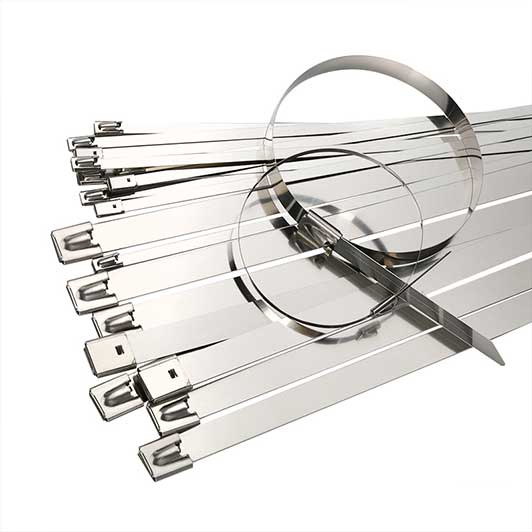
The Self-Locking Stainless Steel Ties use a ball-lock design with a low profile and smooth rounded edges. Niuli specifies a working temperature range of -60°C to 550°C for this product family, with widths and lengths available for customization.
For environments where direct metal contact or additional surface protection is a concern, Niuli also offers epoxy-coated and PVC/polyester-coated stainless steel ties. The company specifically describes these coatings as helping with anti-corrosion, UV resistance, edge protection, and avoidance of metal-to-metal corrosion.
That makes the product range useful across different solar environments:
- 304 stainless steel for general outdoor applications where the environment is relatively mild.
- 316 stainless steel for coastal and high-chloride locations.
- Coated stainless steel where an additional barrier between the tie and surrounding hardware is desirable.
For solar mounting systems, the goal is not to pick the most expensive stainless steel tie available. It’s to specify the combination of material grade + coating + installation method + environmental protection that fits the site.
-
FAQs
Q1. Will stainless steel cable ties cause galvanic corrosion on aluminum solar rails?
They can contribute to galvanic corrosion when the stainless steel and aluminum are electrically connected and moisture or another electrolyte is present. The risk depends on the environment, surface condition, area ratio, and joint design.
Q2. Is 316 stainless steel safer than 304 for aluminum solar rails?
316 has better resistance to chloride-related corrosion, so it is generally more suitable in coastal and salt-exposed environments. That said, changing from 304 to 316 does not eliminate the galvanic couple with aluminum. Electrical isolation may still be needed.
Q3. Does anodized aluminum prevent galvanic corrosion?
Anodizing provides a protective surface layer, but the protection can be compromised by scratches, cuts, drilling, abrasion, or other damage. The condition of the coating at the actual contact point matters.
Q4. What is the easiest way to interrupt galvanic corrosion?
One of the most direct methods is to electrically isolate the dissimilar metals. Keeping the joint dry and preventing electrolyte contact is another important control measure.
Q5. Are coated stainless steel cable ties useful on aluminum solar rails?
They can be. A suitable coating can add a physical barrier between the stainless steel and aluminum and provide additional protection against moisture and corrosion. The coating should remain intact throughout installation and service.
Q6. Should solar projects always use 316 stainless steel cable ties?
No. 316 is not automatically necessary for every solar installation. Site exposure, salt level, humidity, expected service life, and project cost should all be considered.
Q7. Does Niuli offer 304 and 316 stainless steel cable ties?
Yes. Niuli’s stainless steel tie range includes SUS201, SUS304, and SUS316, as well as coated stainless steel options.
Q8. Does Niuli offer coated stainless steel cable ties?
Yes. Niuli offers both epoxy-coated and PVC/polyester-coated stainless steel cable ties. The company states that the coatings provide additional edge protection and help avoid metal-to-metal corrosion.
-
Conclusion
Stainless steel cable ties and aluminum solar rails can be used together, but the joint deserves some thought when the installation is exposed to moisture or salt.
The basic galvanic-corrosion conditions are well established: dissimilar metals, electrical contact, and an electrolyte. Coastal solar systems are more likely to provide the electrolyte because salt deposits, humidity, condensation, and rain can keep the contact area conductive.
The practical controls are straightforward:
Choose the appropriate stainless steel grade. Isolate dissimilar metals where necessary. Protect the contact area with a suitable coating or barrier. Keep water and salt from accumulating around the joint.
For inland solar systems, 304 stainless steel may be enough. For coastal or salt-exposed installations, 316 offers better corrosion resistance. Where the galvanic interaction itself is the main concern, though, isolation or a suitable coated tie can matter more than upgrading the stainless grade.
Niuli Electric offers SUS304 and SUS316 cable ties as well as epoxy- and PVC/polyester-coated stainless steel options, giving solar installers and industrial buyers several ways to build a corrosion-conscious cable-management system.
Explore the Niuli Stainless Steel Cable Tie Catalog to compare available grades and coated options, or Request Free Samples before placing a bulk order.
For a solar mounting project, send Niuli your rail material, installation environment, cable size, and corrosion requirements to discuss a suitable stainless steel cable-tie configuration.
