


Introduction
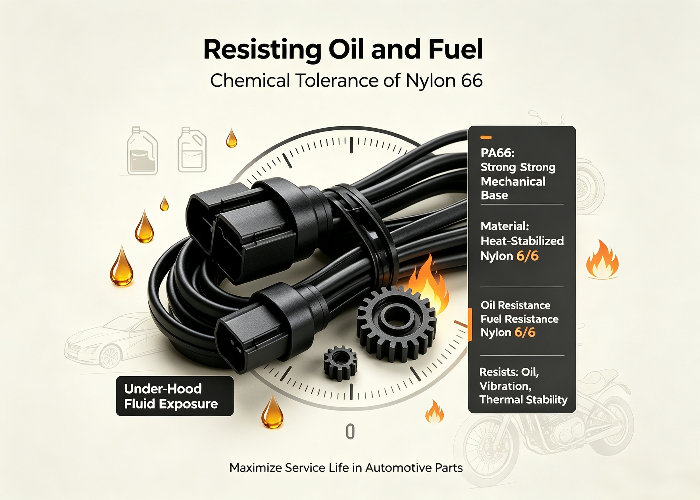
Nylon 66 (PA66)’s ability to shrug off petroleum-based fluids while maintaining mechanical strength at under-hood temperatures is exactly why automakers have relied on it for decades. In this article, we’ll explore Nylon 66 chemical resistance to oil and other automotive fluids and how to maximize service life.
What Is Nylon 66 Cable Ties and Why Cars Use It
Nylon 66 is a semicrystalline polyamide formed from hexamethylenediamine and adipic acid. Its tight, regular chain packing gives PA66 a high melting point (~265 °C), strong hydrogen bonding, and low permeability to non-polar liquids like oils and fuels.
Nylon 66 vs Nylon 6
Both are polyamides, but Nylon 66 has a higher melting point (≈265 °C vs ≈220 °C) and absorbs less moisture (2.5–3% at saturation vs 3–4% for Nylon 6). That means better dimensional stability and stiffness retention in humid or wet environments. For parts facing heat, vibration, and oil spray simultaneously, that margin matters.
Key Properties for Automotive
- Thermal range: Standard grades run –40 °C to 85 °C; heat-stabilized variants reach 120 °C.
- Tensile strength: PA66 ties handle loads from 18 lbs (8 kg) up to 250 lbs (110 kg).
- Flame retardancy: UL 94V-2 keeps parts self-extinguishing near heat sources.
- UV resistance: Stabilized grades resist sunlight degradation for exposed applications.
Which Automotive Chemicals Nylon 66 Resists
Engine Oil & Grease
Engine oil and grease are the most common fluids Nylon 66 ties encounter. Because motor oil is a non-polar hydrocarbon mixture, it cannot easily penetrate or plasticize PA66’s crystalline regions. Decades of field data confirm that Nylon 66 retains tensile strength and flexibility after prolonged immersion in conventional and synthetic oils at elevated temperatures. Lithium, calcium, and synthetic greases behave similarly. This is the core of Nylon 66 chemical resistance to oil: the material doesn’t swell, soften, or embrittle when oil is present.
Gasoline, Diesel & Ethanol-Blended Fuel
PA66 holds up well against gasoline and diesel short-term splashes and even sustained contact with standard unleaded fuel cause minimal dimensional change or strength loss. Diesel is gentler still due to its lower aromatic content. The one caveat is ethanol-blended fuels that ethanol is a polar solvent that can interact with PA66’s amorphous regions, causing slight swelling and a modest strength drop over long exposure. For continuous contact with high-ethanol blends, automakers often specify barrier-enhanced grades or switch to specialty polymers.
Coolant & Brake Fluid
Ethylene glycol coolant is remarkably benign toward PA66,even at 100–110 °C, it causes negligible swelling. Glycol-ether brake fluids (DOT 3, DOT 4) are similarly well-tolerated for splash contact, though years of continuous high-temperature immersion can eventually cause minor plasticization. In practice, clips and ties see splatter, not soaking .so this is rarely a concern.
What Actually Damages Nylon 66?
PA66 is tough but not invincible. Known aggressors include:
- Strong mineral acids — sulfuric, nitric, hydrochloric; battery acid is the most likely automotive source.
- Phenols and formic acid — true solvents for polyamides; can dissolve PA66 at room temperature.
- Strong bases — concentrated NaOH or KOH can hydrolyze amide bonds over time.
- Chlorinated solvents — at elevated temperature, some can plasticize or stress-crack PA66.
- UV radiation — prolonged direct sunlight without stabilizers causes chalking and embrittlement.
- Moisture — nylon is hygroscopic; absorbed water lowers stiffness and affects dimensional stability
Head-to-Head: Nylon 66 vs Other Plastics
| Property | PA66 | PA6 | PP | PBT |
| Oil & grease resistance | Excellent | Good | Excellent | Excellent |
| Fuel resistance | Good | Moderate | Moderate | Good |
| Tensile strength | High | Medium-High | Low-Med | Med-High |
| Acid resistance | Poor | Poor | Good | Good |
Limited with ethanol-blended fuels. Nylon 66 is the best all-rounder when you need strength, heat resistance, and oil resistance simultaneously. PP wins on acid and moisture resistance but loses on strength and heat. PBT is a strong fuel-contact alternative at higher cost.
Real Automotive Uses
Under-Hood Clips, Ties & Connectors
Nylon 66 cable ties are the workhorse of under-hood wire harness management. They bundle sensor wires, secure relay connectors, and anchor looms to chassis brackets ,all while sitting next to oil-coated engine blocks. As one Niuli Electric fleet customer noted: “The cable tie works well in the engine room, ensures the stable operation of the machine, good quality!”
Sensor & Housing Parts
PA66 is injection-molded into sensor housings, connector bodies, and retainer clips for MAP sensors, knock sensors, and fuel injector connectors. Its dimensional stability at temperature that combined with chemical inertness to fuel vapors and oil mist,keeping mating surfaces sealed and snap-fits engaged over the vehicle’s life.
Limitations & When to Switch Material
If a part will sit in continuous, direct contact with battery acid, E85 fuel, or aggressive solvents at high temperature, look beyond PA66. Alternatives include PPS for extreme chemical and thermal exposure, PBT for fuel system components, or fluoropolymer-lined parts. The cost jumps significantly why PA66 remains the default until those edge cases apply.
How to Maximize Chemical Life
- Use virgin, stabilized resin. Reprocessed nylon may have degraded molecular weight, reducing both mechanical and chemical performance.
- Mind the temperature ceiling. Chemical attack accelerates with heat. Above 85 °C continuous, specify a heat-stabilized grade rated to 120 °C.
- Add UV stabilizer for exposed parts. Carbon-black-filled or UV-stabilized PA66 prevents sunlight-driven embrittlement.
- Choose the right tie design. Wider-band ties (4.8 mm, 7.6 mm, 9 mm) distribute stress and offer more cross-section to resist surface softening.
Conclusion
Nylon 66 has earned its place under every car hood for a simple reason: it works. Its chemical resistance to oil, grease, fuel, coolant, and brake fluid combined with genuine mechanical toughness and a temperature range covering nearly every automotive zone that makes it the go-to material for clips, ties, and housings that must survive years of heat and hydrocarbons. It isn’t perfect; strong acids, phenols, and high-ethanol fuels can challenge it. But for the vast majority of under-hood applications, PA66 strikes the best balance of performance, availability, and cost.
FAQ
Is Nylon 66 resistant to engine oil and grease?
Yes. Engine oil and grease are non-polar hydrocarbons that PA66’s crystalline structure naturally resists. Prolonged immersion in motor oil at operating temperature causes negligible swelling or strength loss.
Does gasoline or diesel damage Nylon 66 parts?
Standard gasoline and diesel cause minimal damage in splash or incidental contact. Ethanol-blended fuels are more aggressive and can cause slight swelling over long-term continuous exposure.
How does Nylon 66 handle brake fluid and engine coolant?
Both are well-tolerated. Ethylene glycol coolant is essentially inert to PA66 though years of continuous immersion at high temperature may cause minor plasticization.
Does Nylon 66 absorb oil or swell over time?
No. Non-polar hydrocarbons cannot penetrate PA66’s tightly packed crystalline regions. Dimensional change in oil is negligible which is exactly why it’s chosen for engine-bay fasteners.
Can Nylon 66 parts survive long-term under the hood near oil leaks?
Yes, provided temperatures stay within the rated range. Oil splash near leaks is well within PA66’s tolerance. The bigger long-term risk is heat and UV, not the oil itself.
Download Niuli Electric‘s Cable Management Product Datasheets or Request Free Factory Testing Sample Kits today.
