


Introduction
Chassis wiring lives in one of the harshest environments a cable will ever see. A car frame rattling over potholes, a washing machine drum spinning, or a CNC machine cutting metal which is the panel underneath never stops moving. Standard zip ties and screw clamps that seem secure on the bench have a habit of working loose after a few thousand cycles, and a loose harness means chafed insulation and intermittent faults. That’s exactly why push mount ties chassis wiring projects reach for a different fastener: one that anchors directly into a drilled hole and removes the separate piece vibration loves to shake free. This guide covers how they work, why they beat the alternatives, and how to install them so they stay put.
What Are the Push Mount Cable Ties
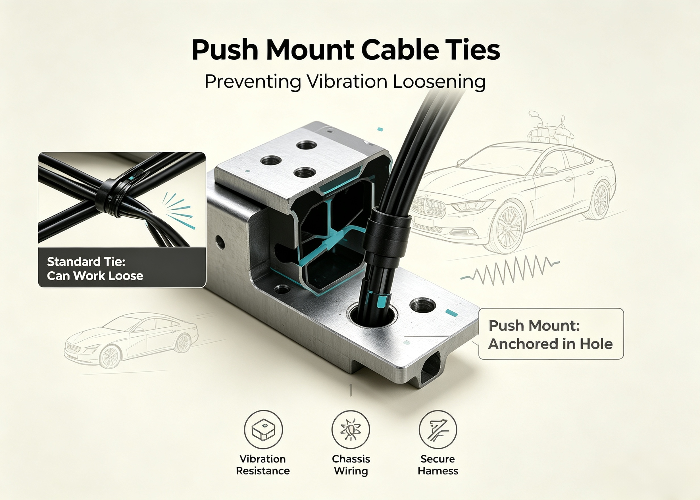
A push mount cable tie is a standard nylon tie with an integrated arrowhead molded onto the head. You push that mount through a pre-drilled hole, barbs behind the head lock against the hole wall, and the strap then cinches the bundle like any other tie. No screw, no clip, no adhesive — the tie is the fastener.
Niuli Electric makes push mount ties from 100% virgin UL-approved Nylon 66 (PA66). Specs: UL 94V-2 flammability, –40 °C to 85 °C working range, and UL, CE, RoHS, REACH, SGS certification. They come in natural and black, with hole diameters from 4 mm to 7.5 mm, bundle capacities up to 46 mm, and tensile ratings from 18 to 50 lbs (8–22 kg) by width.
Why Chassis Wiring Loosens Under Vibration
How Vibration Works Ties Loose
Vibration isn’t a single shove — it’s thousands of tiny repeating loads. Each cycle nudges a fastener a fraction of a millimeter. A screw slowly backs out of its thread; a tie looped through a bracket creeps toward the open end; a self-locking pawl inches backward and loses grip. None of it looks dramatic on day one, but over weeks of road harmonics the micro-movements accumulate until the anchor gives way.
Common Failure Modes
Fastener backing out — a screw or nut holding a clip relaxes under cyclic load.
Tie sliding — the tie shifts along an edge or rail it was looped through.
Ratchet creep — sustained vibration lets the locking pawl loosen its grip.
Abrasion — a bundle that works free rubs a sharp edge and frays the jacket.
Embrittlement — heat or UV ages a low-grade tie until it snaps.
How Push Mount Ties Prevent Loosening
Barbed Grip Inside the Hole
The arrowhead carries angled barbs that engage the inside wall of the panel hole. Once pushed fully home, pull-out becomes physically difficult without deforming the plastic. The anchor becomes part of the panel,the vibration can shake the bundle, but it can’t unscrew or unclip the point of attachment.
Captive Head = No Secondary Fastener
This is the key advantage. A conventional install needs two parts: the tie and the screw or clip that holds it. Push mount ties collapse that into one component. With no separate fastener, there’s no fastener to back out,one less failure mode at every anchor point across the harness.
Right Hole Size & Tension
The mount is engineered for a specific hole diameter (4–7.5 mm across the range). Too large and the barb can’t grip; too small and it won’t seat. Match the tie to the drilled hole, push it straight in until flush, and cinch snug. Over-tensioning stresses the head and cracks it faster than vibration would. Size the tie to the bundle: a 4.8 mm-wide tie carries far more load than a 2.5 mm one.
Head-to-Head: Push Mount vs Other Fixings
| Factor | Push Mount Ties | Standard Zip Ties | Screw Clamps | Adhesive Clips |
| Vibration resistance | Excellent | Moderate | Good* | Poor |
| Secondary fastener | None | Often needed | Yes (screw) | None |
| Install speed | Fast | Fast | Slow | Medium |
| Reusable | No | No | Yes | No |
| Best for | Panel harnesses | Bundle-to-bundle | Heavy lines | Smooth surfaces |
Screw clamps resist vibration well but fail if the screw backs out,but the exact mode push mounts eliminate. For chassis wiring where you can drill a hole, push mount ties give the ideal vibration security per dollar.
Real Uses
Automotive Chassis & Harness
Under-hood and under-body harness routing is the classic case. Push mount ties secure looms to fender liners, firewall pass-throughs, and frame rails where road shock and engine harmonics never stop. They shrug off temperature swings and oil mist while keeping sensor leads exactly where they were routed.
Control Panels & Appliances
Panel builders anchor DIN-rail wiring and keep bundles clear of live terminals inside enclosures. In appliances — washers, dryers, HVAC units — the compressor and drum deliver constant vibration; push mount ties hold the internal loom steady for years without a screw loosening.
Machinery & Enclosures
Any rotating machine transmits vibration to its frame. CNC equipment, conveyors, and pumps all benefit from push mount anchors for motor cables and sensor leads. The captive head means crews aren’t hunting for a dropped screw every time they re-route a wire.
Installation Tips That Prevent Failures
- Drill the right hole. Match the mount diameter to the tie you specified
- Push straight in. Seat the arrowhead flush and square; a cocked mount grips unevenly.
- Route first, cinch second. Position the bundle, then tension the strap.
- Don’t over-tension. Snug is enough,a tension tool prevents necking at the head.
- Size up for weight. Use a 4.8 mm or wider tie for heavy bundles and long runs.
- Double up on hot spots. Near exhausts or direct-drive motors, a second tie removes the single point of failure.
Niuli’s precision burr-free injection molds give smooth, flash-free edges, so the tie won’t cut or abrade the PVC or TPE jacket it clamps,protection that matters most under dynamic movement.
Conclusion
Push-mount cable ties are widely adopted for chassis wiring applications because they address the fundamental cause of fastener loosening—the reliance on separate, discrete fastening components. By integrating the tie and anchoring function into a single captive system, these devices eliminate both screw back-out and clip slippage, delivering robust retention with a single, cost-effective component. When specified in virgin polyamide 66 (PA66), with appropriately sized mounting holes and optimized installation tension, they maintain harness positioning precisely as routed—withstanding years of exposure to vibration, thermal cycling, and mechanical shock. As such, they represent one of the most reliable and cost-efficient fastening solutions available.
FAQ
What are push mount cable ties and how do they lock into a panel?
They’re nylon ties with an integrated arrowhead mount on the head. You push the mount through a pre-drilled hole; barbs behind the head splay against the wall and lock it. The strap then cinches the bundle like a standard tie .
Why do push mount ties resist vibration loosening better than standard zip ties?
Standard ties rely on a separate anchor (screw, bracket, or clip) that vibration can shake free. Push mount ties have no separate fastener, the tie itself is the captive anchor, so there’s nothing to back out or slip.
Can push mount ties be removed or reused?
Like most nylon zip ties, they use a one-way ratchet and aren’t designed for reuse. Removal means cutting the strap; the mount can be pushed out from behind, but the tie is spent. Pair them with reusable P-clips at service points for adjustability.
How much wire bundle can one push mount tie hold?
Niuli’s range covers bundles up to 46 mm in diameter, with tensile ratings from 18 lbs (8 kg) on the 2.5 mm width to 50 lbs (22 kg) on the 4.8 mm width. Match the width to the real bundle weight plus any vibration-induced pull.
Are push mount ties only for metal chassis, or do they work on plastic panels too?
They work on any panel you can drill a clean hole in — metal or plastic. The barb grips the hole wall, not the material type. For thin or soft plastic, pick the smallest suitable mount and confirm the panel thickness supports barb engagement.
Download Niuli Electric‘s Cable Management Product Datasheets or Request Free Factory Testing Sample Kits today.
