


Introduction
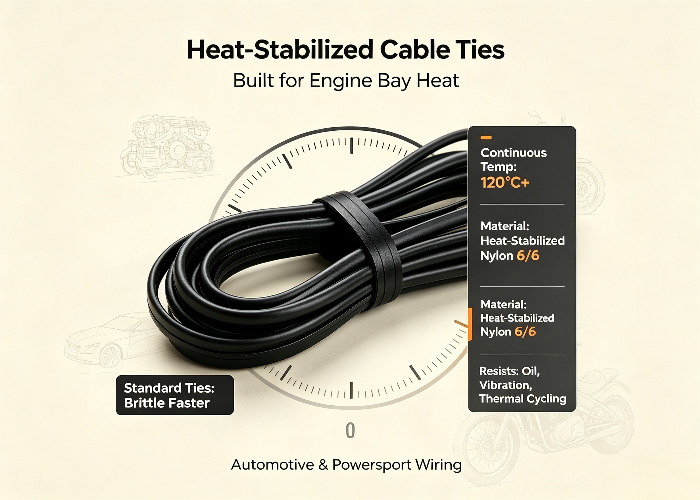
The engine bay is among the harshest environments a polymer can face. Temperatures routinely top 120 °C, while oil, coolant, fuel vapors, constant vibration, and thermal cycling eat through standard nylon 6/6 ties, often leaving them brittle and weak within one season. Automotive-grade engine bay ties, molded from heat-stabilized nylon 6/6 with superior thermal-oxidative resistance, are built to survive exactly this. This guide covers their material specs, how they outperform ordinary ties, relevant industry certifications, and installation best practices for automotive and power sport builds.
What Are the “Heat-Stabilized” Cable Ties?
Heat-stabilized cable ties are nylon 6/6 (PA66) ties that have been compounded with thermal stabilizers additives that slow the breakdown of the polymer when it’s baked at high temperature for long periods. Think of it as sunscreen for plastic. Standard nylon starts to soften and creep (slowly stretch and lose grip) around 85°C (185°F). Heat-stabilized grades are engineered to stay locked, flexible, and strong at 105°C (221°F) continuous, and to survive short spikes well beyond that.
Standard Nylon vs Heat-Stabilized Nylon
The difference isn’t the base material; it’s the recipe. Both start as PA66. Standard ties get a basic additive package for everyday indoor or light-outdoor use. Heat-stabilized ties get extra thermal stabilizers (and usually a higher-grade pigment) so the molecular chains don’t unravel under sustained heat.
| Dimension | Standard Nylon (PA66) | Heat-Stabilized Nylon (PA66) |
| Base material | 100% virgin PA66, same polymer as heat-stabilized | 100% virgin PA66, same polymer as standard |
| Additive package | Basic additive package for everyday indoor or light-outdoor use | Extra thermal stabilizers (usually a higher-grade pigment) so molecular chains do not unravel under sustained heat |
| Service temperature (Niuli spec) | -40°C to 85°C | Up to 120°C for the heat-stabilized heavy-duty variant |
| Typical use | Everyday indoor wiring, panels, light outdoor runs | Sustained-heat zones: engine bays, near exhaust headers, hot cabinets |
| Failure mode under heat | Near an exhaust header, may go brittle and snap within a few months | In the same spot, can hold for years |
| Cost | Lower cost per bag | Runs a bit more per bag |
| Value proposition | General-purpose, best for the budget | In a heat-exposed location, the premium is cheap insurance against a wiring failure |
In practice:,a standard tie near an exhaust header might go brittle and snap in a few months. A heat-stabilized tie in the same spot can hold for years. The trade-off is cost — heat-stabilized ties run a bit more per bag,but in an engine bay that premium is cheap insurance against a wiring failure.
Why Engine Bays Destroy Ordinary Ties
An engine compartment is a perfect storm. Ambient under-hood temps routinely hit 80–100°C (176–212°F) on a warm day, and localized zones — turbo housings, exhaust manifolds, cylinder heads — push far higher. Add in:
- Thermal cycling: heat up, cool down, repeat thousands of times, which fatigues plastic.
- Oil and grease: petroleum accelerates nylon degradation if the tie isn’t resistant.
- Vibration: constant shaking works ties loose or creates stress cracks at the lock.
- UV through vents (motorcycles especially): sun plus heat is brutal.
Ordinary ties simply aren’t formulated for that combination, which is why “automotive engine bay cable ties” should always mean the heat-stabilized grade.
Key Ratings to Know When Choosing Heat-Stabilized Cable Ties
Don’t just grab the first black bag. Check these specs:
- Continuous temperature rating :look for 105°C (221°F) minimum; some high-temp grades reach 120°C+.
- Flame class:UL 94V-2 is common; 94V-0 is best (self-extinguishing, no dripping).
- Material grade :PA66 with thermal stabilizers; verify virgin (not recycled) nylon for consistency.
- Tensile strength:match the tie size to the bundle weight; over-loaded ties fail at the lock.
- Certifications:UL, RoHS, REACH signal a controlled, traceable manufacturing process.
A trustworthy supplier will print or document these ratings. If a vendor can’t tell you the temp rating, that’s your answer.
Best Uses: Cars vs Motorcycles
Car Engine Bay Wiring Harness
In cars, the main harness runs along the firewall, fender liners, and intake tract. Heat-stabilized ties secure sensor leads, the ECU loom, and aftermarket amp or turbo wiring. Route them away from the exhaust side and they’ll outlast the vehicle.
Motorcycle Looms
Bikes are tougher: smaller fairings, direct engine heat, and zero insulation from road vibration. A motorcycle loom is fully exposed, so every tie takes the hit. Use heat-stabilized ties exclusively here, and double up on sections that wrap near the engine or headers.
Common Pitfalls to Avoid
- Using standard “all-purpose” ties because they were handy.
- Zip-tying a harness directly to a hot pipe instead of using a heat shield or P-clip.
- Over-tightening until the tie necks down — that’s a stress point that cracks.
- Mixing metal and plastic clamps without isolating them (galvanic issues, abrasion).
Installation Tips That Prevent Failures
A good tie installed badly still fails. Follow these:
- Route first, tie second. Keep bundles at least a few inches from manifolds and turbo housings.
- Don’t max out tension. Snug is enough; the ratchet should click, not scream.
- Support heavy runs. For long looms, add a tie every 6–8 inches so no single tie carries the load.
- Trim the tail. A flapping tail catches on belts and pulleys — cut it close.
- Use the right size. A 2.5mm-wide tie on a thick harness will creep; size up.
Done right, your automotive engine bay cable ties become invisible and you’ll only notice them when you realize the harness is still exactly where you left it, years later.
Conclusion
If your wires live under a hood or behind a bike’s side cover, standard nylon ties are a gamble you’ll lose. Heat-stabilized cable ties are purpose-built for that heat, vibration, and oil — and they’re the difference between a clean, reliable loom and a roadside wiring meltdown. Choose the right temperature and flame rating, install with a little care, and your harness will stay put for the life of the machine.
FAQ
What temperature can heat-stabilized cable ties withstand in an engine bay?
Quality heat-stabilized PA66 ties are rated for continuous service around 105°C (221°F), with short-term spikes higher. That comfortably covers normal under-hood ambient, though you should still keep them off direct manifold contact.
Are regular black nylon ties safe in a car engine compartment, or will they melt?
They won’t “melt” at typical bay temps, but standard black ties soften and creep above 85°C, going brittle and snapping within months. For anything under the hood, use heat-stabilized ties.
Are these ties flame retardant, and does that matter in a car?
Good ones are looking for UL 94V-2 or ideally 94V-0. It matters because a tie sitting near hot components shouldn’t become fuel if a small fire or spark occurs; flame-retardant grade self-extinguishes.
Will heat-stabilized ties stay tight under engine vibration?
Yes, far better than standard ties, because the stabilized polymer resists the fatigue cracking that vibration causes. Pair them with proper spacing and correct tension and they’ll hold through years of shaking.
Does tie color affect heat performance in the engine bay?
Not directly. Heat performance comes from the stabilizer package, not the pigment. Black is simply the common color for stabilized/UV grades; the rating on the bag matters more than the shade.
Upgrade Your Automotive Wire Harness Reliability with Niuli Electric.Prevent engine bay wiring failures and heat-induced brittleness. Niuli Electric manufactures UL 62275 certified, 100% Virgin PA66 heat-stabilized cable ties engineered with Factory Hydration Conditioning for extreme under-hood vibration and thermal endurance.
Download Niuli Electric‘s Automotive Cable Fastener Catalog or Request Free Technical Testing Sample Kits today.
