


Introduction
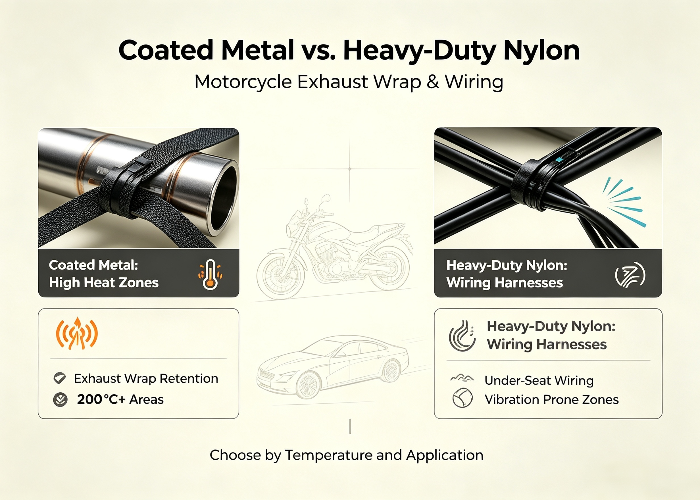
Motorcycle builders, technicians, and restorers routinely rely on cable ties as indispensable fastening tool,keeping exhaust wraps taut, securing wiring harnesses, and suppressing component vibration. However, not all cable ties perform equally under the demanding thermal, mechanical, and environmental conditions inherent to motorcycle applications. A critical engineering consideration arises when selecting between coated metal and nylon cable ties: which material offers appropriate thermal stability and mechanical integrity near high-temperature exhaust components (e.g., headers operating above 200 °C), and which remains suitable for low-temperature, vibration-prone zones such as under-seat wiring?
This guide provides a comparative technical analysis of both types, clarifying performance boundaries, failure modes, and application-specific suitability. By synthesizing material properties, thermal ratings, and real-world service data, it enables evidence-based selection,ensuring optimal fastener choice for exhaust wrap retention versus wiring harness management.
What Are Coated Metal Ties?
Coated metal ties are stainless-steel cable ties wrapped in a smooth polymer layer,usually PVC, nylon, or epoxy. The steel band (commonly 304, or 316 for marine and heavy salt exposure) carries the strength; the coating does three jobs: it protects the bundle from abrasion, it makes the tie electrically non-conductive on the outside, and it gives a clean, rounded surface that won’t cut wire jackets.
They use a self-locking ball mechanism that grips once tensioned, and most can be released and re-tensioned for adjustments. The headline advantage is heat: the coating is typically rated for continuous service around 150°C, while the bare steel itself shrugs off far higher temperatures. They also laugh off road salt, oil, brake fluid, and UV. For anything close to an exhaust, that heat ceiling is the whole ballgame.
What Are Heavy-Duty Nylon Ties?
Heavy-duty nylon ties are high-tensile zip ties molded from 100% virgin Nylon 66 (PA66)—the same UL-approved resin grades used across professional harness work (INVISTA U4820L, DuPont 101L, ASCEND 21SPC). “Heavy-duty” simply means a thicker body and a higher loop tensile strength, ranging from around 50 lbs up to 250 lbs for the biggest sizes.
Standard PA66 works from -40°C to 85°C and carries a UL 94V-2 flammability rating. A heat-stabilized heavy-duty variant pushes the working ceiling to 120°C. Two details matter for real-world installs: burr free injection molds leave smooth edges that spread clamping force evenly and protect soft PVC or TPE wire jackets, and Factory Hydration Conditioning holds the polymer at a stable 2.5%–3.0% internal moisture so the tie stays flexible through winter installs and thermal cycling instead of going brittle. All Niuli nylon ties are certified to UL, CE, RoHS, and REACH, and a black UV-stabilized version is available for sun-exposed routing.
Why Motorcycles Are Brutal on Ties
Exhaust Header Heat
A running exhaust header sits anywhere from 400°C to 700°C. Even wrapped, the radiant heat in that zone is far beyond what any nylon can tolerate. Plain PA66 softens and loses grip well before its 85°C rating is exceeded by much, and even the 120°C heat-stabilized grade will creep, sag, and eventually let go near a header. Heat is the single biggest reason ties fail on a motorcycle.
Vibration, Rain, Road Salt & UV
Engines vibrate, roads buzz, and every tie is constantly micro-shaking. A tie that isn’t fully seated or tensioned correctly walks loose over a few hundred miles. Then there’s the weather: rain and road salt corrode bare or cheap metal, while direct sunlight embrittles plain (non-UV) nylon. A tie has to beat heat, shake, corrosion, and sun all at once—which is why material choice is never one-size-fits-all.
Comparison: Coated Metal vs Heavy-Duty Nylon
| Factor | Coated Metal Tie | Heavy-Duty Nylon Tie |
| Max continuous temperature | ~150°C (coating); steel far higher | 85°C std / 120°C heat-stabilized |
| Survives exhaust-header zone | Yes | No |
| Vibration hold | Excellent, locks rigid | Good if seated; can creep under heat |
| Corrosion / rust | 304/316 stainless, salt-proof | Non-corroding polymer |
| Electrical conductivity | Non-conductive coating outside | Naturally non-conductive |
| Reusable | Yes, re-tensionable | Standard no; releasable type yes |
| Weight & cost | Heavier, higher cost | Lighter, lower cost |
| Best use | Hot zones, exhaust wrap | Cool wiring looms |
Where Each Wins
Exhaust Wrap → Coated Metal
This is the easy call. Exhaust wrap lives in the hottest, most violent environment on the bike. Only a coated stainless tie handles the radiant heat, the vibration, and the occasional oil splash without failing. Use metal here without hesitation.
Wiring Loom Away From Heat → Nylon or Metal
If your harness runs through the front fairing, under the seat, or along the swingarm away from headers, heavy-duty nylon is the smarter pick—lighter, quieter, cheaper, and more than strong enough. Choose metal only if that loom still sees serious heat or you want a permanent, tamper-proof lock.
High-Heat Near Engine → Metal
Any tie routed near the cylinders, the regulator/rectifier, or a turbo housing should be metal. The 120°C heat-stabilized nylon is tempting, but “near engine” radiant temperatures routinely blow past that. When in doubt and it’s hot, go metal.
Conclusion
There’s no universal winner in the coated metal vs nylon ties motorcycle debate,only the right tie for the location. Wrap the exhaust and anything hugging the engine in coated stainless steel. Route the cool wiring loom in heavy-duty nylon PA66 to save weight and money. The mistake to avoid is putting standard nylon where it gets hot: it will let go, and usually at the worst moment. Match the material to the heat, and your build stays tidy for the long haul.
FAQ
Can heavy-duty nylon ties handle exhaust header heat, or will they melt?
They will fail. Even heat-stabilized PA66 tops out around 120°C, while a header radiates far beyond that. For exhaust wrap, always use coated metal ties.
What are coated metal ties, and why are they coated?
They are stainless-steel bands (304 or 316) wrapped in PVC, nylon, or epoxy. The coating protects the bundle from abrasion, makes the tie non-conductive on the outside, and prevents the steel from cutting wire jackets.
Do coated metal ties conduct electricity and short the wiring?
The steel conducts, but the insulating coating fully covers it, so the outer surface is non-conductive. As long as the coating is intact, it won’t short your wiring.
Are coated metal ties reusable, and do they rust?
Yes—the self-locking ball mechanism can be released and re-tensioned. Grade 304 resists rust in normal conditions; 316 is the choice for heavy road salt or coastal riding.
Can I use the same tie type for both the exhaust wrap and the wiring loom?
You can use coated metal for both, but it’s overkill and heavier for cool looms. The efficient setup is metal on the exhaust and heavy-duty nylon on the cooler harness.
Spec Your Motorcycle Ties with Niuli Electric
Whether you’re wrapping headers or routing a clean harness, Niuli Electric builds both sides of this comparison to spec: 100% Virgin PA66 heavy-duty ties with UL 62275 compliance, Factory Hydration Conditioning, and Numerous alternatives for the hot zones.
Download Niuli Electric‘s Cable Management Product Datasheets or Request Free Factory Testing Sample Kits today.
