


Introduction
A run of facade lighting cable looks tidy on the drawing and, in my experience, stays tidy for the first season.The reason is simple but easy to miss: on a tall building the cable is not held by its own weight, it is beaten by the wind. A ground level run sees a gentle breeze; a run forty floors up sees a faster, gusting, accelerated flow that whips the cable against the wall and works every tie in tension thousands of times a year. This article sets out how wind changes the fixing problem, the five ways a facade cable run actually fails, and a practical method for routing and securing the cable so it survives the exposure.
The Hidden Stresses of High-Rise Facades on Cable Runs
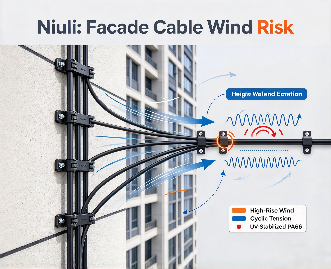
Three things make a high-rise facade harder on cabling than anyone expects. Wind speed climbs with height because the earth’s surface drag falls away as you go up, so the top of the building meets a faster mean wind than the base. The building itself then reshapes that wind: flow accelerates around corners, over parapets and past ledges, so local speeds at those edges sit well above the facade average. On top of the mean speed, gusts arrive as short, sharp spikes that reverse the load on the cable, first pushing it out, then slamming it back. None of this shows on a static load schedule, which is exactly why I have seen facade runs fail where a calm calculation said they should be fine.
Where Facade Cable Runs Fail First: Five Modes
Abrasion against the building
The cable whips in the wind and rubs on a concrete edge or a metal mullion until the jacket is cut and the conductor shows. This is the most common cause of a sudden failure after a storm.
Fatigue and slip at the fixing
A tie sees tension, then slack, then tension again. The ratchet creeps, the head cracks, or the bundle slips down the run. The load is small each time, but it reverses every gust, and that is what breaks plastic.
Fixing failure at the interface
The tie is sound but the saddle or clip it hangs from pulls out of the substrate, or it was fixed to a brittle cladding panel that gave way. The tie did its job; the thing it was tied to did not.
Water entering at the luminaire
Poor routing lets water track down the bundle into the fitting, or a tie pulled tight traps a pool of water against the gland. The cable tie is not the leak, but the routing it enforces can be.
Ageing of an under-specified tie
A cheap standard tie, dry and not UV stabilised, goes brittle in sun and wind within a season or two and snaps on the first hard gust. It was never sized for the exposure it was put in.
| Mode | What you see on site | Root cause | The fix |
| Abrasion | Jacket cut, conductor exposed | Cable whips against a hard edge | Standoff from wall, pad sharp edges |
| Fatigue and slip | Loose bundle, cracked tie head | Cyclic load reverses each gust | Size for gust tension, cyclic factor |
| Interface failure | Saddle pulled out of facade | Wrong anchor or brittle panel | Fix to structure, verify pull-out |
| Water at luminaire | Damp fitting, tracked water | Poor routing, tight trap | Seal entry, route with fall |
| Tie ageing | Brittle, snapped tie | Dry, non UV stabilised PA66 | UV-stabilised black PA66 tie |
Wind, Not Weight: The Real Fixing Sizing Criterion
The cable on a facade weighs grams per metre; the wind load on it can be many times that. Sizing the fixing from the cable’s weight is the mistake that sinks most of these jobs. The number you actually need is the design wind speed at the building’s height and exposure, taken from the local code (in the US that is ASCE 7, in Europe EN 1991-1-4) or from the project’s wind engineer because the height and the surroundings change it.
How to Secure a Facade Cable Run
- Get the design wind speed for the height and exposure from the structural or wind engineer before you size anything.
- Route the cable on a continuous support, a saddle rail or a row of clips, so the tie is a secondary restraint, not the only thing holding the run.
- Choose UV-stabilised black PA66 ties for the exposure; carbon black plus a HALS stabiliser is what keeps them from chalking and cracking in sun. Size to peak gust tension times your safety factor, and step up to Super Strong or double side teeth ties where the load is high.
- Use ties with burr-free moulds so the soft PVC or TPE jacket on the luminaire cable is not nicked at the bundle.
- Keep the cable off the wall with a standoff so it cannot abrade, and keep ties clear of sharp facade edges or pad them.
- Where gusts are extreme or the site is coastal, move to stainless steel ties.
- Seal the cable entry at each luminaire so water cannot track down the bundle.
| Exposure | Product | Why |
| Moderate height, inland | UV-stabilised PA66 tie (Anti-UV range) | Sun and gusts, no salt |
| Tall, exposed, coastal | Stainless steel tie | Salt plus high gusts, longest life |
| High cyclic load anywhere | Super Strong or double side teeth PA66 | Extra tensile headroom |
Installing Facade Cable Routing and Fixings
Survey the facade and mark the windward face, the leeward face, and the corners and parapet where flow accelerates. Fix the continuous support at code spacing, closer at the edges than along the flat face. Lay the cable with a standoff from the wall so it rides above the surface instead of against it. Secure it with UV-stabilised ties at every support, tensioned to finger tight plus one ratchet click; over-tensioning stresses the head and can crack a cold tie. Pad any point where the cable crosses a sharp edge. Seal the luminaire glands and document each fixing location so the next inspection knows what to look for.
Conclusion
Facade lighting fails from wind before it fails from weight. Read the wind speed at the height, size the tie for the gust, keep the cable off the wall, and use material that will not age out before the next inspection. Do those four things and a facade run stays put through the storms that take the under-specified ones down.
Niuli Electric manufactures cable clips, cable ties and wiring accessories from virgin PE and PA66 grades, supplied worldwide with CE, RoHS, REACH, SGS and custom material documentation.
FAQs
Why do facade lighting cable fixings fail more often than ground-level ones?
Because wind speed rises with height and the building accelerates it at corners and parapets, so a facade run takes faster, gusting, cyclic loads that a ground-level run never sees. The static weight of the cable barely changes; the dynamic wind load does.
How much wind load should a facade cable fixing be specified for?
Take the design wind speed for the building’s height and exposure from the local code or the wind engineer, then size the tie for peak gust tension with a cyclic safety factor of 3 to 5. Do not size from the cable’s weight, because the wind load dominates.
Can I fix facade lighting cables to the cladding panels?
Only if the panel and its fixings are rated for the load and the pull-out is verified. Many cladding systems are not, and a tie that is sound will still fail if the panel it hangs from gives way. Fix to the structure behind, not the panel face.
How do I stop cables chafing against the building?
Keep a standoff between the cable and the wall so the run rides above the surface, route ties away from sharp edges or pad those points, and support the cable on a continuous saddle rail so it cannot whip freely. Abrasion is a routing problem before it is a tie problem.
How often should facade lighting cabling be inspected?
At least annually and after any major storm, because a failed tie is cheap to replace but reaching it costs rope access or a platform. Inspect for jacket abrasion, tie slip, UV chalking and any water tracking at the luminaires, and replace under-specified ties before they let go.
