


Introduction
This article walks through what RoHS actually restricts in a solder wire, why “lead-free” is not the same promise as “RoHS-compliant,” the paperwork that backs a compliance claim, and the way humidity attacks lead-free solder before the iron ever touches it.
What RoHS Actually Regulates in a Solder Wire
RoHS is the EU restriction on hazardous substances in electrical and electronic equipment, set out in Directive 2011/65/EU and extended by 2015/863. It caps ten substances in any homogeneous material of a product. “Homogeneous” is the word that trips people up. It means a material that cannot be mechanically pulled apart into different compositions, so the limit applies to the alloy itself, the flux core, and the reel, each measured on its own. A product passes only when every homogeneous part stays under the ceiling.
The table lists the substances most relevant to a solder wire and their concentration limits. These are the published Directive ceilings, stated here as reference figures; confirm the current list and any local equivalent with your compliance officer before you write a spec.
| Restricted substance | Ceiling in homogeneous material |
| Lead (Pb) | 0.1% by weight (1000 ppm), with specific exemptions |
| Mercury (Hg) | 0.1% (1000 ppm) |
| Cadmium (Cd) | 0.01% (100 ppm) |
| Hexavalent chromium (Cr VI) | 0.1% (1000 ppm) |
| Polybrominated biphenyls (PBB) | 0.1% (1000 ppm) |
| Polybrominated diphenyl ethers (PBDE) | 0.1% (1000 ppm) |
| DEHP, BBP, DBP, DIBP (phthalates) | 0.1% (1000 ppm) each |
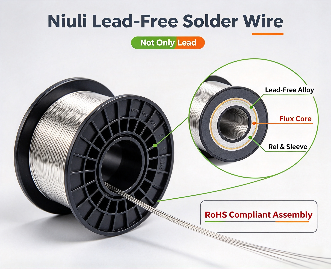
For a solder wire the substance that gets the attention is lead. A lead-free alloy keeps lead out of the metal, but RoHS is not only about lead. The flux core and any sleeve or reel material must also sit within the same ceilings. A compliant wire is a compliant assembly, not just a compliant metal.
Why “Lead-Free” and “RoHS-Compliant” Are Not the Same Claim
The two phrases describe different scopes, and buyers conflate them constantly. “Lead-free” is a statement about the alloy: the tin blend contains no intentional lead. “RoHS-compliant” is a statement about the finished product as a whole, measured against all ten substances across every homogeneous part.
A wire can be lead-free and still miss RoHS if the no-clean flux core carries a restricted phthalate plasticiser, or if the reel or the anti-tarnish wrap uses a banned brominated flame retardant. The metal passed; the rest of the bill of materials did not. Equally, a wire sold as “RoHS-compliant” is not automatically lead-free in the alloy sense where a valid exemption applies, because an exemption lets a defined lead content sit above the general ceiling in a named use. The label tells you about one scope; the compliance status is about the other. Ask for the document that covers the whole bill of materials, not just the tin.
The Paper Trail Behind a “RoHS Compliant” Label
A compliance label earns trust only when paperwork sits behind it. Three documents carry the weight, and each does a different job.
Declaration of Conformity (DoC)
The manufacturer’s signed statement that the product meets RoHS. It names the product, the directives, and usually the standards applied. It is a self-declaration. It shows intent and responsibility, not a measured result.
Third-party test report
A laboratory report with the actual measured substance values. Look for an accredited lab, a named lot or batch, the test method, and the measured result set against the limit. This is the document that proves what is in the material, provided it covers the specific lot you received and not a sister grade from a different month.
Material declaration
A full substance disclosure, often built to IPC-1752A or IEC 62474. It lists what is in each homogeneous material, including the flux and the reel. It lets you screen the whole bill of materials without waiting for a test, and it is the fastest way to catch a restricted additive before you buy.
| Document | Proves | Does not prove |
| Declaration of Conformity | The maker accepts responsibility for compliance | That this specific lot was tested or measured |
| Third-party test report | The named lot’s measured values against the limits | That every lot shares those values, or that flux and reel were sampled |
| Material declaration | What each homogeneous material contains | That the values were independently verified, or that the lot matches the declaration |
Where Humidity Attacks Lead-Free Solder Before the Iron
The compliance paperwork says the wire is fine. The workshop can still spoil it. In a humid electronics assembly area the failure usually starts in storage, not at the joint.
Oxidation
Tin forms an oxide layer on any exposed surface, and warm humid air speeds the reaction. A dull grey spool wets poorly and leaves grainy joints. The alloy was compliant on the day it shipped; the surface changed in the rack.
Flux moisture pickup
No-clean flux is hygroscopic. Left open in damp air it draws in water, then sputters and pops at the iron and leaves a weak or porous fillet. The joint looks finished and fails later under thermal or mechanical stress.
Condensation
A cold spool brought into a warm humid room hits its dew point and beads with water. The moisture sits on the wire and at the flux core, then drives both oxidation and activation problems. Temperature cycling through a day does the same thing on a smaller scale, especially near outside walls.
| Mode | What you see | Fix |
| Oxidation | Dull wire, poor wetting, grey joints | Store sealed with desiccant; use a fresh spool or light abrade the tip |
| Flux moisture pickup | Sputtering, porous fillet, later failure | Keep flux-cored wire in original sealed pack; discard opened reels after a wet season |
| Condensation | Beaded water on a cold spool | Warm the spool to room temperature inside its bag before opening |
How to Verify a Supplier’s Compliance Claim
- Request the Declaration of Conformity and the material declaration up front, before you place the order, not after a failure.
- Ask for a third-party test report that names the lot you will receive, not a generic catalogue report for a similar grade.
- Confirm the lab is accredited and the method is stated, typically XRF screening with wet-chemical ICP used to confirm a suspect result.
- Read the measured value against the limit and check the method detection limit; a “not detected” sitting below a weak MDL is not the same as a clean pass.
- Match the declared homogeneous materials to what is on the reel: alloy, flux, sleeve, and the reel itself.
- Hold one sealed reel from the lot as a reference and re-test if a batch fails incoming inspection.
Specifying RoHS-Compliant Lead-Free Solder for Humid Assembly
Write the requirement so a supplier can meet it without guessing. A workable clause reads: “Lead-free solder wire, RoHS Directive 2011/65/EU with 2015/863, tin-based alloy, CE and RoHS marked, supplied with DoC, IPC-1752A material declaration, and a lot-specific third-party test report; delivered in sealed original packaging with desiccant; store below [your humidity cap] until use.” For fine electronics pick a thin diameter such as 0.5 mm or 0.6 mm; for general through-hole work 0.8 mm to 1.0 mm covers most joints. Choose no-clean flux for controlled residues, and confirm the flux chemistry is inside the declared substance list. Keep the storage rule in the purchase order, because in a humid shop the packaging is part of the specification rather than an afterthought.
Specify RoHS-Compliant Lead-Free Solder with Niuli Electric:Contact Niuli Electric’s Soldering Accessories catalog or request free lead-free solder wire sample kits.
FAQs
What does “RoHS compliant” actually mean for a solder wire?
It means every homogeneous part of the wire, the tin alloy, the flux core, the sleeve and the reel, stays within the Directive’s substance ceilings. It is a whole-product status, not a claim about the metal alone, which is why the flux and the reel matter as much as the alloy.
Does the RoHS lead exemption for high-temperature solder apply to standard lead-free wire?
The lead exemptions in Annex III cover specific high-temperature applications and defined equipment categories, not general lead-free wire. Standard lead-free wire is made without intentional lead and does not rely on those exemptions. If a buyer ever specifies a leaded high-temperature alloy, the exemption number and its expiry date must be checked line by line against the current Directive.
What documents prove a solder wire is RoHS compliant?
A Declaration of Conformity shows the maker accepts compliance. A lot-specific third-party test report shows measured values. A material declaration such as IPC-1752A lists every homogeneous material. Together they support a claim; none of them alone is enough, because each proves a different slice of the story.
How should solder wire be stored in a humid electronics workshop?
Keep it in the original sealed pack with desiccant, inside a closed cabinet away from windows and outside walls. Warm a cold spool to room temperature inside its bag before opening so it does not condense. Do not leave an opened reel exposed through a wet season, because no-clean flux will pull moisture from the air the whole time it sits there.
Can humidity spoil the flux inside no-clean solder wire?
Yes. No-clean flux is hygroscopic and pulls moisture from damp air. The flux then sputters at the iron and can leave a weak joint that looks complete. Reseal opened reels and discard any that have sat open in a humid room for a season, since the moisture is already in the core by then.
