


Introduction
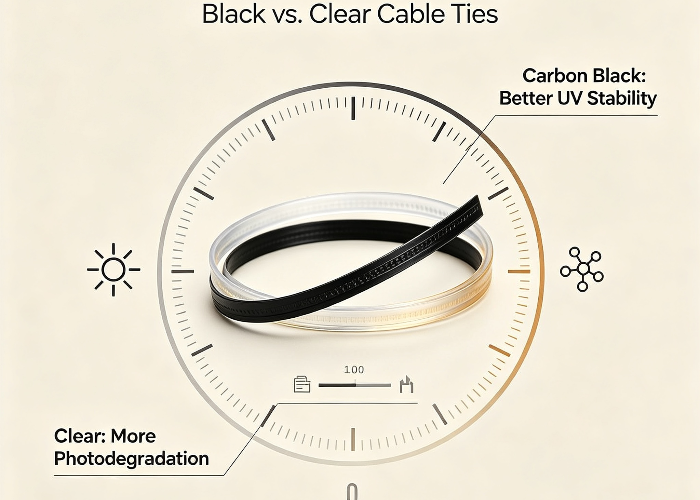
When evaluating UV resistance in cable ties, color is not merely aesthetic; it is the primary determinant of service life under outdoor conditions. Specifically, black cable ties—typically compounded with carbon black—exhibit significantly enhanced UV stability compared to their clear counterparts, which are more susceptible to photo degradation, embrittlement, discoloration, and mechanical failure over time. This guide provides a comparative analysis of material composition, elucidates the photochemical mechanisms by which pigment selection governs UV durability, presents evidence-based estimates of expected service life under typical environmental conditions, and identifies optimal application contexts for each type in exterior decorative lighting installations.
What These Two Ties Actually Are
Before we get into the science, let’s clear up what’s sitting in those bags. Both clear and black cable ties are made from nylon 6/6 (PA66) — the same tough thermoplastic used in everything from engine components to zippered hoodies. The difference is all in the additive package.
What Are Clear (Natural) Cable Ties?
Clear ties,also called “natural” ties,are essentially nylon in its raw form. With no pigment and no UV stabilizers beyond a basic package, they let light pass straight through. That transparency is exactly why they’re loved for discreet indoor bundling: on a white wall or behind a TV, you barely notice them. But that same clarity is also their weakness outside, because untreated nylon has almost no natural defense against the sun’s rays.
What Are Black Cable Ties?
Black ties are the same nylon base, but with carbon black pigment mixed in and that pigment does far more than change the color. In outdoor and UV-stabilized grades (the kind manufacturers like Niuli Electric produce with fresh, USA-imported PA nylon), black ties are engineered specifically for weather exposure. They’re the default choice for solar arrays, outdoor signage, and any installation that lives in direct sun year-round.
Why Tie Color Decides UV Life
Here’s the part most buyers never learn: UV damage isn’t about heat, it’s about photons. The sun throws out ultraviolet radiation that breaks the molecular bonds in nylon, making it brittle. Color is what stands between those photons and your tie.
The Role of Carbon Black in Absorbing UV
Carbon black is a master at soaking up UV energy. When ultraviolet light hits a black tie, the carbon particles absorb those high-energy wavelengths and dissipate them as a tiny amount of heat — instead of letting them rip apart the polymer chains. This is why quality black ties can shrug off years of sun while staying flexible. In the clear vs black zip ties UV resistance debate, carbon black is the black tie’s secret weapon, and it’s the reason “UV-stabilized” almost always means “black.”
How Clear Ties Resist UV Without Black
Clear ties can’t lean on carbon black, so they need a different shield: UV-absorbing chemical additives (like hindered amine light stabilizers, or HALS) blended into the nylon. Good manufacturers add these to give natural ties a fighting chance outdoors. The catch? Even stabilized clear ties typically still trail black ones in raw UV life, because pigment-based protection is simply more robust than an additive you can’t see.
What is “UV Life” Really Means
“UV life” isn’t a stopwatch that hits zero — it’s the point where a tie loses enough strength and flexibility to be unreliable. Outdoor nylon slowly loses tensile strength and turns chalky or brittle. A tie with “1-year UV life” won’t vanish at month thirteen; it just becomes risky to trust under tension. So when brands quote UV ratings, read them as “expected service life before noticeable degradation,” not “expiration date.” Humidity, temperature swings, and mechanical load all accelerate the clock.
Head-to-Head: Clear vs. Black UV Life
| Factor | Clear (Natural) Ties | Black (UV-Stabilized) Ties |
| Typical outdoor UV life | 6–12 months (basic); up to ~2 yrs (stabilized) | 3–5+ years in direct sun |
| Sun protection method | HALS/additive package | Carbon black pigment |
| Appearance over time | Yellows, clouds, goes brittle | Fades slightly, stays flexible |
| Best environment | Indoor, shaded, short-term | Full sun, long-term outdoor |
| Decorative look | Nearly invisible | Bold, industrial |
For anything that lives in real sunlight, black wins the longevity contest every time. Clear ties are the smart pick only when sun exposure is minimal and looks matter most.
Best Uses in Decorative Lighting
Holiday & Festival String Lights
For seasonal displays,whether it’s holiday cheer, festive gatherings, or special celebrations,lights typically shine for a few weeks to a couple of months. Clear cable ties work beautifully here: they blend discreetly with gutters and eaves, letting your lights take center stage without distraction. That said, if you live in a region with intense summer sun (like rooftop displays for Independence Day), we warmly recommend black UV-stabilized ties,they’re thoughtfully designed for lasting performance, especially when you plan to reuse them year after year.
Landscape & Garden Lighting
Path lights, deck step lighting, and shrub uplights spend the entire season basking in sunlight and that’s where black cable ties truly shine. Their UV-resistant pigment helps them stay strong and flexible all season long, while their subtle dark tone blends naturally with soil, mulch, and fixtures. Clear ties, while lovely for short-term use, may gradually yellow or weaken before the season wraps up,so for peace of mind and reliability, black is our gentle suggestion.
Solar & Signage Installations
Solar panels and outdoor signage are meant to stay put year after year,facing full sun and carrying steady loads. This is precisely the kind of demanding, long-term application black UV-stabilized cable ties were designed for. For these important installations, we kindly encourage choosing black ties: your safety, stability, and confidence matter most and every detail counts.
Conclusion: Quick Decision Guide
Still deciding? Here’s the cheat sheet:
- Full sun, long-term, outdoors → Black UV-stabilized ties. Non-negotiable for durability.
- Indoor, shaded, or short-term decorative → Clear ties. Invisible and tidy.
- Mixed seasonal use → Keep both on hand; clear for the look, black for the heat.
- Anything structural or solar → Always black.
Mastering the clear vs black zip ties UV resistance choice means your decorative lighting stays up, looks good, and doesn’t surprise you with a midnight snap.
FAQ
Do clear cable ties block UV as well as black ones?
No. Black ties use carbon black to physically absorb UV, while clear ties rely on invisible chemical stabilizers. Black almost always outlasts clear in direct sun.
How long do black vs clear ties last outdoors in decorative lighting?
Black UV-stabilized ties typically last 3–5+ years in full sun; basic clear ties often degrade within 6–12 months, with stabilized clear versions reaching about 2 years.
Which looks better for decorative lighting—clear or black ties?
Clear ties are nearly invisible and keep attention on the lights, great for clean indoor or subtle outdoor looks. Black ties read as more industrial but disappear nicely against dark fixtures and foliage.
Why do my clear ties turn yellow or cloudy after being outside?
That’s UV and oxidation breaking down the nylon and any additives. It’s the first visible sign of brittleness setting in time to swap them for black UV-stabilized ties if they’re still outside.
For indoor or shaded decorative displays, does tie color even matter?
Barely. With no real sun exposure, clear and black ties perform similarly, so choose based on looks. Clear wins for “I don’t want to see the tie” installations.
Source UV-Stabilized Cable Ties Directly from Niuli Electric
Eliminate premature outdoor tie failures in your lighting installations. Niuli Electric manufactures 100% Virgin PA66 cable ties in both high-pigment Carbon Black and HALS-stabilized clear formulations, engineered with Factory Hydration Conditioning for extreme weather flexibility.
Download Niuli Electric‘s Cable Management Product Datasheets or Request Free Factory Testing Sample Kits today.
