



- Solid concrete holds a plug by radial expansion against a drilled hole.
- Hollow brick has no back wall, so the plug must collapse behind the void to clamp.
- A collapsible (toggle) body anchors in hollow brick where expansion plugs would spin free.
- Anti-rotation fins and ribs stop the plug turning as the screw drives.
- Match plug type and drill size to the substrate or the fix fails on first load.
A wall plug looks trivial until it spins freely in a wall that will not hold a screw. The reason it fails is physics: the plug has to react the screw’s pull with a clamp or an expansion against the substrate, and hollow brick and solid concrete provide completely different things to push against. Pick the wrong mechanism and the plug just rotates in its hole.
How a Plug Actually Holds
When you drive a screw, the plug wants to (a) expand outward against the hole wall and (b) rotate with the screw. A good plug does the first and fights the second. The outward expansion or a behind-the-wall clamp is what carries the load; the resistance to rotation is what lets you tighten the screw instead of drilling the plug round.
Solid Concrete: Expansion
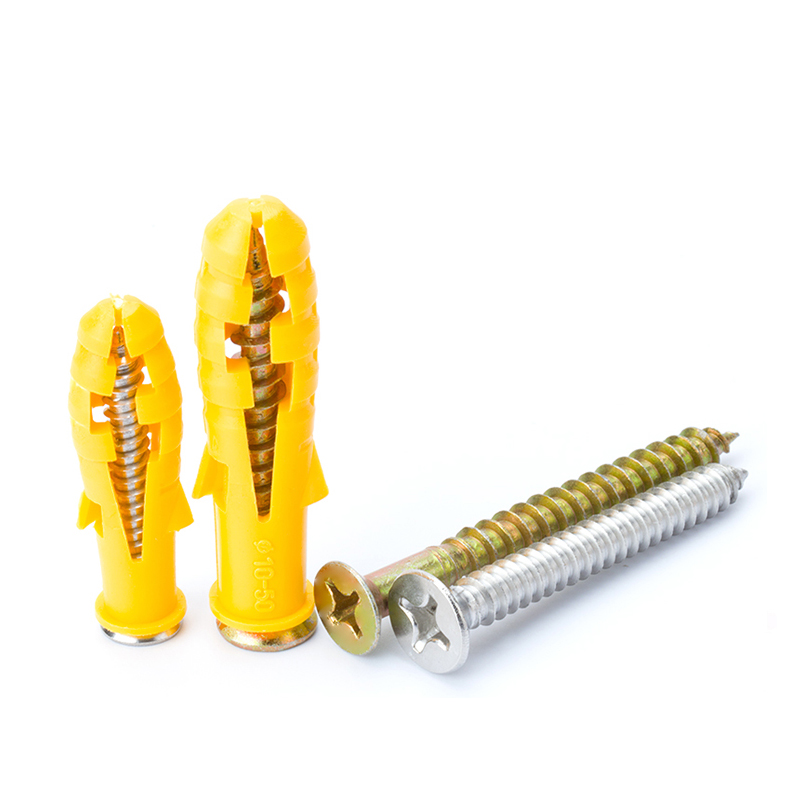
In solid concrete or dense masonry the hole has a back wall and parallel sides. A standard expansion plug is compressed by the screw and presses its ribs hard into the surrounding material, generating friction that holds the load. The deeper and tighter the hole, the more clamp force. This is the simple, reliable case — provided the drill bit matches the plug and the hole is not blown out.
Hollow Brick: Collapse Behind
A hollow brick or block has a void behind the front face. An expansion plug there has nothing to push against behind it, so it can pull straight out or spin. The fix is a collapsible-body (toggle) plug: as the screw draws in, wings or a body fold open behind the void and clamp the front face between the screw head and the toggled body. The load is carried by that clamp across the wall, not by friction in a thin front skin.
Anti-Rotation Fins
| Substrate | Holding mechanism | Plug type |
|---|---|---|
| Solid concrete | Radial expansion | Standard expansion plug |
| Dense masonry | Expansion + ribs | Ribbed plug |
| Hollow brick | Behind-wall clamp | Collapsible toggle plug |
| Plasterboard | Toggle / cavity | Cavity anchor |
Table 1. Match the mechanism to the wall.
Anti-rotation fins and external ribs do two jobs: they bite the hole wall so the plug stays put while the screw turns, and they add friction so the plug resists pull-out. Without them, a smooth plug simply rotates with the driver and never tightens. In brittle brick the fins also spread the local stress so the plug does not crush the surrounding material.
Drill Size and Depth
The drill bit diameter must match the plug: too small and the plug cannot seat (or cracks the brick); too large and it spins. Depth matters too — a plug set proud of the surface cannot expand or clamp correctly. Use the maker’s drill chart, and in hollow brick stop at the right depth so the toggle clears the void and opens behind it rather than inside the front skin.
Choosing by Substrate
Read the wall before choosing. Tap it: a dull sound suggests a void. If you are fixing into the face of a hollow block, use a collapsible toggle plug; if you hit solid material, use expansion. Mixing them up is the most common cause of a plug that will not hold, and the fix is to change the plug, not to over-tighten the screw.
Screw Selection and Torque
The plug is only half the fixing; the screw does the clamping. Use the screw diameter the plug is designed for, because a thin screw in a wide plug body leaves the clamp loose and a fat screw can split the plug. Drive to a sensible torque: enough that the plug expands or the toggle closes, not so hard that the head pulls into the wall or the plug distorts. In soft substrates, ease off the torque and let the plug mechanism do the work; in hard concrete a firm, steady drive seats the expansion. A screw that is too long punches through the back of a thin cavity and loses the clamp, so match the length to the substrate depth as carefully as you match the plug.
- Use the screw size the plug is rated for.
- Drive to seat the plug, not to bury the head.
- Match screw length to substrate depth.
- In soft walls, ease the torque to avoid distorting the plug.
Worked Example: A Partition Conduit Fix
A conduit was being fixed to a partition that sounded hollow on a tap. The installer first used standard expansion plugs, which simply spun in the void and pulled out. Switching to a collapsible toggle plug, the screw drew the body open behind the block and clamped the face; the conduit then held firm. The lesson was read the wall first: the same screw and the same load needed a different plug mechanism because the substrate had no back wall.
Common Pitfalls
- Do not use expansion plugs in hollow brick or block.
- Match the drill bit to the plug; an oversize hole spins.
- Use anti-rotation ribs so the plug does not turn.
- Do not over-tighten to fix a spinning plug; change type.
Niuli Wall Plugs
Niuli Electric supplies PP wall plugs and plastic wall plugs for concrete and masonry, with the rib and fin geometry that stops rotation and the sizes that match standard masonry bits.
Quick Selection Checklist
- Solid concrete holds a plug by radial expansion against a drilled hole.
- Hollow brick has no back wall, so the plug must collapse behind the void to clamp.
- A collapsible (toggle) body anchors in hollow brick where expansion plugs would spin free.
- Anti-rotation fins and ribs stop the plug turning as the screw drives.
- Match plug type and drill size to the substrate or the fix fails on first load.
Frequently Asked Questions
Why does my plug spin in brick?
Likely a hollow void; an expansion plug has nothing to clamp behind it.
What plug for hollow brick?
A collapsible toggle plug that opens behind the void.
Do fins really matter?
Yes, they stop the plug rotating while you drive the screw.
What if the hole is too big?
The plug spins; redrill or use a larger plug, do not over-tighten.
Concrete or brick drill bit?
Match the plug size from the maker chart; masonry bit for both.
Why tap the wall first?
A hollow sound means a void and you need a toggle plug.
Can I use one plug for both?
No; expansion fails in hollow, toggle is weak in solid. Choose by wall.
Will over-tightening help?
No, it strips the hole; change the plug type instead.
How deep should I drill?
To the plug length so it seats fully and can expand/clamp.
Are Niuli plugs ribbed?
Yes, with anti-rotation ribs and fins for a solid bite.
Related Resources
Match the plug to the wall — send the substrate and load and we will specify plug and drill size.
