


Introduction
In electrical installations, the cost of misidentified wiring surfaces long after the panel is closed, during commissioning, routine maintenance, or an emergency shutdown, when a crew has only seconds to confirm which conductor is live. In control cabinets, panel boards, and machine harnesses, dozens of identical bundles routinely run side by side with no intrinsic way to distinguish power, signal, earth, and control at a glance. Color coded electrical cable ties address this directly: by assigning a defined color to a circuit function, they extend the conductor’s own identification scheme to the bundling layer, converting visual sorting from interpretation into routine procedure.
What Are The Color-Coded Ties
Color-coded cable ties are standard nylon zip ties produced in specific, consistent colors so the tie itself carries meaning. At Niuli Electric they are moulded from 100% virgin UL-approved Nylon 66 (PA66) using burr-free injection molds that leave smooth, rounded edges, and they can be produced in any color against an RGB or Pantone sample. The tie does the same mechanical job as a black tie,bundling and securing,but it also broadcasts a category at a distance, before anyone reads a label.
It helps to separate two ideas. A “colored” tie is any tie in a non-black color, often chosen for branding or simple grouping. A “color-coded” program is deliberate: each color is assigned a defined meaning in a documented legend, and that meaning is enforced across a site. The hardware is identical; the discipline is what makes it identification rather than decoration.
Why Color-Code Wiring at All
Faster ID, Fewer Miswires
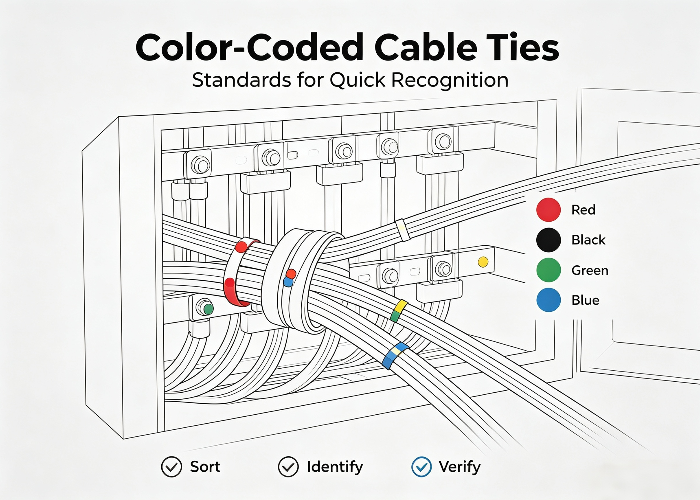
A red tie on a power run and a blue tie on a data run remove the single biggest cause of field mistakes: guessing which cable is which. During first install, teams route the right cable to the right terminal the first time, which means fewer rework loops and fewer crossed connections that only show up under load.
Troubleshooting & Maintenance Speed
When something fails at 2 a.m., color does the heavy lifting. A technician can isolate a circuit, a phase group, or a hazard line by sight, cut diagnostic time, and get the system back online faster. In shared or multi-contractor sites, a documented color plan also keeps every crew on the same page.
The Safety Standards Behind Colors
Here is the nuance that matters: the tie color follows the wire’s color code, not a separate “tie” standard. In most regions, conductor identification traces back to schemes such as IEC 60445 (equipment terminals) and local wiring rules like the NEC in the U.S., which assign meaning to insulation colors — green/yellow for protective earth, and so on. A colored tie is a secondary visual aid that should mirror those codes so nobody is misled. It is not a substitute for the conductor’s own insulation color or for proper labeling.
Common Color Schemes
Phase / Circuit Colors
In three-phase work, ties often track phase identity,for example ,brown/black/grey for L1/L2/L3 under IEC practice, or the red/black/yellow commonly seen in North American single and split-phase setups. Keeping the tie color aligned with the phase color prevents cross-phase connections that can trip breakers or unbalance loads.
Earth & Hazard Marking
Green or green-and-yellow ties flag protective earth and grounding conductors, while a bright yellow or orange tie can mark a hazard, a high-voltage run, or a do-not-disturb circuit during maintenance. The goal is instant recognition of the wires you must treat with respect.
Low-Voltage & Custom
Blue is widely used for signal, data, and low-voltage control; white or grey for neutral; and custom Pantone colors for OEM-specific schemes. Because Niuli can match any RGB or Pantone color, fleets and product lines can lock in a proprietary coding system that competitors cannot accidentally replicate.
Marking Methods
Color is one tool,combining it with text closes the loop. Here is how the main marking methods stack up.
| Method | What it shows | Best for | Limitations |
| Color-coded tie | Function / category at a glance | Fast visual grouping | No specific ID (e.g. circuit No.) |
| Marker / write-on tie | Color + handwritten label | Unique IDs per cable | Handwriting legibility varies |
| Heat-shrink sleeve | Printed text on the wire | Permanent, neat ID | Applied before termination |
| Flag / tag | Hanging printed label | Large, distant reading | Bulky in tight bundles |
For most electrical panels, a color-coded tie plus a marker tie (written with a permanent cable-tie pen) gives the best balance of speed and specificity.
Best Practice & Pitfalls
Construct a concise, one-page color legend and affix it inside the equipment enclosure. Maintain strict consistency between tie colors and the established conductor insulation color-coding standards. Exercise caution when selecting colored ties for outdoor use: unlike black UV-resistant ties, most colored ties lack equivalent UV stability—refer to the accompanying caveat. Never rely solely on color to convey safety-critical information; always supplement color coding with durable labels and the wire’s native insulation color. Avoid unnecessary complexity: a limited set of carefully selected, high-contrast colors is more effective and more reliably recalled than an expansive, visually overloaded palette.
Practical illustration: A small HVAC contractor may adopt red for 240 V power feeds, blue for low-voltage thermostat and control circuits, green for equipment grounding conductors, and yellow for circuits under service lockout/tagout. Printing this scheme on a laminated reference card mounted inside the panel door and delivering a single, standardized training session to all technicians that ensures immediate operational clarity. The resulting efficiency gains and risk reduction typically yield a measurable return on investment during the first emergency response. Crucially, it is procedural discipline,not the physical tie that ensures both safety and speed.
Conclusion
Color coded electrical cable ties are a low cost, high impact upgrade to any wire identification program. They speed installation, slash miswires, and make maintenance safer — provided the colors track recognized wiring codes and are backed by labels and a shared legend. Used this way, they turn a tangle of look-alike bundles into an organized, readable system.
FAQ
Do color-coded cable ties meet electrical wiring color standards?
The ties themselves don’t set the standard; they should mirror the conductor color codes already required by local rules. Used that way, they support compliance and readability rather than replace it.
What do the different tie colors mean for wiring?
Meaning is assigned by your documented scheme ,commonly red for power, blue for data/low-voltage, green or green-yellow for earth, yellow/orange for hazard. The tie color should match the wire’s function so the message is consistent.
Can I rely on a colored tie instead of the wire’s insulation color?
No. A colored tie is a secondary aid only. The conductor’s own insulation color and any required labeling remain the authoritative identification; the tie reinforces them visually.
Are colored ties still UV-resistant and flame-retardant like black ones?
Niuli’s colored ties use the same UL-approved PA66 base with UL 94V-2 flammability and a -40°C to 85°C range, so flame retardancy matches the black ties. UV resistance depends on the grade for sustained outdoor sun, specify a UV-stabilized variant, as carbon-black loading is what gives black ties their edge.
Is there an official standard for which tie color means what?
There is no single official “tie color” standard. Meaning comes from the wiring color codes in force plus your own documented legend. The key is consistency across a site and alignment with the conductor codes, not a universal tie-color chart.
Niuli Electric manufactures color coded electrical cable ties from 100% virgin UL-approved PA66, produced under Factory Hydration Conditioning (stable 2.5%–3.0% internal moisture for lasting flexibility) and compliant with UL 62275, UL 94V-2, CE, RoHS, and REACH. Our Colorful Cable Ties are made in any RGB or Pantone color you specify, and our Marker Cable Ties add a write-on surface for unique cable IDs — the same spec-grade nylon trusted in panels, racks, and control cabinets.
