



Introduction
Inspection windows open and close with minimal notice; and the same distribution boards serve successive trade contractors on a weekly basis. Under such dynamic conditions, permanent one-way cable ties become an operational liability,each modification necessitates cutting, discarding, and re-supplying new ties. Consequently, the choice between releasable and standard cable ties is not merely theoretical; it directly impacts labor efficiency, material waste, and the speed and cleanliness of site demobilization. This article compares both tie types across three key dimensions mechanism of operation, static and dynamic holding performance, and normalized cost-per-use—and then analyzes why releasable ties are routinely preferred on temporary construction sites, while identifying specific scenarios where standard ties remain technically and economically justified.
What Is a Releasable Cable Tie?
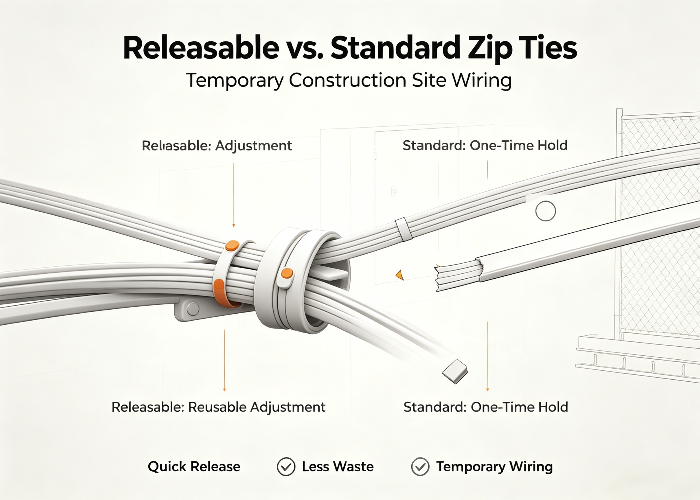
Releasable cable ties are designed with an integrated release tab built into the locking head. Unlike one-time-use alternatives, they can be loosened, adjusted, removed, and reapplied multiple times without damaging the tie itself or the bundled material.An be released and reused for multiple installation cycles depending on the design and operating conditions.
Constructed from high-grade nylon 66 (the same base material as most standard ties), releasable variants feature a modified pawl-and-ratchet mechanism. Pressing the release lever disengages the locking teeth, allowing the strap to slide back out freely. This design makes them ideal for temporary bundling, prototyping, maintenance work, and any application where cables or hoses may need re-routing over time.
Premium releasable cable ties are available in UV-stabilized and heat-resistant formulations, supporting both indoor and short-term outdoor deployment. They are available in miniature, standard, and heavy-duty widths to match different load requirements.
What Is a Standard Cable Tie?
Standard cable ties commonly referred to as zip ties, self-locking ties, or permanent cable ties,which are the most ubiquitous fastening solution in industrial and commercial settings. They operate on a simple, irreversible ratchet mechanism: once the serrated strap is pulled through the head, the locking pawl engages and cannot be released without cutting the tie.
Standard cable ties are valued for their low unit cost, consistent tensile strength, and fast, foolproof installation. They are manufactured in bulk from nylon 66, with options for UV stabilization, heat resistance, and flame retardancy for specialized environments. Because they lack a release mechanism, their locking head is more compact and structurally uniform, making them suitable for permanent, high-vibration, and outdoor permanent installations.
Available in a vast range of lengths, widths, colors, and load ratings, standard cable ties are the default choice for permanent bundling, wire harness assembly, and high-volume production lines where reusability is not required.
Releasable vs. Standard: The Core Comparison
| Factor | Releasable Cable Tie | Standard Cable Tie |
| Locking mechanism | Release tab disengages the pawl | One-way ratchet, irreversible |
| Reuse | Yes — dozens of cycles | Single-use |
| Holding strength (same width) | Slightly lower, small head tradeoff | Slightly higher, very consistent |
| Removal | Finger-press release, no tools | Must be cut |
| Cost-per-use | Lower across multiple cycles | Lower for one-shot bulk use |
| Best fit | Temporary, adjustable, service work | Permanent, high-volume installs |
Why Temporary Construction Sites Favor Releasable Ties
Phased wiring & fit-out changes
A site’s power map shifts as trades move in. Releasable ties let electricians re-route temporary feeders and sub-circuits without cutting and re-supplying each time, keeping the bundle tidy through every phase change.
Frequent inspections
Inspectors and supervisors need to open bundles to verify conductor sizing, connections, and labeling. A releasable tie opens and closes in seconds, so the harness can be inspected and re-secured without consuming a fresh tie on every visit.
Equipment & temp power that moves weekly
Temporary distribution boards, welders, pumps, and site lighting relocate as work fronts advance. Releasable ties travel with the equipment that secure it on Monday, release and move it on Thursday, re-secure on Friday instead of burning through boxes of disposables.
“Leave-no-trace” demobilization
At handover, cut standard ties leave stray strap ends and plastic waste around conduits and trays. Releasing ties removes the bundle cleanly with no offcuts, supporting a tidier demob and less site debris to clear.
When Standard Ties Are Still the Right Call
Releasable is not universal. For permanent connections that final panel terminations, fixed tray routes, and any circuit that will not be touched again the standard tie’s marginally higher and more consistent strength, lower unit cost, and tamper-evident lock make it the better choice. On long-term outdoor permanent runs, a UV-stabilized black standard tie is also the more economical permanent fix. The pragmatic site keeps both: releasable for the moving, temporary layer, standard for the permanent layer it eventually becomes.
Best Practices for Temporary Site Wiring
Tension with a tool; don’t over-cinch
Use a tensioning tool with a preset force rather than hand-pulling. Over-tightening can deform the head and fatigue the pawl on a releasable tie, shortening its reuse life and risking damage to soft PVC/TPE jacketed site cable.
Color-code by phase/circuit for quick re-identification
Assign a consistent color to each phase, circuit, or trade and document it. When a bundle is released and re-run weekly, color-coding keeps re-identification fast and prevents mistermination during re-energization.
Inspect reusable ties for head wear before reusing
Before each re-use, check the pawl and teeth for wear, cracking, or UV chalking. A tie that no longer seats fully can slip under load that retire any that show head damage rather than gamble on a temporary live circuit.
Remove by releasing, not cutting, to avoid nicking adjacent cables
Cutting a tie buried in a dense temporary bundle risks scoring neighboring conductors with the blade. Releasing leaves the adjacent cables untouched and keeps the tie in the reusable pool.
Conclusion
For temporary construction site wiring, the releasable cable tie earns its place because the site is never static:,phases change, inspections recur, and temp power moves weekly.
FAQ
How do releasable cable ties actually unlock — what’s the mechanism?
A release tab inside the locking head lifts the pawl off the serrated strap when pressed. With the pawl clear, the strap slides back out freely. No cutting or tools are needed, and the tie can be re-closed and reused.
Can a releasable tie hold as tightly as a standard one, or does it slip?
At the same width and PA66 grade, a releasable tie holds slightly less than a standard tie because the release mechanism reduces effective tooth contact area in the head. Used within its rated loop tensile strength, it does not slip; the difference is small and well within margin for temporary site loads.
Are releasable ties reusable forever, or do they wear out?
They are reusable, not infinite. Repeated release cycles, load, UV exposure, and temperature all wear the pawl and teeth. Inspect the head before each re-use and retire ties that show cracking, chalking, or incomplete seating.
On a construction site, when should I use standard instead of releasable?
Use standard ties for any final, permanent connection,such as panel terminations, fixed tray routes, and long-term outdoor permanent runs where you want maximum consistent strength, lowest unit cost, and a tamper-evident lock that will not be reopened.
Do releasable ties cost a lot more than standard ones?
The unit price is higher, but cost-per-use is usually lower on a temporary site because one releasable tie replaces many disposables across phases, inspections, and equipment moves while also cutting plastic waste and re-supply trips.
Download Niuli Electric‘s Temporary Site Wiring Catalog or Request Free Temporary Site Wiring Sample Kits today.
