


Introduction
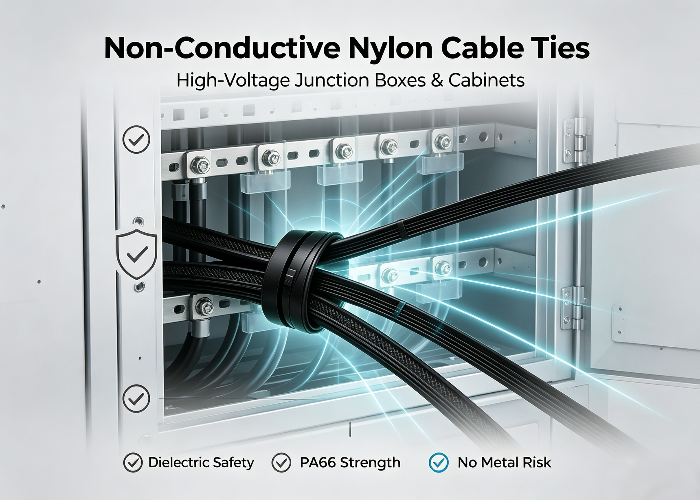
Step inside any high-voltage junction box, energized distribution cabinet, or live switchgear assembly, and one under recognized hazard often goes unseen: a stray metal fastener poised to bridge two live conductors and trigger a catastrophic short circuit.Nylon 66 (PA66) cable ties deliver the robust, reliable mechanical retention of a standard zip tie, paired with the dielectric insulating performance required for energized electrical environments. That unique balance of strength and electrical safety is exactly why PA66 ties have become the default fastening solution across high-voltage enclosures, MV switchgear builds, and electric vehicle charging infrastructure.
Why Conductivity Is the Real Risk in HV Enclosures
Inside a junction box or cabinet, conductors run at tight spacing with little air clearance. A stray metal clamp, an unshielded stainless tie, or a loose screw can sit millimeters from a live busbar. At low voltage a tiny accidental contact is a nuisance; at hundreds of volts it is an arc, a short, and a trip that can cascade into equipment damage or fire. The danger is rarely the tie doing its job,it is the tie becoming an unintended conductor. That is the core reason specifiers reach for nylon rather than metal inside energized enclosures.
Consider the failure chain. A coated stainless tie looks safe until a tool nick damages the coating during installation,now a conductive band sits next to a 400 V busbar. A carbon-black-filled “heavy-duty” nylon tie may look identical to a standard one yet carries enough conductivity to complicate creepage design. Even a dropped steel screw, if a metal tie holds it in place, becomes a permanent hazard. None of these scenarios happen with a clean, unfilled virgin PA66 tie. Removing conductivity from the bill of materials is cheaper and more reliable than adding insulation later.
What Makes Nylon Non-Conductive
Nylon 66 is a semicrystalline thermoplastic polymer. By nature it is a high-resistance insulator, not a conductor: there is no free electron path through the molecular chain, so current does not flow through the tie body. That gives it a useful dielectric strength that helps prevent accidental contact between a secured bundle and nearby live parts.
Material quality matters more than people assume. Niuli Electric moulds its ties from 100% virgin UL-approved PA66 resins,grades such as INVISTA U4820L, DuPont 101L, and ASCEND 21SPC,using hot-runner injection with burr-free injection molds that leave smooth, rounded edges. Cheap regrind or carbon-filled blends can quietly raise conductivity and defeat the insulation you specified. For electrical duty, only clean, unfilled virgin nylon should be used.
Dielectric behavior is what sets it apart from a metal fastener. A nylon tie does not just avoid conducting,its high bulk resistivity means it resists surface tracking under normal electrical stress, so a bundle routed near, but not touching, a live terminal stays safely isolated. That is why electrical specs call for listed cable-management products rather than hardware-store ties of unknown filler content.
The Humidity Caveat
Here is the part beginners miss. Nylon is hygroscopic,it absorbs moisture from the air. In a dry cabinet that is fine; the tie stays a confident insulator. But in humid or wet environments, absorbed water can raise surface leakage current and, over long exposure, encourage tracking along the surface. The fix is not to avoid nylon but to respect its moisture behavior: keep ties within rated conditions, avoid continuous immersion, and where the enclosure sees real humidity, pair good ventilation with proper creepage and clearance design. Niuli’s Factory Hydration Conditioning keeps internal moisture at a stable 2.5%–3.0% so ties stay flexible rather than brittle,but that is about mechanical life, not a license to ignore wet-duty limits.
Comparison: Tie Types for HV
| Factor | Metal / Stainless Tie | Carbon-Filled Nylon | Standard PA66 (Virgin) |
| Electrical insulation | Conductive — needs coating | Reduced (additive conductive) | Non-conductive |
| Risk inside live box | High if coating scratched | Moderate | Low |
| Humidity behavior | Corrodes / rusts | Stable | Hygroscopic — manage |
| Temperature | High | Good | -40°C to 85°C (120°C HS) |
| Best HV use | Exhaust / exterior only | Avoid in live enclosures | Inside enclosures |
For work inside energized enclosures, virgin PA66 is the clear winner. Metal belongs outside, away from live parts.
Where to Use Them
HV Junction Boxes & Switchgear
Route and secure control wiring, sensor leads, and secondary circuits inside junction boxes and switchgear without introducing a conductive path. Virgin PA66 ties keep bundles tidy and away from bus bars. In switchgear, where maintenance staff work close to exposed terminals, the absence of any conductive fastener is a quiet but real safety upgrade.
Panel boards & Distribution
In panel boards and distribution boards, nylon ties organize branch circuits and neutral assemblies. Their UL 94V-2 flammability rating and smooth, burr-free edges protect soft PVC/TPE insulation from abrasion during thermal cycling. Because the tie itself cannot bridge phases, a tidy panel stays a safe panel even after years of load swings and vibration.
EV Charging & Solar Combiner
EV charging stations and solar combiner boxes sit outdoors and see both voltage and weather. Non-conductive nylon ties manage DC and comms cabling safely; just apply the humidity caveat and keep spacing to spec.
Conclusion
Non-conductive nylon cable ties are the safe, practical choice for securing wiring inside high-voltage junction boxes and cabinets. They remove the metal fault path, hold firmly under vibration, and stay insulating under normal conditions that provided you use clean virgin PA66, respect the humidity caveat, and keep creepage distances to design.
FAQ
Are nylon cable ties actually non-conductive and safe around live high voltage?
Yes,virgin nylon 66 is an insulating polymer that does not conduct electricity under normal conditions and offers useful dielectric strength. It is a cable-management component, not a substitute for a rated insulation system, so always maintain proper clearance.
Why use nylon instead of metal ties inside a junction box?
Metal ties can become an unintended conductor if their coating is scratched or they touch a live part, creating a short or arc. Nylon ties add no conductive path, eliminating that failure mode entirely inside energized enclosures.
Does nylon stay insulating when it gets wet or humid?
Largely yes, but nylon is hygroscopic. Absorbed moisture can raise surface leakage and, over time, invite tracking in continuously wet conditions. Manage humidity, ensure ventilation, and follow creepage design.
Can nylon ties handle the heat inside a loaded HV cabinet?
Standard PA66 is rated -40°C to 85°C, with heat-stabilized heavy-duty variants to 120°C. Most indoor HV enclosures stay within that band; for sustained high-heat zones, spec the heat-stabilized grade.
Will nylon ties develop tracking or creepage over time near high voltage?
Clean virgin nylon resists tracking under normal, dry-to-moderate conditions. The risk rises with sustained humidity, contamination, and ignored clearance. Spec UL 62275-compliant ties, keep surfaces clean, and respect creepage distances.
with Niuli Electric
Niuli Electric manufactures non-conductive nylon cable ties from 100% virgin UL-approved PA66, produced under Factory Hydration Conditioning and compliant with UL 62275, UL 94V-2, CE, RoHS, and REACH — the same spec-grade ties trusted inside junction boxes, switchgear, and EV charging builds worldwide.
Download Niuli Electric‘s Non-Conductive Nylon Cable Ties Catalog or Request Free Non-Conductive Tie Sample Kits today.
