
 Introduction
If you have ever removed last season’s Christmas lights and discovered a handful of brittle, discolored zip ties, you are already familiar with the issue: standard nylon degrades rapidly under ultraviolet (UV) radiation. For landscape lighting installations, seasonal festival displays, and permanent garden lighting systems, the choice of cable tie directly influences whether wiring remains secure for a single season or reliably endures for a decade. This guide examines the material science behind UV resistance in cable ties, provides a comparative analysis of key polymer formulations, and identifies the most suitable UV-stabilized cable ties for demanding outdoor lighting applications.
What Are UV-Resistant Cable Ties?
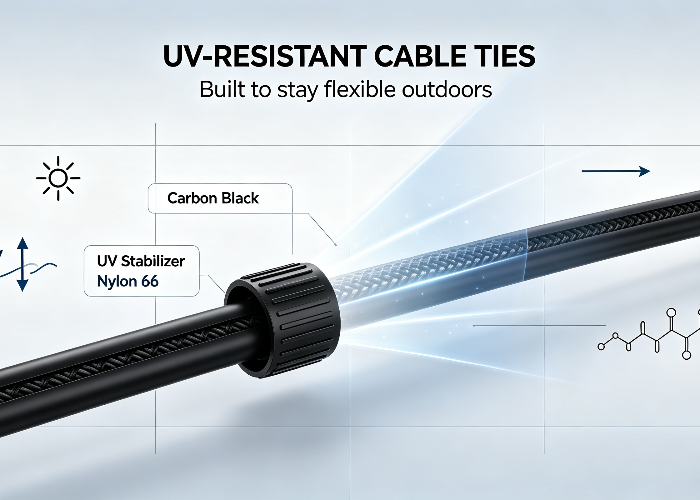
UV-resistant cable ties are zip ties engineered to survive constant sunlight instead of crumbling under it. The standard nylon tie you grab from a hardware drawer is made from Nylon 66 with only about 1% carbon content — fine indoors, useless in a flowerbed. A true UV-stabilized tie is formulated with at least 2% carbon black (or an equivalent UV-stabilizer package) blended into 100% fresh Nylon 66. That additive soaks up ultraviolet radiation and shields the polymer chains, so the tie stays flexible and keeps its grip instead of going brittle.
Beyond UV stabilizers, low-temperature brittleness prevention is essential for seasonal longevity. Niuli’s ties undergo Factory Hydration Conditioning, maintaining a precise 2.5%–3.0% internal moisture content. This prevents polymer dry-out, ensuring the ties remain flexible and dynamic without cracking during sub-zero winter installations or severe thermal cycling.
Why Regular Zip Ties Fail Outside
Plain nylon degrades because UV photons break the molecular bonds in the polymer. Outdoors, three things accelerate it:
- Direct UV load — south-facing runs and rooftops take the harshest dose.
- Heat cycling — daytime expansion and nighttime contraction work the lock head.
- Moisture and pollution — salt air and chemicals speed surface cracking.
A non-UV tie can turn white, chalky and snappy in a few months to a couple of years. When it lets go, your low-voltage cable drops, your fixtures sag, and you’re back on a ladder. For paid landscape contracts, that’s a callback you can’t bill for,and a reputation hit you don’t want.
What Makes a Cable Tie “UV-Resistant”?
Material: Nylon 6/6 vs Stainless Steel vs UV-Stabilized Compound
- Nylon 66 (UV-stabilized): the everyday winner for lighting. Cheap, insulating, and with 2% carbon black it shrugs off years of sun.
- Stainless steel (304/316): the heavy hitter for coastal, high-salt or corrosive sites. Decades of life, but pricier and conductive — not ideal near live low-voltage joints without sleeving.
- UV-stabilized compound (white/custom): same nylon base plus HALS/UV-absorber additives instead of carbon black. Still weathers well, just a shorter outdoor life than black.
UV Rating & Temperature Range
Look for a stated working range, not just a “weatherproof” sticker. Niuli’s UV ties run −40°C to 85°C, with extended builds up to 120°C. Black versions are rated roughly 5–10 years outdoors; natural/white a bit less because they carry less carbon. For true peace of mind, ask the supplier for an accelerated-weathering report (ASTM G154/G155 hours to specified tensile loss) — a serious maker will have one, and it separates real UV ties from dyed impostors.
Tensile Strength & Width
Bigger bundle means a wider tie. A 4.8 mm tie handles light string runs; pathway and signage bundles want 7.6 mm or wider. Width also spreads clamping force so you don’t dent the cable jacket. Match the tie’s rated tensile to the real load plus wind pull, not to the lightest thing you can get away with.
To prevent wire damage during high-tension bundle cinching, Niuli utilizes precision burr-free injection molds. The smooth, flash-free edges distribute clamping force evenly, protecting soft PVC and TPE landscape wire jackets from being cut or abraded during installation and dynamic wind movement.
Locking Type: Indoor vs Outdoor Grade
Both feature a unidirectional ratchet head; however, true outdoor-grade cable ties incorporate UV-stabilized compounds in both the strap and the head—not solely in the strap. A cable tie with UV-stabilized material in the strap but an unstabilized (conventional) head is prone to premature failure at the locking mechanism, precisely where mechanical stress and tensile load are concentrated. To ensure long-term site compliance and peace of mind, specify ties from manufacturers with verified quality control. Niuli’s UV-resistant ties strictly conform to international cable management standards, including UL 62275, UL 94V-2 flammability ratings, CE, RoHS, and REACH compliance.
Top Picks at a Glance
| Tie | Material | Best for | Outdoor life |
| Niuli Anti-UV Black | Nylon 66 + 2% C-black | Landscape, holiday, solar | 5–10 yrs |
| Niuli UV White / Custom | Nylon 66 + stabilizer | Aesthetic light installs | 3–7 yrs |
| Niuli 304 / 316 SS | Stainless steel | Coastal, signage | 10+ yrs |
Best UV-Resistant Cable Ties: Detailed Reviews
Niuli Anti-UV Black Cable Ties (NLZD) — The default pick. 100% fresh imported Nylon 66, ≥2% carbon black, UL 94V-2, −40 to 85 °C. Sizes from 4×100 mm up. It holds string lights and conduit firmly, stays black and flexible for seasons, and reads as a clean “industrial” finish on dark wiring. Pros: best price-to-life, fully insulating. Cons: not the right call for highly corrosive coastal runs without stepping up to steel.
Niuli UV-Stabilized White & Custom Colors — Same nylon base, HALS stabilizer instead of carbon. Choose it where black clashes with the fixture or the brief calls for a near-invisible tie. Slightly shorter sun life; ideal for visible, design-led installs where looks matter as much as longevity.
Niuli 304 / 316 Stainless Steel Ties — For sea spray, chemical plants, and permanent signage. Reusable, decades of service, and untroubled by UV entirely. The trade-off is cost and conductivity, so keep them clear of live terminals or sleeve the ends.
How to Match Ties to Your Project Type
Landscape & Pathway Lighting Contracts
Use 4.8–7.6 mm black UV ties. Bundle along the low-voltage wire every 12–18 inches, keep tension modest, and you get a clean, long-lived run the client won’t call you back about. It’s the install that sells the next contract.
Holiday / Festival Large-Scale Displays
Volume is the game. Standardize on black anti-UV ties, mix 4.8 mm for strings and 7.6 mm for frames, and tension with a tool for speed. Reusable steel isn’t worth it here — nylon is cheaper and the display comes down anyway, so buy for the season, not for eternity.
Solar racking and signage in salt air? Step up to 316 stainless, or at least verify the nylon tie’s UV and corrosion rating. Solar string runs do fine on black nylon; the racking clamps near the roof edge, where heat and spray meet.
FAQ
Black UV-stabilized nylon vs. stainless steel: which is better for outdoor lighting?
For most lighting, black UV nylon wins on cost and insulation. Choose 304/316 stainless for coastal, high-salt or corrosive sites where polymer ties eventually degrade. Stainless costs more but can outlive the installation.
How do UV-resistant cable ties actually resist sunlight?
Carbon black (or HALS stabilizers) absorbs UV photons before they can break the nylon’s polymer chains, keeping the tie flexible and strong instead of brittle. That’s why black ties lead on weather ability.
Can I use UV-resistant ties for solar panels, holiday lights, and landscape lighting?
Yes,black UV nylon suits all three. For solar racking in harsh conditions, pair it with stainless at the most exposed clamp points to cover the worst-case spots.
Do UV-resistant ties stay flexible in extreme cold and heat, and can they be reused?
They stay flexible from about −40 °C to 85 °C (up to 120 °C extended). Like most nylon zip ties they use a one-way lock and aren’t built to reuse; stainless versions are resealable if you need adjustability.
How tight should I tension UV-resistant ties outside?
Use a tension tool, leave a little slack for thermal movement, and never over-cinch,over-tightening cracks the head faster than the sun ever will. Correct tension, not the UV rating, decides real-world life.
Upgrade Your Outdoor Lighting Reliability with Niuli Electric Avoid costly contractor callbacks and winter tie failures. Niuli Electric manufactures UL 62275 certified, 100% Virgin PA66 UV-stabilized cable ties engineered with factory hydration technology for multi-year outdoor endurance.
