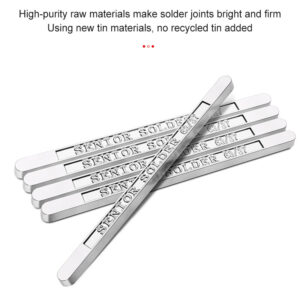
When you’re working with high-flow soldering applications, choosing the right solder bar is essential to ensure smooth melting, stable flow, and high-quality joints. Tin-lead solder bars remain a preferred choice in many industries because of their predictable behavior. This guide helps you understand when they are the best fit for your needs.
What Makes Tin-Lead Solder Bars Suitable for High-Flow Applications?
Tin-lead solder bars offer consistent melting behavior, excellent wetting performance, and superior flowability. This makes them ideal for processes where solder must spread quickly and uniformly.
Key Advantages:
Low melting temperature
Smooth, stable flow
Strong bonding performance
Reduced oxidation and surface defects
Ideal Scenarios for Using Tin-Lead Solder Bars
High-Speed Wave Soldering
If your production line requires fast solder flow, tin-lead solder bars maintain reliable performance under continuous heating.
Benefits: reduced bridging, minimal dross, and excellent hole penetration.
Applications Requiring Uniform Wetting
When you need even spreading across pads or terminals, tin-lead alloys provide better wetting compared to many lead-free alternatives.
Temperature-Sensitive Components
Their lower melting point (typically around 183°C for Sn63/Pb37) helps protect delicate components from heat damage.
Complex Boards with Tight Pitch
Tin-lead solder flows smoother, reducing the risk of solder shorts or voids on dense PCBs.
Repair or Rework Tasks
For rework stations, the controllable melting behavior significantly improves efficiency and reduces reflow time.
Why Not Use Tin-Lead in All Cases?
Although tin-lead solder bars excel in high-flow applications, they may not be suitable for projects requiring:
RoHS compliance
Lead-free manufacturing environments
High-temperature or harsh-environment endurance
Understanding this helps you choose the right alloy for each project.
Tin-Lead vs Lead-Free Solder Bars for High Flow
Feature
Tin-Lead Solder Bars
Lead-Free Solder Bars
Melting Temperature
Lower
Higher
Flowability
Excellent
Moderate
Oxide Formation
Low
Higher
Ideal for High-Speed Flow
Yes
Not always
Environmental Compliance
No
Yes
How to Choose the Right Tin-Lead Alloy
For high-flow conditions, the most common and effective alloys include:
Sn63/Pb37 – Eutectic, fast melting, best flow stability
Sn60/Pb40 – Slightly higher melting point, cost-effective
Choose based on flow speed, board density, and component heat tolerance.
FAQs
Q: Are tin-lead solder bars still widely used?
Yes. Despite lead-free alternatives, tin-lead solder bars remain common in non-RoHS industrial and repair applications.
Q: Do tin-lead solder bars offer better flow?
Absolutely. Their lower melting point and eutectic characteristics deliver superior flowability.
Q: Can I use tin-lead solder in consumer electronics?
Only if RoHS compliance is not required.
Q: What is the best alloy for fast solder spreading?
Sn63/Pb37 is typically the best choice.
Conclusion
Tin-lead solder bars remain one of the most reliable choices for high-flow applications thanks to their low melting temperature, excellent wetting, and smooth flow performance. If you want consistent quality and strong solder joints, consider high-grade tin-lead solder bars from Niuli Electric, designed for professional and industrial use.