



Introduction
Cable ties are everywhere on packaging equipment — organizing electrical cables, pneumatic tubing, sensors, hoses, machine components. They’re cheap, light, and quick to install, which is exactly why nobody thinks twice about them.
That’s the problem. In a hygiene-sensitive environment, ordinary nylon has one serious weakness: conventional metal detection systems can’t see it. If a standard tie snaps, gets damaged, or is cut during installation, a plastic fragment can end up in the product or packaging area — and the metal detector will walk right past it.
Metal detectable nylon cable ties close this specific gap. They use a nylon compound, commonly PA66, with a detectable additive dispersed throughout the polymer. The finished tie — and, depending on the formulation and detector settings, even smaller cut-off sections — generates a signal when it passes suitable inspection equipment. Commercial products specifically advertise total metal dispersion through the tie and detection of cut-off sections.
For automated food and pharmaceutical packaging, the principle is straightforward:
Reduce the risk of loose components → make necessary cable-management components detectable → identify potential foreign material through the plant’s inspection system.
This article covers how these ties work, why PA66 is the usual choice, where they fit best, and what manufacturers and packaging-machine builders should check before specifying them.
Why Can Ordinary Nylon Cable Ties Become a Contamination Risk?
Cable ties sit close to production equipment, but they’re not part of the product-contact system. That’s precisely why they slip through contamination-risk assessments.
A modern automated packaging line may carry hundreds of:
- Electrical cables
- Sensor wires
- Pneumatic tubes
- Control cables
- Conveyor components
- Machine guards
- Actuator lines
- Instrumentation cables
Ties are used around filling machines, conveyors, inspection systems, labeling equipment, cartoners, robotic equipment — pretty much every piece of automated machinery on the floor.
Under normal conditions, a tie holds for years. The risk appears when it gets damaged through:
- Excessive tightening
- Incorrect installation
- Mechanical impact
- Repeated vibration
- Flexing or movement
- Exposure to unsuitable chemicals
- Elevated temperatures
- Aging or environmental degradation
- Accidental damage during maintenance
And there’s one especially simple source of loose plastic: the cut-off tail. After tightening, the excess strap gets cut away. If nobody collects that piece, it becomes a loose plastic fragment somewhere around the machine — invisible to a metal detector in its ordinary nylon form.
Metal detectable ties change this by building the detectable material into the tie itself rather than relying on a separate metal component in one part of the product.
What Are Metal Detectable Nylon Cable Ties?
A metal detectable nylon cable tie is manufactured from a nylon compound containing a detectable additive — most commonly polyamide 6.6 (PA66) with finely dispersed metallic or ferromagnetic material.
The additive doesn’t turn the tie into a metal part. It stays a polymer-based fastening product; the formulation simply gives it a detectable response under appropriate inspection conditions. Some commercial PA66 products use metallic particles dispersed throughout the polymer, which matters because detectability isn’t limited to the head or any single section. (TME)
This distinction matters in packaging applications. Over its life, a tie gets:
- Installed around a group of cables.
- Tightened around the bundle.
- Cut to remove the excess tail.
- Exposed to vibration during machine operation.
- Damaged or broken during maintenance.
If a fragment separates from the original tie, the detectable material stays inside that fragment. That’s one of the key reasons these ties are used in food and pharmaceutical processing environments.
How Does Metal Detection Help Prevent Contamination?
Let’s be precise about the phrase “prevent contamination.”
A metal detectable tie cannot stop itself from breaking. What it does is add a detection and control layer for the case where a component or fragment comes loose and reaches a product stream.
The chain looks like this:
Cable Tie Damage → Fragment Released → Product/Material Stream → Metal Detector → Detection → Rejection/Corrective Action
In an automated plant, the inspection system can be configured to identify a detectable foreign object and trigger the appropriate response — which, depending on the line, may include:
- Automatic product rejection
- Conveyor stoppage
- Alarm activation
- Operator inspection
- Batch isolation
- Root-cause investigation
Actual detection capability depends on the metal detector, the product, the conveyor configuration, and operating conditions. Manufacturers therefore describe detectability as application-dependent rather than guaranteeing that every fragment gets caught under every condition.
Keep that distinction in mind when writing specifications. The wrong claim:
“Every cable-tie fragment will always be detected.”
The accurate one:
Metal detectable cable ties are designed to provide a detectable signal under suitable inspection conditions, helping reduce the risk of undetected plastic foreign material.
Why Is Detectability Throughout the Cable Tie Important?
The most useful characteristic of these ties is distributed detectability.
If the detectable material lived only in the head, cutting the strap could produce a section with little or no detectable material. A distributed formulation solves that: commercial products disperse metallic material through the whole tie, so even relatively small cut-off sections can be picked up by suitable inspection systems.
This matters especially on automated packaging equipment, where cutting the tie is part of every installation. Walk through it:
Cable bundle → Cable tie → Tighten → Cut excess → Finished installation
The discarded tail may be nothing more than a small piece of plastic. With ordinary nylon, that’s all it ever is. With a properly formulated detectable tie, the cut-off piece keeps the detectable component — and the plant’s foreign-body system gets another chance to catch it if it reaches the monitored product stream.
Why Is PA66 Commonly Used?
PA66, or nylon 6/6, dominates industrial cable ties for a reason: it combines mechanical strength, dimensional stability, temperature performance, and durability. All of these get tested on automated packaging machinery, where a tie may need to withstand:
- Continuous mechanical vibration
- Cable-bundle tension
- Equipment movement
- Temperature fluctuations
- Cleaning procedures
- Long-term installation
- Mechanical handling during maintenance
Detectability should never come at the expense of basic fastening performance. The goal is to combine:
Mechanical performance + Detectability + Appropriate material compliance + Reliable processing
Commercial food-industry detectable ties come in PA66 metal-detectable formulations, with different tensile-strength and dimensional options for different applications. For a cable-tie manufacturer, this is where formulation discipline shows. You can’t just mix an additive into ordinary nylon and call it done — dispersion, molding behavior, mechanical performance, moisture conditioning, and batch-to-batch consistency all need to be controlled.

Metal Detectable Does Not Mean “Made of Metal”
Another point that gets misunderstood constantly.
A metal detectable nylon tie is still, fundamentally, a polymer fastening component. The detectable response comes from the formulation — commercial products are described as PA66 with metallic particles or metal-detectable additives dispersed through the polymer. (TME)
So the tie keeps everything you expect from a nylon tie and gains a foreign-body detection function on top. That’s worth having, because replacing polymer cable management with actual metal parts creates a new set of problems:
- Corrosion concerns
- Weight
- Electrical conductivity
- Surface damage
- Installation difficulty
- Compatibility with existing cable-management systems
Metal detectable nylon takes a different route: keep the polymer fastening solution, make it compatible with a contamination-control strategy.
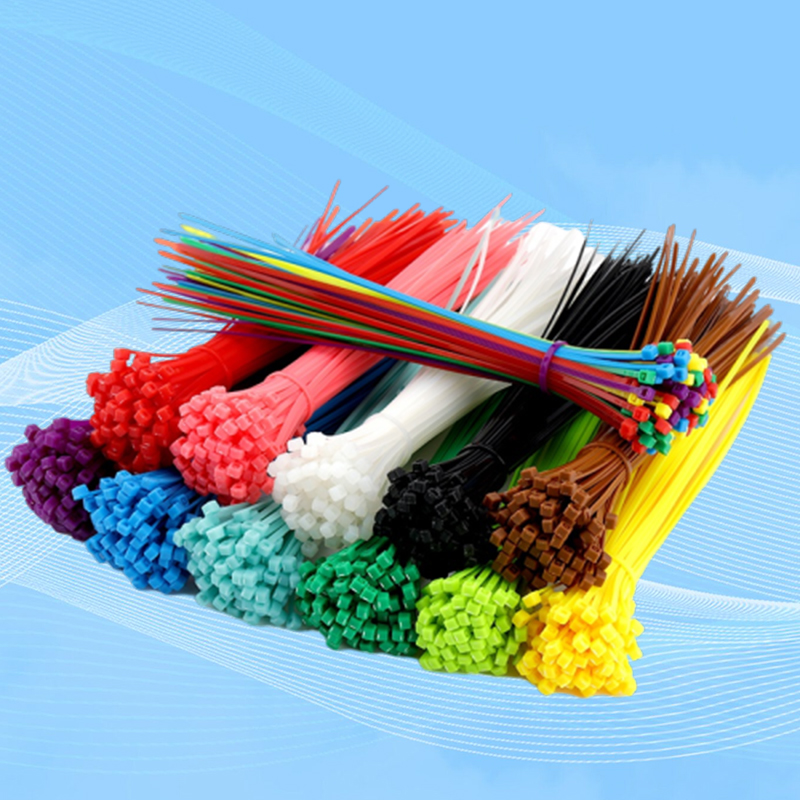
Why Blue Cable Ties Are Common in Food Processing
Many metal detectable ties are supplied in blue or another high-contrast color. The color doesn’t create the metal-detection function — it adds a separate, visual layer of control.
Blue is the food-industry standard because it contrasts strongly against most food products and production surfaces. Manufacturers describe the coloring as an aid to visual detection and quality-control procedures.
Two detection methods, working together:
Visual Detection
Workers can more easily spot a blue tie or fragment during:
- Equipment inspection
- Maintenance
- Cleaning
- Line clearance
- Pre-operational inspection
Instrumental Detection
The detectable formulation provides a signal through a suitable metal detection system.
Neither substitutes for the other. They work best as complementary controls within a broader foreign-body management system.
Where Are Metal Detectable Cable Ties Used?
These ties matter most wherever foreign-body control is a serious concern.
Food Processing
Applications include:
- Meat processing
- Dairy processing
- Bakery production
- Beverage production
- Snack and confectionery packaging
- Prepared foods
- Ingredient handling
- Food filling and packaging
Ties are used around sensors, electrical cables, pneumatic systems, machine guards, and conveyors.
Pharmaceutical Manufacturing
Pharma production demands tight control of foreign materials. Detectable ties can be used around:
- Packaging machines
- Filling equipment
- Labeling machines
- Conveyors
- Inspection equipment
- Electrical installations
- Automation systems
Commercial manufacturers specifically identify metal-detectable PA66 ties for food and pharmaceutical processing environments.、
Beverage Packaging
High-speed beverage lines carry extensive automation and cable management, and their ties face:
- Moisture
- Repeated cleaning
- Vibration
- High-speed machine movement
Material selection here needs to weigh detectability and environmental durability together.
How Do They Fit into Automated Packaging Lines?
Automated packaging systems are a particular challenge: the equipment runs continuously, often at high speed. A typical line looks like:
Product Feeding → Filling → Sealing → Inspection → Labeling → Cartoning → Case Packing
Cable management runs through every stage. If a tie comes loose or breaks, the fragment may travel with the product or packaging material.
Metal detectable ties do their best work inside a broader foreign-body control strategy:
Detectable Components
↓
Good Installation Practices
↓
Routine Equipment Inspection
↓
Metal Detection / X-Ray Inspection Where Applicable
↓
Automatic Rejection
↓
Root-Cause Investigation
That’s far more robust than swapping in detectable ties and calling the contamination risk solved.
Metal Detection vs. X-Ray Detection
Metal detection and X-ray inspection are different technologies. A metal detectable tie is designed primarily for metal detection systems; some products are also built for dual detectability, combining metal and X-ray response. Commercial examples exist in PA66 formulations marketed specifically for food-industry use.
The right option depends on what the plant already runs. When selecting a tie, ask:
- Does the production line use metal detection?
- Does it use X-ray inspection?
- Are both technologies used?
- What is the detector sensitivity?
- What product is passing through the detector?
- What is the product effect?
- What is the smallest foreign-body size that needs to be detected?
- Has the actual cable-tie material been tested on the production equipment?
That last question is the one people skip. “Metal detectable” is not a universal detection guarantee — the real-world result depends on the tie, the detector, the product, the packaging format, orientation, speed, and detection settings.
Mechanical Strength Still Matters
Detectability is one requirement. The tie also has to hold cables and components securely for its entire service life.
The mechanical specification sheet should cover:
- Minimum tensile strength
- Strap width
- Strap thickness
- Bundle diameter
- Locking mechanism
- Head design
- Installation method
- Temperature range
- Chemical resistance
- Environmental exposure
Commercial metal detectable PA66 ties come in different tensile-strength classes and sizes, so selection can follow the actual bundle and installation requirements.
On automated machinery, picking a tie just because it’s detectable creates a new risk if the tie is mechanically underspecified. The selection has to answer two questions at once:
“Can it be detected?”
and
“Can it reliably hold the application?”

Installation Practices Are Still Important
Detectable material reduces the risk from invisible plastic fragments. It doesn’t excuse sloppy installation. Operators should avoid:
Excessive Tightening
Over-tightening can damage the tie or the cables being secured.
Incorrect Cutting
The excess tail should be cut cleanly and close to the locking head with an appropriate tool.
Sharp Protruding Edges
A poorly cut tie leaves a sharp projection that can interfere with nearby components or make cleaning harder.
Uncontrolled Cut-Off Pieces
Cut-off tails should be collected and removed, not left lying around the machine.
Improper Cable Routing
Never place ties where they’ll rub repeatedly against moving components.
The detectable material is an additional risk-control measure — not a replacement for proper mechanical installation.
What About CIP and Cleaning Chemicals?
Food and pharmaceutical packaging equipment gets cleaned often. Depending on the environment, ties may encounter:
- Water
- Detergents
- Alkaline cleaning solutions
- Sanitizers
- Temperature fluctuations
- Humidity
- Process residues
PA66 is the industry workhorse, but the specific formulation should be checked against the actual chemical and temperature environment — especially near washdown areas or equipment that goes through regular sanitation.
A product specification needs to cover environmental compatibility, not just tensile strength and detectability.
Why Material Dispersion Matters to Cable-Tie Manufacturers
For the manufacturer, compound quality is everything. The detectable additive must be dispersed sufficiently and consistently through the polymer.
Poor dispersion shows up as variation in:
- Detectability
- Mechanical strength
- Surface appearance
- Injection-molding behavior
- Dimensional consistency
A well-controlled PA66 formulation starts with consistent raw materials and processing. For industrial nylon ties, the processing factors that matter include:
- Virgin PA66 resin quality
- Additive dispersion
- Moisture control
- Injection molding parameters
- Mold design
- Cooling conditions
- Post-molding conditioning
- Dimensional inspection
One example: nylon is hygroscopic and absorbs moisture from the environment. Moisture conditioning has to be managed properly — too little or too much affects both mechanical behavior and processing consistency in molded PA66 parts.
So a metal detectable PA66 tie demands control on two fronts: the detectable formulation and the underlying nylon processing quality.
How Should Buyers Evaluate a Metal Detectable Nylon Cable Tie?
Don’t buy on the phrase “metal detectable” alone. A practical checklist:
- Base Material — confirm whether the tie is PA66 or another polymer, and whether that material suits the operating environment.
- Detectable Material — ask what detectable additive is used and whether it’s distributed throughout the tie.
- Fragment Detectability — confirm the manufacturer has tested cut-off sections or smaller fragments.
- Detector Compatibility — test the actual tie on the metal detector used in your production line.
- Tensile Strength — make sure the tie handles the real cable bundle and mechanical load.
- Temperature Resistance — consider both normal operation and cleaning conditions.
- Chemical Resistance — evaluate exposure to detergents, sanitizers, oils, and other chemicals.
- Visual Identification — a contrasting color supports visual inspection and maintenance.
- Regulatory Documentation — request the material, compliance, and test documentation your quality system requires.
- Manufacturing Consistency — batch-to-batch consistency is essential for a component inside a contamination-control strategy.
Metal Detectable Cable Ties vs. Standard Nylon Cable Ties
| Feature | Standard Nylon Cable Ties | Metal Detectable Nylon Cable Ties |
| Base material | Typically nylon | Typically PA66 with detectable additive |
| Cable management | Yes | Yes |
| Mechanical fastening | Yes | Yes |
| Detectable by metal detector | Generally no | Designed to be detectable |
| Cut-off fragment detectability | Generally no | Can be detectable, depending on formulation and detector |
| Visual identification | Depends on color | Often high-contrast colors such as blue |
| Food/pharma foreign-body control | Limited | Better suited to contamination-control programs |
| Installation method | Similar | Similar |
| Main purpose | Cable fastening | Cable fastening + foreign-body detection capability |
The key difference isn’t mechanical — a metal detectable tie doesn’t replace a normal tie. It adds an inspection-compatible material property to a cable-management component you already know how to use.
Metal Detectable Does Not Replace HACCP or Foreign-Body Controls
It’s tempting to think detectable ties solve the contamination problem. They don’t.
A robust food or pharmaceutical quality system still needs:
- Hazard analysis
- Preventive controls
- Equipment inspection
- Maintenance procedures
- Line clearance
- Foreign-body detection
- Product rejection procedures
- Cleaning procedures
- Staff training
- Traceability
- Corrective actions
Detectable ties support these controls by making one class of plastic component easier to find. Commercial manufacturers position their products as supporting quality processes such as HACCP — not replacing the quality system.
Keep that framing in mind when specifying them for an automated packaging line.
Common Mistakes When Choosing Metal Detectable Cable Ties
Mistake 1: Assuming Every Metal Detector Will Detect Every Fragment
Detection depends on the actual tie, detector sensitivity, product effect, fragment size, orientation, and operating conditions.
Mistake 2: Looking Only at the Full Cable Tie
The cut-off section may be the real contamination risk. Ask specifically about fragment detectability.
Mistake 3: Choosing Based Only on Color
Blue helps visual identification, but color doesn’t make a tie metal detectable.
Mistake 4: Ignoring Mechanical Requirements
A detectable tie still needs sufficient tensile strength and dimensional compatibility.
Mistake 5: Ignoring the Cleaning Environment
A tie on a washdown packaging machine needs resistance to moisture, chemicals, and temperature.
Mistake 6: Assuming Metal Detectability Means X-Ray Detectability
Different mechanisms. If both are required, choose a product designed and tested for dual detection.
Mistake 7: Treating the Cable Tie as an Isolated Component
Evaluate the tie together with the packaging machine, inspection system, product, cleaning process, and foreign-body control program.
What Should a Manufacturer Provide?
For food and pharmaceutical applications, a catalog page isn’t enough. A cable-tie manufacturer should provide technical documentation covering:
- Material specification
- PA66 grade
- Detectable additive information
- Tensile strength
- Dimensions
- Operating temperature
- Chemical resistance
- Regulatory/compliance documentation where applicable
- Detection test information
- Batch consistency
- Quality-control procedures
For large OEM or automated packaging-machine projects, customers may also request samples for testing on their actual detection equipment. That’s often the most valuable step — laboratory detectability and production-line detectability are not necessarily the same thing.
Q&A
Q1. How do metal detectable nylon cable ties work?
They use a nylon compound containing a detectable additive. When the material is properly formulated and passes through a suitable metal detection system, the tie — or a detectable fragment — generates a signal that triggers the inspection system. Commercial PA66 products use metallic material dispersed throughout the tie.
Q2. Can a metal detector detect a cut-off piece of a cable tie?
It can, depending on the formulation, fragment size, detector sensitivity, product effect, and operating conditions. Some commercial products are designed with detectable material distributed throughout the tie precisely so cut-off sections can be detected too.
Q3. Why are metal detectable cable ties used in food processing?
They add a foreign-body control measure. If a detectable tie or fragment ends up in a monitored product stream, the material is designed to be picked up by suitable inspection equipment instead of passing through as an invisible plastic foreign object.
Q4. Are metal detectable cable ties made entirely from metal?
No. They remain polymer-based ties. A detectable additive is blended into the nylon compound to provide the detection response.
Q5. Are metal detectable cable ties made from PA66?
Many industrial food-industry detectable ties use metal-detectable PA66 formulations. Confirm the exact grade and formulation from the manufacturer’s technical documentation.
Q6. Why are many detectable cable ties blue?
Blue provides high visual contrast, making components easier to spot during equipment inspection, maintenance, and cleaning. The color itself contributes nothing to metal detectability.
Q7. Can metal detectable cable ties be used in pharmaceutical packaging?
Yes. Metal-detectable ties are specifically marketed for food and pharmaceutical processing environments. Confirm exact suitability against the facility’s material, hygiene, and compliance requirements.
Q8. Are metal detectable cable ties also X-ray detectable?
Some products handle both metal and X-ray detection. Metal detectability alone doesn’t guarantee X-ray suitability, though — if both technologies are in play, select a tie specifically specified for dual detection.
Q9. Do metal detectable cable ties have the same strength as ordinary nylon cable ties?
They can deliver substantial mechanical strength, but the exact tensile rating depends on size and formulation. Compare the manufacturer’s specified tensile strength against your actual bundling requirements rather than assuming all detectable ties perform identically.
Q10. Do metal detectable cable ties completely eliminate contamination risk?
No. They’re one component of a broader foreign-body control strategy. Proper installation, maintenance, visual inspection, metal detection or X-ray inspection, product rejection, and HACCP or other applicable quality procedures all remain important.
Conclusion
In automated food and pharmaceutical packaging, cable ties are small parts — but installed close to production and packaging operations, they become part of the foreign-body conversation.
Metal detectable nylon ties address the risk by pairing the mechanical function of a nylon tie with a detectable material formulation. The key advantage is distribution: detectable material throughout the tie means a piece cut off during installation, or a section that breaks away, keeps its detectability and can be identified by a suitable inspection system. Commercial PA66 products are developed specifically for food and pharmaceutical processing, with configurations designed to support detection of cut-off sections.
Detectability can’t be evaluated in isolation, though. The tie still needs appropriate tensile strength, dimensional stability, temperature resistance, chemical resistance, and reliable molding quality.
For manufacturers, that puts the weight on formulation and production control: a consistent PA66 compound, uniform additive dispersion, controlled moisture conditioning, stable injection molding, and proper quality testing all feed into consistent finished-product performance.
For food and pharmaceutical equipment manufacturers, the most reliable approach is to evaluate the tie together with the actual metal detector, product, packaging format, operating environment, and foreign-body control procedure. Where X-ray inspection is also used, a dual-detectable product may be worth considering.
In the end, selecting a metal detectable PA66 tie comes down to three questions:
Can the tie securely perform its fastening function?
Can potential fragments be detected under the actual inspection conditions?
Can the material withstand the production and cleaning environment?
Answer all three, and metal detectable nylon cable ties earn their place in a broader contamination-control strategy for automated food and pharmaceutical packaging lines.
