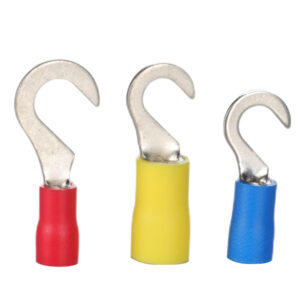
Choosing the right terminal for your wiring project is crucial for safety and reliability. Hook terminals and ring terminals each offer unique advantages. You need to understand their pros and cons to make the right choice. This guide helps you compare these two types for optimal electrical connections.
What Are Hook and Ring Terminals?
Hook Terminals: Feature a hook-shaped end that loops around a screw or stud, allowing quick installation and easy removal.
Ring Terminals: Have a closed circular end that fits securely over a stud or screw, providing a strong, permanent connection.
Both are widely used in automotive, electrical, and industrial wiring systems.
Pros and Cons of Hook Terminals
Pros
Quick to install and remove without complete disassembly
Ideal for temporary connections or test setups
Flexible for applications where frequent reconnections are needed
Cons
Less secure than ring terminals in high-vibration environments
May loosen over time if not properly seated
Not ideal for permanent or high-current connections
Pros and Cons of Ring Terminals
Pros
Provides a strong, reliable connection
Excellent for high-vibration environments
Prevents accidental disconnection
Cons
Requires complete removal of the screw or stud for installation
Less convenient for temporary or frequently changed connections
Slightly longer installation time
When to Choose Hook Terminals
Use hook terminals if:
You need temporary wiring solutions
Frequent maintenance or reconnection is required
Quick testing is part of your workflow
Hook terminals are commonly used in test benches, prototyping, and temporary installations.
When to Choose Ring Terminals
Ring terminals are best when:
You need permanent, secure connections
Connections are exposed to vibration or movement
Safety and reliability are critical
They are widely used in automotive wiring, industrial panels, and high-current applications.
Can hook terminals be used in high-vibration environments?
Not recommended, as they may loosen over time. Ring terminals are preferred for such applications.
Are ring terminals more expensive than hook terminals?
Generally, they are slightly more costly due to higher material and manufacturing requirements, but offer superior reliability.
Can I reuse hook terminals?
Yes, they are designed for repeated connections and disconnections.
What materials are commonly used for these terminals?
Copper, brass, and tinned or nickel-plated variants are most common, ensuring conductivity and corrosion resistance.
Which terminal is safer for permanent electrical systems?
Ring terminals provide superior safety because the connection is fully enclosed and secured.
Conclusion
Selecting the right terminal ensures a reliable and safe electrical connection. Hook terminals excel in temporary or test applications, while ring terminals offer long-term security and vibration resistance. Niuli Electric provides high-quality hook and ring terminals to meet your wiring needs efficiently and safely.