



Key Takeaways
- Corrugated conduit protects engine-bay wiring from heat, oil, abrasion and chafe.
- PA6 (nylon 6) is stiff, low-cost and fine for mild heat but absorbs water and softens in hot oil.
- PA12 (nylon 12) resists fuel and oil far better, absorbs almost no water, and stays flexible in cold.
- For engine-bay and fuel-line-adjacent runs, PA12 is the safer long-life choice.
- Pair conduit with the right clips and slit vs non-slit style for the assembly method.
Inside an engine bay the wiring harness lives in the worst neighbourhood on the vehicle: radiant heat from the block, splashed oil and fuel, road salt, and constant vibration that rubs looms against brackets. Corrugated conduit is the standard shield, but not all conduit is equal. The two common automotive grades are PA6 (nylon 6) and PA12 (nylon 12), and the difference shows up exactly where engine bays are cruel — heat, oil and cold.
Why Engine Bay Needs Conduit
A bare loom in an engine bay gets abraded by moving parts, cooked by exhaust proximity, and soaked in fluids. Corrugated conduit gives a ribbed, flexible armour that spreads impact, resists scraping and keeps the bundle routed. The material of that armour decides whether it is still flexible after a hot summer and a cold winter, or has gone brittle and cracked.
PA6 (Nylon 6): Cheap Workhorse
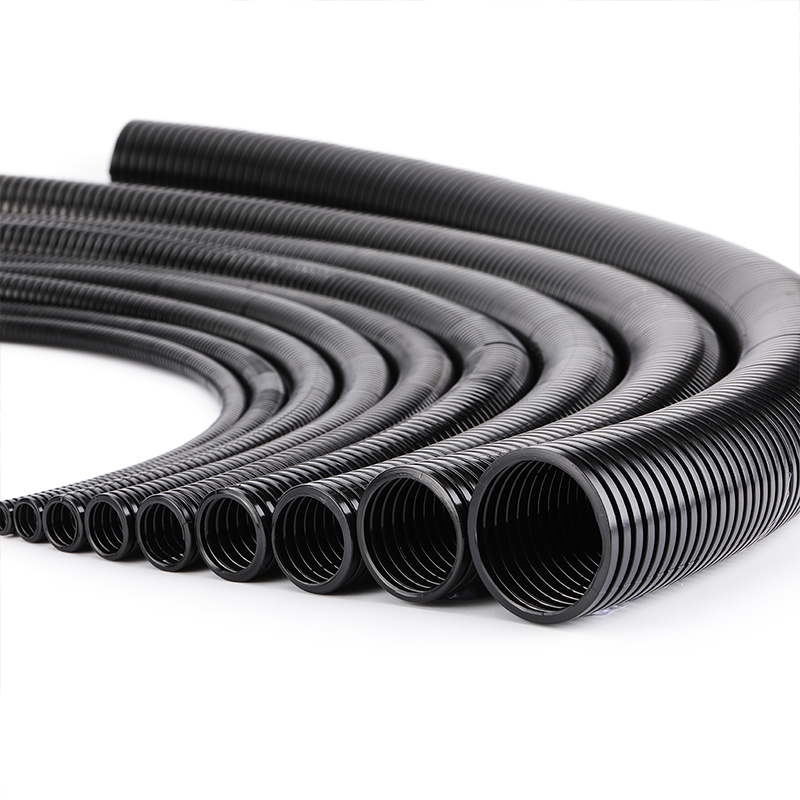
PA6 is the high-volume, low-cost nylon conduit. It is stiff enough to hold a route, easy to slit and cheap to make, and for mild under-bonnet zones away from direct heat and fuel it does the job. Its weaknesses are water take-up (PA6 absorbs several percent, which can affect dimensions and long-term stability) and softening in hot oil. In a hot, oily engine bay it ages faster than PA12.
PA12 (Nylon 12): The Tough Grade
PA12 costs more but is engineered for exactly this environment. It absorbs almost no water, so it does not swell or lose properties in damp conditions, and it resists fuel, oil and hydraulic fluid far better than PA6. It also stays flexible at low temperature, which matters for cold-climate vehicles where PA6 can stiffen and crack. For runs near the engine, turbo or fuel lines, PA12 is the grade that survives the vehicle’s service life.
Comparison Table
| Property | PA6 (Nylon 6) | PA12 (Nylon 12) |
|---|---|---|
| Cost | Low | Higher |
| Water take-up | Several % | Near zero |
| Oil / fuel resist | Moderate | Excellent |
| Heat (engine bay) | OK mild | Better sustained |
| Cold flexibility | Stiffens | Stays flexible |
| Best use | Mild zones | Engine bay, fuel near |
Table 1. PA6 vs PA12 corrugated conduit for vehicles.
Oil, Fuel and Heat
The killer for PA6 in an engine bay is hot oil wicking into the ribs and softening the wall; over time the conduit sags and the loom it protects chafes. PA12 shrugs off the same fluid. Combined with exhaust radiant heat, PA12 keeps its shape and flexibility where PA6 can go brittle. If the harness runs close to the engine or a fuel line, specify PA12 and do not save the small per-metre difference.
Cold Flex and Water Take-Up
In cold climates PA6’s water take-up can freeze and its stiffness rises, so a loom clipped to a cold bracket can crack the conduit on a pothole hit. PA12’s near-zero water absorption and low-temperature flexibility avoid that. For vehicles sold across climates, PA12 is the conservative, warranty-friendly choice.
Split vs Unsplit Conduit
Split (slit) conduit lets you lay the loom in after building the harness; unsplit gives better sealing and protection but must be threaded. For engine-bay retrofits and serviceability, split conduit with a corrugated tube connector is common; for original equipment, unsplit with moulded fittings seals better. spiral wrapping bands are an alternative where you need open access along the run.
Beyond material, how you fix the conduit matters: use lined cable clips or p-clips with a rubber sleeve so the loom cannot rub the bracket raw, and keep the conduit clear of sharp edges and moving parts. A protected PA12 run with lined clips outlasts a bare PA6 run by years — the fitting, not just the plastic, decides the service life.
Worked Example: A Turbo Harness
A turbocharger harness runs centimetres from the hot side. Specified in PA6 to save cost, the conduit softens in hot oil and the loom chafes within a year. Re-specified in PA12, the same harness stays flexible through summer heat and winter cold, resists the oil mist, and shows no cracking at 100,000 km. The small per-metre saving of PA6 is lost to an early harness replacement; PA12 is the life-cycle choice for the engine bay.
Niuli Conduit Range
Niuli Electric supplies corrugated tube in PA6 and PA12, plus connectors, spiral wrapping bands and cable tidy kits to complete the harness protection. For engine-bay and fuel-adjacent runs, ask for the PA12 grade.
Quick Selection Checklist
- Corrugated conduit protects engine-bay wiring from heat, oil, abrasion and chafe.
- PA6 (nylon 6) is stiff, low-cost and fine for mild heat but absorbs water and softens in hot oil.
- PA12 (nylon 12) resists fuel and oil far better, absorbs almost no water, and stays flexible in cold.
- For engine-bay and fuel-line-adjacent runs, PA12 is the safer long-life choice.
- Pair conduit with the right clips and slit vs non-slit style for the assembly method.
Frequently Asked Questions
Is PA6 good enough for engine bay?
For mild zones away from heat and fuel, yes; near the engine or fuel lines, PA12 lasts longer.
Why is PA12 more expensive?
It is a higher-grade nylon with near-zero water take-up and much better oil/fuel resistance.
Does PA6 absorb water?
Yes, several percent, which can swell it and lower long-term stability; PA12 absorbs almost none.
Which stays flexible in cold?
PA12 stays flexible; PA6 stiffens and can crack in cold climates.
Does oil damage corrugated conduit?
Hot oil softens PA6 over time; PA12 resists fuel and oil far better.
Split or unsplit conduit?
Split for serviceability/retrofit; unsplit for better sealing in OEM builds.
Can I use spiral wrap instead?
Yes, spiral wrapping bands give open access; conduit gives more sealed impact protection.
What temperature can PA12 take?
Check the grade, but PA12 sustains engine-bay heat better than PA6; keep margin below rating.
Are Niuli conduits PA12 available?
Yes, Niuli supplies both PA6 and PA12 corrugated conduit.
How do I size conduit?
By loom outer diameter with slack for bending; over-tight conduit stresses the ribs.
Related Resources
Specify PA12 for engine-bay runs — send the loom diameter and we will size the conduit and clips.
