



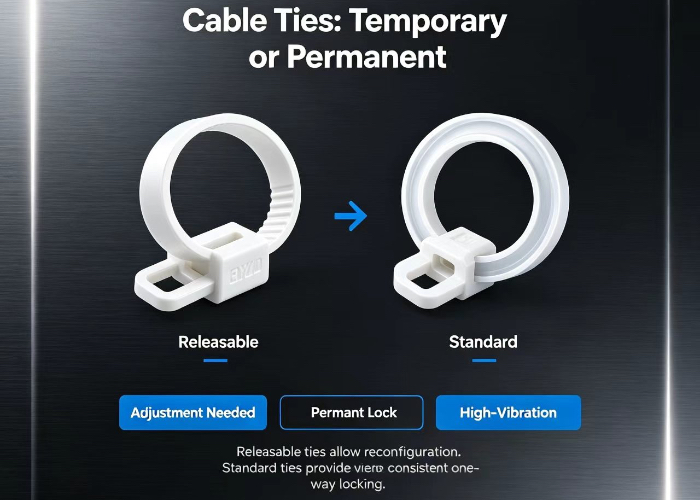
Choosing between releasable and standard cable ties depends on whether your project requires temporary adjustment or permanent fastening. While both use nylon locking mechanisms, their designs, strength characteristics, and ideal applications are different.
What Are Releasable Cable Ties?
Releasable cable ties are designed with an integrated release tab built into the locking head. Unlike one-time-use alternatives, they can be loosened, adjusted, removed, and reapplied multiple times without damaging the tie itself or the bundled material.An be released and reused for multiple installation cycles depending on the design and operating conditions.
Constructed from high-grade nylon 66 (the same base material as most standard ties), releasable variants feature a modified pawl-and-ratchet mechanism. Pressing the release lever disengages the locking teeth, allowing the strap to slide back out freely. This design makes them ideal for temporary bundling, prototyping, maintenance work, and any application where cables or hoses may need re-routing over time.
Premium releasable cable ties are available in UV-stabilized and heat-resistant formulations, supporting both indoor and short-term outdoor deployment. They are available in miniature, standard, and heavy-duty widths to match different load requirements.
What Are Standard Cable Ties?
Standard cable ties commonly referred to as zip ties, self-locking ties, or permanent cable ties,which are the most ubiquitous fastening solution in industrial and commercial settings. They operate on a simple, irreversible ratchet mechanism: once the serrated strap is pulled through the head, the locking pawl engages and cannot be released without cutting the tie.
Standard cable ties are valued for their low unit cost, consistent tensile strength, and fast, foolproof installation. They are manufactured in bulk from nylon 66, with options for UV stabilization, heat resistance, and flame retardancy for specialized environments. Because they lack a release mechanism, their locking head is more compact and structurally uniform, making them suitable for permanent, high-vibration, and outdoor permanent installations.
Available in a vast range of lengths, widths, colors, and load ratings, standard cable ties are the default choice for permanent bundling, wire harness assembly, and high-volume production lines where reusability is not required.
 How Professionals Choose: 4 Key Differences Between Releasable and Standard Cable Ties
For industrial buyers and engineering teams, the decision comes down to four technical and economic factors. Understanding these distinctions prevents overspending on unnecessary features or cutting corners on permanent installations.
Locking Mechanism & Reusability
The most fundamental difference lies in the locking design. Standard cable ties use a single-direction ratchet lock. The serrated strap engages with a fixed plastic pawl that only allows movement in one direction. Once fully tensioned, the tie cannot be undone — removal requires a cutting tool. This makes them inherently tamper-resistant and reliable for permanent fastening. Releasable cable ties incorporate a spring-loaded release tab into the head. Pressing the tab lifts the pawl away from the strap teeth, enabling full adjustability and removal. High-quality releasable ties can be reused dozens of times without loss of holding force, though repeated use will eventually wear the tooth engagement. For temporary setups, this reusability is a decisive advantage.(High-quality releasable ties can withstand repeated adjustments while maintaining reliable holding performance when used within rated conditions.)
Tensile Strength & Load Bearing
When comparing ties of the same width and material grade, standard cable ties typically deliver slightly higher and more consistent tensile strength. Because standard ties have a solid, uninterrupted locking head with no moving release parts, the load is distributed evenly across the pawl and strap teeth. This structural simplicity translates to predictable break strength and better performance under sustained vibration — a critical factor in automotive, heavy machinery, and permanent outdoor installations. Releasable cable ties, while still rated for substantial loads, have a more complex head geometry. The release mechanism occupies space within the head, which can marginally reduce the effective contact area of the locking teeth. Heavy-duty releasable models compensate with wider straps and reinforced heads, but they generally carry a small strength-to-size tradeoff in exchange for adjustability.
Cost-per-Use & Project ROI
At first glance, standard cable ties are significantly cheaper per unit. For high-volume permanent applications — such as harness assembly on a production line — their low unit cost makes them the clear economic choice. However, the calculation shifts for projects involving installation, testing, teardown, and reconfiguration. Releasable cable ties have a higher upfront price but can be reused across multiple jobs, phases, or maintenance cycles. For electrical panel prototyping, event rigging, or equipment servicing, a single releasable tie replaces multiple disposable standard ties. Over the lifecycle of a project, the cost-per-use of releasable ties is often lower, while also reducing plastic waste and inventory consumption.
Application Versatility
Standard cable ties excel in fixed, permanent, and high-volume scenarios. Their simplicity and low cost make them the default for permanent wiring, conduit bundling, bulk packaging, and any application where the bundle will not need modification. Releasable cable ties shine in dynamic, temporary, or maintenance-heavy environments. Their ability to be loosened, repositioned, and removed without tools (or with only finger pressure) speeds up troubleshooting, upgrades, and layout changes. They are also preferred for delicate cables, hoses, or finished surfaces where cutting a standard tie risks damaging underlying materials.
| Feature | Releasable Cable Ties | Standard Cable Ties |
| Locking method | Release tab mechanism | One-way locking |
| Reuse | Adjustable and reusable | Single-use |
| Installation | Temporary and maintenance work | Permanent installation |
| Strength | Slightly lower in similar sizes | Higher structural consistency |
| Cost | Higher initial cost | Lower unit cost |
| Best applications | Prototyping, service, temporary wiring | Production lines, permanent wiring |
Primary Industrial Applications for Each Type
Releasable Cable Ties
- Electrical & Cable Systems: Temporary wiring during building installation, control panel prototyping, and maintenance re-routing where circuits may need reconfiguration during commissioning.
- Outdoor & Event Lighting: Seasonal landscape lighting, stage rigging, trade show booths, and temporary holiday light displays that require setup and teardown without damaging cables or structures.
- Machinery & Automotive Servicing: Temporary harness routing during equipment testing, diagnostic work, and repair jobs where cables and hoses must be secured temporarily and then released for service.
Standard Cable Ties
- Permanent Electrical & Conduit Wiring: Junction boxes, distribution panels, permanent cable trays, and underground conduit bundling where long-term, maintenance-free fastening is required.
- Automotive & Motorcycle Harness Assembly: Engine bay and chassis wiring that must withstand constant vibration, temperature swings, and exposure to fluids over the vehicle’s lifetime.
Hardware Wholesaling & Industrial Bundling: Bulk packaging, retail hardware packs, general inventory bundling, and high-volume production lines where low per-unit cost and consistent performance are priorities.
NIULI Electric: Abundant Types of Cable Ties for Every Industrial Need
At NIULI Electric, we design and manufacture a full spectrum of cable tie solutions engineered to deliver reliable performance across the world’s most demanding industrial sectors. Our portfolio includes both standard self-locking cable ties and heavy-duty releasable cable ties, available in a wide range of sizes, tensile strengths, and specialized material formulations,which including Detectable Cable Ties ,Heat Stabilized Cable Ties and Flame Retardant Cable Ties for sensitive environment.
All NIULI cable ties undergo rigorous tensile testing and comply with leading international quality and safety specifications, ensuring consistent, predictable performance from delicate signal wire bundling to heavy industrial cabling. We also support custom colors, printed markings, and specialized material formulations, working directly with electrical contractors, automotive OEMs, event production companies, and industrial distributors to deliver tailored fastening solutions that align with exact project requirements and total cost of ownership goals.
Conclusion
The choice between releasable and standard cable ties ultimately depends on whether your application is permanent or temporary, and whether reusability and adjustability justify the modest premium.
- Choose standard cable ties for permanent installations, high-volume production, and projects where low unit cost and maximum tensile consistency are priorities.
- Choose releasable cable ties for prototyping, maintenance, events, and any scenario where cables will need re-routing, adjustment, or removal,because they deliver lower cost-per-use over time and reduce material waste.
For most industrial operations, maintaining inventory of both types is the most practical approach, ensuring teams have the right fastener for every phase of installation, operation, and maintenance.
FAQs
Q1: Can releasable cable ties hold the same weight as standard cable ties of the same size?
Heavy-duty releasable cable ties offer tensile strength ratings close to standard equivalents, but standard ties typically have a slight edge due to their simpler, more solid locking head. Always check the manufacturer’s rated tensile strength for the specific model and size.
Q2: Are standard cable ties suitable for permanent outdoor use?
Standard black nylon cable ties with UV stabilization are designed for permanent outdoor exposure. Clear or natural nylon ties are intended for indoor use only, as sunlight will cause brittleness and premature failure.
Q3: How many times can a releasable cable tie be reused?
Actual lifespan depends on load weight, temperature, and handling.
Q4: Which type is better for electrical panels and UL-listed installations?
Both types can meet electrical safety standards when manufactured to appropriate specifications. Permanent panel wiring typically uses standard UL-listed cable ties, while releasable ties are commonly used during prototyping and temporary wiring phases.
Q5: Do releasable cable ties work in high and low temperature environments?
Most nylon releasable cable ties operate reliably between -40°C and 85°C. For extreme heat or cold environments, confirm the material grade and temperature rating with your supplier before deployment.
