



Introduction
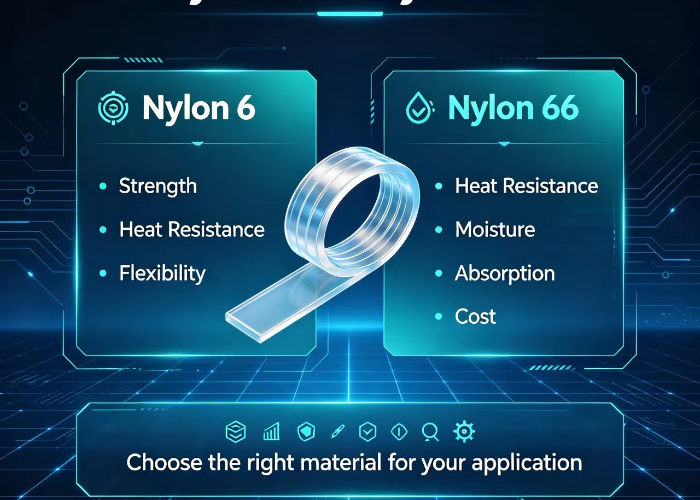
Nylon 6 and Nylon 66 are the two most common materials used to manufacture cable ties. While they look similar, they differ in strength, heat resistance, flexibility, moisture absorption, and cost. Understanding these differences helps buyers choose the right material for their application.
What Are Nylon Cable Ties?
Nylon cable ties—commonly referred to as zip ties, wire ties, or cable fasteners—are self-locking, thermoplastic fastening devices fabricated from polyamide resin. Owing to their cost-effectiveness, rapid installation, electrical insulation properties, and consistent tensile retention, they are extensively deployed in electrical assemblies, automotive wiring harnesses,HVAC systems, and general industrial manufacturing.
Commercially available standard nylon cable ties are predominantly manufactured from either Nylon 6 (PA6) or Nylon 66 (PA66). While both are semi-crystalline thermoplastic polyamides, their polymerization pathways and resulting chain structures differ fundamentally:
- Nylon 6 is formed from a single monomer (caprolactam) through ring-opening polymerization, producing a repeating unit of six carbon atoms.
- Nylon 66 is formed by condensing two monomers—hexamethylenediamine and adipic acid—each contributing six carbon atoms, hence the “66” designation.
This structural difference may sound subtle, but it translates directly into measurable performance gaps that matter in industrial environments. Understanding these gaps is the first step toward optimizing your bill of materials and reducing field failures.
| Feature | Nylon 6 | Nylon 66 |
| Strength | Good | Excellent |
| Heat Resistance | Good | Better |
| Flexibility | Excellent | Good |
| Moisture Absorption | Higher | Lower |
| Outdoor Use | Limited | Better (UV Stabilized) |
| Cost | Lower | Higher |
| Best For | Indoor | Industrial & Outdoor |
5 Major Distinctions Between Nylon 6 and Nylon 66
Strength and Durability
When it comes to tensile strength, rigidity, and load-bearing capacity, Nylon 66 is the clear leader. Its denser crystalline structure and higher hydrogen-bond density give it approximately 15–20% higher tensile strength and greater stiffness compared to Nylon 6 under identical dimensions and test conditions.
- Nylon 66 delivers superior tensile strength, higher modulus of elasticity, and better wear resistance. It maintains its shape and clamping force under sustained mechanical load, making it the standard for heavy-duty bundling, high-vibration environments, and critical fastening applications where slippage or breakage would create safety or downtime risks.
- Nylon 6 offers good strength but is generally more prone to creep (gradual deformation under constant stress) over time. For light-to-medium bundling duties where extreme loads are not expected, it performs reliably and often exceeds minimum industry standards.
For specification purposes, a standard 4.8×200 mm Nylon 66 cable tie typically carries a minimum loop tensile strength of 500 N (≈50 kgf), while an equivalent Nylon 6 tie may rate between 400–450 N. Always verify published tensile values against your actual bundle weight and dynamic load requirements.
Ultraviolet Protection and Heat Resistance
Thermal performance is where the gap between the two materials widens most significantly.
Heat resistance:
- Nylon 66 generally offers higher tensile strength/approximately 15-20%This makes it suitable for engine compartments, industrial machinery, lighting fixtures, and other warm operating environments.
- Nylon 6 softens more readily and loses clamping force, which can lead to loose bundles over time.
UV resistance: Both base nylon grades are susceptible to UV degradation and will become brittle with prolonged outdoor sun exposure. Black carbon-black-filled versions of both materials offer substantially improved UV stability, but Nylon 66 retains its mechanical properties longer under combined UV and thermal stress due to its inherently more robust polymer structure.
For outdoor solar installations, agriculture, marine decking, or construction-site use, black Nylon 66 with UV stabilization is generally the preferred specification, though stabilized Nylon 6 can be acceptable for shorter service-life or lower-temperature outdoor applications.
Flexibility
If flexibility, impact resistance, and ease of installation are priorities, Nylon 6 holds the advantage.
- Nylon 6 is inherently more ductile and impact-resistant, especially at lower temperatures. It bends with less risk of snapping during installation, tolerates tighter bundle radii, and handles manual application—particularly in cold warehouse or outdoor environments—more forgivingly. Its better flow during molding also produces a smoother surface finish and cleaner ratchet tooth engagement.
- Nylon 66 is stiffer and more brittle by nature. While it offers higher ultimate strength, it is more prone to snapping during installation if over-bent or applied at temperatures below freezing. In cold-climate applications, Nylon 66 ties may require pre-conditioning or specialized low-temperature formulations to prevent brittle fracture.
This distinction matters for high-volume assembly lines where operator ergonomics and installation yield rates affect production costs. A more flexible tie reduces rework from broken tabs and speeds up manual or automated application.
Moisture Absorption
All nylons absorb moisture from the environment—a property that acts as a natural plasticizer, increasing toughness but reducing strength and altering dimensions. The difference lies in how much each grade absorbs.
- Nylon 6 has a higher equilibrium moisture absorption rate, typically 2.5–3.5% at 50% relative humidity and 23°C. As it absorbs moisture, it gains flexibility but loses tensile strength and undergoes dimensional swelling. For precision applications where consistent bundle diameter or gap spacing matters, this can be a concern.
- Nylon 66 absorbs less moisture overall—roughly 1.8–2.5% under the same conditions—and retains more of its dry-state strength in humid environments. Its dimensional stability is therefore better, making it preferable for electrical enclosures, precision equipment, and applications exposed to fluctuating humidity.
Importantly, moisture absorption is partially reversible. Nylon ties shipped in sealed packaging arrive at or near dry-as-molded strength. Once opened and exposed to ambient air, they gradually condition and gain toughness while losing some rigidity. For critical load-bearing installations, factor in conditioned-state strength, not just dry-state published values.
Cost-to-Performance Ratio (Value)
From a procurement perspective, price is always part of the equation.
Nylon 6 is the lower-cost material. Its simpler single-monomer production process and wider global supply base translate into a price point typically 20–30% below Nylon 66 resin. For high-volume, low-stress applications—general internal wiring, packaging, light assembly, and disposable use cases—Nylon 6 delivers solid performance at the best unit cost.
Nylon 66 commands a price premium due to its more complex dual-monomer synthesis and tighter process control. However, that premium buys higher strength per millimeter of width, better thermal endurance, lower creep, and greater long-term reliability. In applications where a single tie failure can trigger downtime, rework, warranty claims, or safety hazards, Nylon 66 delivers a lower total cost of ownership despite the higher per-unit price.
The value calculation ultimately depends on:
- Volume consumed annually
- Criticality of the application
- Expected service life
- Cost of failure in the field
 Comparison in Specific Application Scenarios
| Application Scenario | Preferred Material | Rationale |
| Automotive engine bay / under-hood wiring | Nylon 66 | High continuous heat, vibration resistance, and long-term creep resistance are required. |
| Indoor electrical panels & control cabinets | Nylon 6 or Nylon 66 | Both work; Nylon 6 is cost-effective for standard temps; Nylon 66 adds margin for heat buildup. |
| Outdoor solar & renewable energy | Black UV-stabilized Nylon 66 | UV exposure, temperature cycling, and long service life demand maximum durability. |
| Cold-storage facilities / refrigeration | Nylon 6 | Better low-temperature toughness and resistance to brittle fracture during installation. |
| Heavy industrial machinery & robotics | Nylon 66 | Higher tensile strength, wear resistance, and stability under dynamic loads. |
| General assembly / packaging / consumer goods | Nylon 6 | Excellent value for light-to-medium bundling with high consumption volumes. |
| Marine / high-humidity environments | Nylon 66 (UV-stabilized black) | Lower moisture absorption and better dimensional stability in humid, salty conditions. |
| High-volume manual assembly lines | Nylon 6 | More forgiving during installation, fewer breakage rejects, faster throughput. |
How Should You Make a Choice Before Buying?
Use this step-by-step framework to specify the right nylon grade for your project:
Step 1: Define the mechanical load. Calculate the bundle weight and any dynamic forces (vibration, pull, impact). If loads are high or safety-critical, default to Nylon 66. For light, static bundling, Nylon 6 is usually sufficient.
Step 2: Map the operating temperature range. If continuous exposure exceeds 80°C, or if peak temperatures regularly approach 100°C, choose Nylon 66. For room-temperature indoor use, Nylon 6 is adequate.
Step 3: Assess the environment. Outdoor exposure, UV radiation, high humidity, chemical contact, or cold temperatures each tilt the decision. UV-stabilized black Nylon 66 wins for harsh outdoor duty; Nylon 6 is preferable for cold-installation environments.
Step 4: Evaluate service life expectations. For products designed to last 10+ years with minimal maintenance, Nylon 66’s lower creep and better retention of properties justify the premium. For short-life or disposable applications, Nylon 6 offers better economics.
Step 5: Run a total-cost analysis. Compare unit price × annual volume against the projected cost of field failures, rework, and warranty. In many industrial and automotive programs, a 20% material premium is negligible next to the cost of a single recall or downtime event.
Step 6: Validate with samples. Always request sample ties and test them under actual operating conditions—temperature cycling, humidity exposure, load testing—before committing to a full production order. Material data sheets describe ideal conditions; real-world performance may vary.
Nylon 6 vs Nylon 66: Advantages and Limitations
Neither material is universally “better.” Each is engineered around a different set of tradeoffs, and each excels in its intended domain.
Nylon 6 advantages:
- Lower unit cost and better economics for high-volume consumption
- Superior flexibility and impact resistance, especially at low temperatures
- Easier installation with fewer breakage rejects
- Good general-purpose strength for most indoor, light-to-medium duty applications
- Smoother surface finish and consistent molding quality
Nylon 66 advantages:
- Higher tensile strength, stiffness, and load-bearing capacity
- Significantly better heat resistance and higher continuous operating temperature
- Lower moisture absorption and superior dimensional stability
- Better resistance to creep under sustained load
- Longer service life in demanding environments
- Broader acceptance in automotive, aerospace, and heavy-industry specifications
- In practice, many manufacturers maintain both materials in their catalog so customers can match the grade to the application rather than forcing a one-size-fits-all solution.
Conclusion
The selection between Nylon 6 (PA6) and Nylon 66 (PA66) cable ties hinges on a rigorous alignment of material performance characteristics with specific application requirements.
For general-purpose indoor bundling, high-volume cost-sensitive production programs, low-temperature installation environments, and light-to-medium-duty service conditions, Nylon 6 offers proven functional reliability at a competitive unit cost. It remains the predominant material for routine cable management applications and continues to dominate volume-driven procurement segments.
Conversely, Nylon 66 is the preferred engineering-grade solution for applications involving sustained mechanical loading, elevated operating temperatures, outdoor exposure, safety-critical functions, or extended service life expectations. Its superior tensile strength, enhanced thermal stability (higher melting point and heat deflection temperature), reduced hygroscopicity, and lower long-term creep deformation under load render it the industry-standard material in automotive wiring harnesses, industrial automation systems, photovoltaic installations, and other mission-critical domains where functional integrity must be assured over time.
If you’re unsure which material best fits your application, consult your cable tie supplier before placing a bulk order.https://www.cabletienylon.com/,Niuli Electric offers both Nylon 6 and Nylon 66 cable ties, including UV-resistant, heavy-duty and custom OEM solutions.
FAQs
Q1: Is Nylon 66 stronger than Nylon 6 for cable ties?
Yes. Nylon 66 cable ties are about 15–20% stronger in tensile strength than equivalent Nylon 6 ties, with better stiffness, wear resistance, and lower creep under sustained load. For safety-critical or heavy-duty bundling.
Q2: Can Nylon 6 cable ties be used outdoors?
Standard natural Nylon 6 isn’t built for extended outdoor use since UV and moisture will degrade its properties over time. Black UV-stabilized Nylon 6 works for moderate outdoor applications, but for long-term exposure in harsh climates, UV-stabilized black Nylon 66 is the safer bet.
Q3:how strong are nylon cable ties?
The strength of nylon cable ties is measured by minimum tensile strength,the amount of straight pulling force needed to break the tie. Strength is determined almost entirely by the width of the tie body
Q4: Why do nylon cable ties absorb water, and does it affect performance?
Nylon is hygroscopic thanks to its amide groups pulling in moisture from the air. The absorbed water acts as a plasticizer, boosting flexibility and impact resistance while slightly reducing tensile strength and stiffness. Nylon 6 absorbs more moisture than Nylon 66.
Q5: Which is more cost-effective: Nylon 6 or Nylon 66 cable ties?
Nylon 6 is typically cheaper per unit, making it the budget-friendly pick for light-to-medium indoor work. But Nylon 66 often wins on total cost of ownership in demanding environments since it holds up longer, fails less often, and cuts downtime and warranty costs. The smarter choice depends on your application’s criticality and the real cost of failure, not just the sticker price.
