


Introduction
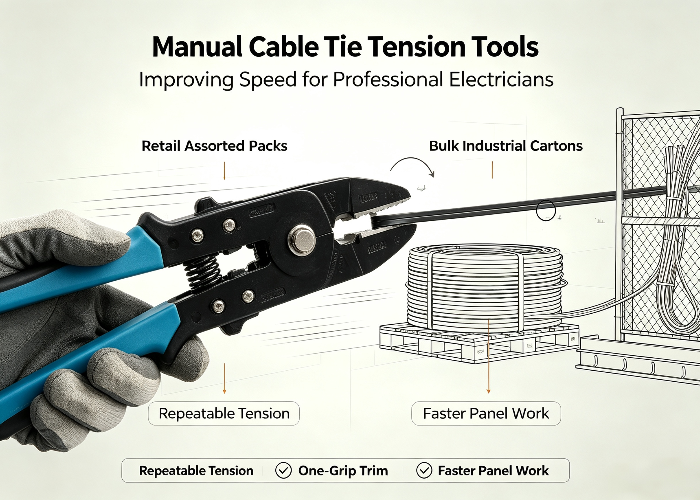
A manual cable tie tension tool reduces that variability by setting a repeatable tension, locking the pawl, and trimming the tail in a single grip cycle. For electricians who run panel boards, control cabinets, or long cable trays, the tool is less an accessory than a throughput control. This article examines how the tool works, where it outperforms hand tying, and what specifiers should verify before standardizing it across a crew.
What Is a Manual Cable Tie Tension Tool?
A manual cable tie tension tool is a handheld, hand actuated device that tensions, secures, and cuts a cable tie in one continuous motion. The operator threads the tie through the bundle, seats the head in the tool nose, and squeezes the handle. An internal tensioning mechanism pulls the strap tight until it reaches the preset force, the pawl locks the head, and a blade shears the excess tail flush with the head.
The term “manual” distinguishes the device from pneumatic or battery powered units. No external air supply or charging is required, which keeps the tool portable across job sites and removes a failure point on remote work. Adjustment is mechanical: a dial or screw sets the target tension so the same model can be tuned for delicate wiring looms or heavy duty bundles.
Hand Tying vs. Manual Tension Tool: The Core Comparison
The contrast is most visible on volume work. Hand tying relies on finger feel, which drifts with fatigue and varies between workers. A tension tool replaces feel with a calibrated setting. The table below summarizes the measurable differences.
| Criterion | Hand Tying | Manual Tension Tool |
| Tension consistency | Varies with fatigue and worker | Repeatable to a preset force |
| Time per tie | Pull, lock, and cut as separate steps | One grip cycle |
| Hand fatigue | High over a full shift | Lower, force spread to full grip |
| Risk of over or under tension | Common from guesswork | Controlled by dial setting |
| Tail cut quality | Often leaves a sharp nub | Flush cut at the head |
| Training required | Low but inconsistent | Brief, then standardized |
Hand tying still suits occasional, low volume tasks and awkward positions where a tool cannot reach. For repetitive runs, the tool wins on every measurable axis.
Why Professional Electricians Adopt a Tension Tool
Professional electricians standardize on tension tools for four reasons that compound across a project.
Consistency. A calibrated tool applies the same clamping force on the first tie and the five hundredth, producing a uniform appearance that reads as quality work and satisfies inspection expectations.
Throughput. A single grip cycle replaces the multi step hand sequence of pull, lock, and cut. On panel boards with dense wiring, that difference scales into hours saved per day.
Ergonomics. Repetitive hand tying loads the same tendons for hours. A tool transfers the force to a full hand grip and a wrist motion, lowering the risk of repetitive strain on long contracts.
Cut safety. The blade trims the tail flush, removing the sharp protruding nub that hand cutters often leave behind. A flush tail reduces the chance of a technician snagging a glove or wire on a leftover strap end.
What to Check Before Specifying a Tension Tool
Before committing a model to a crew, verify the following against the ties you actually stock.
- Tie width range. Confirm the tool accepts the full spread you use. Niuli Electric nylon cable ties span widths from 2.5 mm to 12 mm and tensile ratings from 18 lb to 250 lb, so a site running both light looms and heavy duty bundles needs a tool with an adjustable jaw and a wide tension band.
- Cut quality. Specify a flush cut rather than a protruding one where wire jackets or technician hands will be near the head.
- Ergonomics and weight. On full day use, balance and grip span matter more than on a bench task.
- Blade durability. Ask how many cycles the blade is rated for and whether spares are stocked locally.
- Compatibility with special ties. Heat stabilized ties rated to 120°C and UV resistant outdoor grades must pass the same jaw without slipping.
- A tool that cannot hold its setting drifts back toward hand tying variability, so confirm the adjustment stays put under load.
Kitting Tension Tools for Crews and Contract Rollouts
At crew scale, the tool is only as good as the tie stock it runs on. Standardizing both removes a class of failures.
Procure by crew, not by individual. Issue one matched tool per two electricians with a spare blade set, so a dull blade never stops a line.
Train the setting once. Document the dial position for each tie width you carry, then post it at the gang box. New hires reach the same tension without trial and error.
Pair the tool with a consistent tie. Niuli Electric supplies 100% virgin PA66 ties made from UL approved resin grades including INVISTA U4820L, DuPont 101L, and ASCEND 21SPC, with burr free injection molds that leave smooth, flash free edges. Those edges distribute clamping force evenly and protect soft PVC and TPE wire jackets from cutting during tensioning. Because the resin and dimensions stay constant, the tool setting calibrated on Monday still fits the tie pulled on Friday.
Keep the strap flexible. Factory Hydration Conditioning holds internal moisture at a stable 2.5% to 3.0%, so ties stay flexible instead of brittle during cold weather installs and thermal cycling, which keeps the strap from cracking under the tool’s pull.
Conclusion
A manual cable tie tension tool is a low cost lever on jobsite productivity. It converts an inconsistent hand motion into a repeatable, calibrated result, and it does so without batteries or air lines. Electricians adopt it for the consistency, the speed, the ergonomics, and the cleaner cut. The payoff grows with volume and with crew size, which is exactly where professional work lives. The tool earns its place when it is matched to the tie stock, set once, and issued as standard kit.
FAQ
How does a manual cable tie tension tool actually work?
The operator inserts the tie head into the tool nose, wraps the strap around the bundle, and squeezes the handle. An internal mechanism tensions the strap to the preset force, the pawl locks the head, and a blade cuts the tail flush. The whole cycle is one grip.
Does using a tension tool really make tying faster than by hand?
Yes, on repetitive runs. The tool replaces the separate pull, lock, and cut steps with a single motion, and it removes the pauses caused by checking tension by feel. The time saved compounds across hundreds of ties per day.
Will a tension tool crush or damage the cable jacket?
Not when set correctly. The target tension is adjustable, so the tool can be tuned below the point that would deform a soft jacket. Flush cutting at the head also avoids the protruding nub that hand cutters sometimes leave, which is the more common source of abrasion.
Can one manual tool handle different tie widths and sizes?
Most manual tools cover a range through an adjustable jaw and tension dial. A site running Niuli ties from 2.5 mm to 12 mm widths should confirm the tool’s stated band before purchase, because very narrow and very wide ties sit differently in the nose.
How do I know when the tie is “tight enough” with a tension tool?
You set the threshold in advance on the tool’s adjustment, then trust the calibrated stop. The tool cuts at the preset force, so “tight enough” becomes a documented setting rather than a finger judgment. Recheck the dial after blade changes.
Niuli Electric manufactures 100% virgin PA66 cable ties from UL approved resin grades and conditions every lot through Factory Hydration Conditioning, holding internal moisture at a stable 2.5% to 3.0% so ties stay flexible instead of brittle under the tool’s pull.
