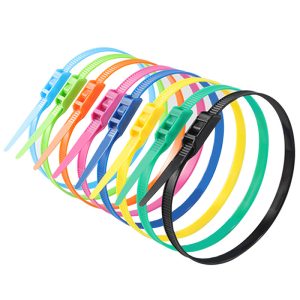
If you manage complex wiring or extended cable runs, standard cable ties may not always be enough. In-line cable ties offer a practical solution for extending, repairing, or organizing cables efficiently. Understanding what they are and when to use them helps you improve cable management reliability and installation flexibility.
What Are In-line Cable Ties?
In-line cable ties are specially designed ties that allow you to connect two cable ties end-to-end or extend the bundling length without replacing existing ties. Unlike standard cable ties, they feature a structure optimized for joining or reinforcing cable bundles.
They are commonly used in maintenance, retrofitting, and large-scale cable routing projects.
How In-line Cable Ties Work
In-line cable ties function by securely locking onto another cable tie or cable section, forming a continuous fastening system. This design allows you to:
Extend cable bundles without removing existing ties
Reinforce weak or overloaded tie points
Repair cable management systems quickly on-site
This makes them ideal for environments where downtime or reinstallation is costly.
When Should You Use In-line Cable Ties?
Cable Extensions and Retrofits
If your cable run becomes longer due to system expansion, in-line cable ties let you extend the bundle without cutting or replacing original ties.
Maintenance and Emergency Repairs
During maintenance, damaged or undersized cable ties can be reinforced using in-line ties, saving time and labor.
Large or Irregular Cable Bundles
When bundling oversized or uneven cable groups, in-line cable ties provide added flexibility compared to fixed-length ties.
Key Advantages of In-line Cable Ties
Reduces the need to remove existing cable ties
Saves installation and maintenance time
Improves flexibility in complex cable layouts
Cost-effective solution for cable management upgrades
For industrial users, these advantages directly translate into improved efficiency.
In-line Cable Ties vs Standard Cable Ties
Feature
In-line Cable Ties
Standard Cable Ties
Length Flexibility
High
Fixed
Retrofit Friendly
Yes
No
Maintenance Speed
Fast
Slower
Reusability
Partial (application-based)
Limited
Best Use Case
Extensions & repairs
Basic bundling
Common Applications
Electrical panels and control cabinets
Industrial machinery wiring
Telecommunications and data centers
Automotive and transportation systems
Any project involving evolving cable layouts can benefit from in-line cable ties.
FAQs
Can in-line cable ties replace standard cable ties?
They are designed to complement standard cable ties, not fully replace them.
Are in-line cable ties strong enough for industrial use?
Yes, when properly selected, they provide reliable strength for industrial cable management.
Do in-line cable ties work with all cable tie sizes?
Compatibility depends on design and size; always check specifications before use.
Can they be used outdoors?
UV-resistant and weatherproof versions are suitable for outdoor applications.
Are in-line cable ties reusable?
Some designs allow limited reuse, depending on locking mechanism and application.
Conclusion
In-line cable ties offer a smart solution when standard cable ties fall short. They improve flexibility, reduce downtime, and simplify cable extensions and repairs. Niuli Electric supplies high-quality in-line cable ties designed for reliable performance, helping you manage cables more efficiently in both industrial and commercial environments.