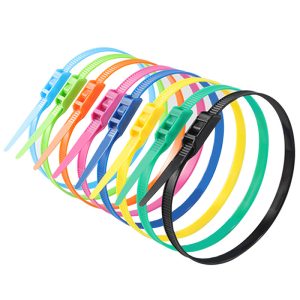
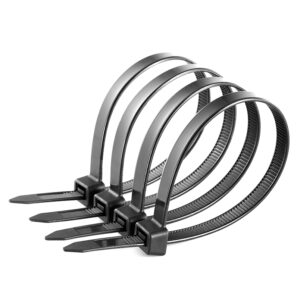
Choosing the right cable tie is crucial for efficient cable management, but with so many options available, how do you know which one is best? In this guide, we compare in-line cable ties with standard cable ties to help you decide which option suits your needs for a secure, organized setup.
What Are In-line Cable Ties?
In-line cable ties are specialized cable ties designed to secure cables or wires in a straight line, often used in applications where the cable or wire runs along a flat surface or in parallel rows. These ties are typically flat and long, allowing for the cables to be securely bundled without twisting or tangling.
Key Features of In-line Cable Ties:
Straight Line Design – Keeps cables aligned and prevents tangling.
Compact – Offers a sleek and tidy appearance.
Ideal for Flat Surfaces – Works well when cables need to be mounted on walls or panels.
Versatile – Suitable for various cable sizes and applications.
What Are Standard Cable Ties?
Standard cable ties are the most common type of cable management solution. They feature a simple design, typically a single strap with a locking mechanism that securely binds cables together. These ties are ideal for most general cable management tasks, from securing wires behind desks to bundling cables in electrical panels.
Key Features of Standard Cable Ties:
Simple and Effective – Straightforward design that’s easy to use.
Available in Multiple Sizes – Suitable for small to large bundles of cables.
Strong and Durable – Ideal for heavy-duty use.
Versatile – Works in a wide range of applications.
In-line Cable Ties vs. Standard Cable Ties: Key Differences
Design and Functionality In-line cable ties are designed for specific applications where cables need to be neatly aligned or mounted on a flat surface. Standard cable ties, on the other hand, are more general-purpose and can be used in a variety of settings to bundle cables together, whether on a wall, in a machine, or behind furniture.
Ease of Use Standard cable ties are generally easier to use and more versatile. They require only a simple pull to secure the cables and can be tightened or loosened by releasing the locking mechanism. In-line cable ties may require more careful placement to ensure the cables are aligned and secured properly.
Strength and Durability Both in-line and standard cable ties are designed to hold cables securely, but standard cable ties are often better for high-stress applications or heavy-duty uses due to their stronger material and locking mechanism. In-line ties are more suitable for lighter, organized installations.
Aesthetics In-line cable ties are often preferred for installations where the appearance is important, as they offer a neat, uniform look. Standard cable ties, while functional, can be bulkier and may not provide the same level of visual appeal for certain installations.
Applications In-line cable ties are ideal for projects where cables must stay in a fixed position along a flat surface, such as in control panels or for outdoor installations. Standard cable ties are better suited for general use, from organizing cables in computers to bundling wires in industrial settings.
Which One Should You Choose?
For Clean and Organized Installations: If you need to keep cables neatly aligned and securely attached to a flat surface, in-line cable ties are the way to go.
For General Use and Flexibility: If you need a simple, versatile solution that works for a variety of applications, standard cable ties are the best option.
For Heavy-Duty Applications: Choose standard cable ties for applications where strength and durability are crucial, such as in industrial or outdoor environments.
For Neat, Aesthetic Installations: Opt for in-line cable ties when the visual appearance of your cable setup matters, such as in high-end electronics or design-focused spaces.
FAQs
Q: Can in-line cable ties be used in outdoor settings?
Yes, in-line cable ties can be used outdoors, especially if you choose UV-resistant models that can withstand exposure to the elements.
Q: Are standard cable ties reusable?
Standard cable ties are typically single-use only, although there are some reusable models available, which feature a locking mechanism that can be undone.
Q: Can in-line cable ties support heavy-duty cables?
In-line cable ties are better suited for lighter-duty applications. For heavy-duty cables, it’s better to use standard cable ties, which provide a stronger grip.
Q: How do I choose the right size cable tie?
When choosing a cable tie, consider the diameter of the cables you need to bundle. Ensure the tie is long enough to wrap around the bundle and secure it firmly.
Conclusion
In-line and standard cable ties both have their advantages depending on your needs. Whether you’re organizing cables for aesthetics, functionality, or durability, Niuli Electric offers a range of high-quality cable ties to suit any project. Choose the right cable tie for your application and experience optimal cable management today.