


Introduction
A vehicle wiring loom is only as reliable as the points that hold it in place. Securing vehicle wiring looms in high temperature conditions is therefore a material selection problem before it is an installation one. This article works through the heat zones inside a vehicle, the failure modes that matter, and how to read a cable tie specification so the fastener you specify survives the environment it is actually mounted in.
What Counts as a High-Temperature Environment in a Vehicle
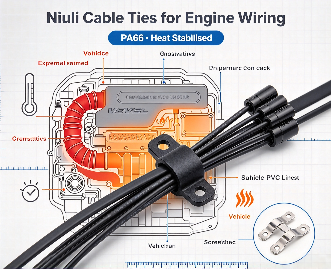
The baseline engine bay in a running vehicle sits around 60°C to 85°C, with peaks during heavy load or in hot climates that push trapped air toward 100°C. The thermal map gets far more demanding close to the exhaust manifold, where local skin temperatures reach 200°C to 400°C on the manifold itself and 120°C to 150°C on nearby surfaces. Turbocharger housings and downpipes behave the same way. The area around the catalytic converter and the front of the cylinder head is the next tier, typically 90°C to 120°C at the mounting surface. Even the cabin side of a bulkhead or a battery box in direct sun can hold 70°C to 90°C in summer.
The practical rule is straightforward. Any tie routed within a hand span of the exhaust or turbo sits in the extreme zone, while any tie elsewhere in the bay sits in the moderate zone. Both routing decisions and material choice follow from that split.
What Actually Fails First in a Hot Engine Bay
Three mechanisms account for most under-hood loom failures, and none of them is a dramatic snap on day one.
Embrittlement of the fastener
Standard PA66 ties are formulated for ambient to moderate heat. Under sustained engine-bay temperatures the polymer slowly loses impact toughness and the moulded tongue becomes brittle. The tie does not break immediately. It loses impact strength first, so the failure shows up later when the loom is disturbed during service or a stone strike lands on a brittle section.
Creep and clamp force loss
Nylon is a viscoelastic material. Held under constant tension at elevated temperature, it creeps, and the bundle diameter it once gripped slackens. A tie that was tight at installation can be loose within a season, letting the loom move and chafe against a neighbouring component.
Abrasion from vibration
A loosely secured loom vibrates against a bracket or pipe. The insulation jacket, not the tie, usually fails first here, rubbing through to the conductor. The root cause is still the tie, because the tie was the element meant to keep the loom still.
The fix for all three starts with selecting a tie rated for the zone, then tensioning it correctly and routing the loom away from the hottest surfaces wherever the harness design allows it.
How to Read a Cable Tie Spec for Under-Hood Use
Working versus installation temperature
A specification sheet shows two numbers, and they are not the same. Installation temperature is the range in which you can physically tension and seat the tie. Working temperature is the range the finished joint must survive for its service life. An engine-bay tie must meet the working figure for the zone, not just the installation figure, because the bay stays hot for years rather than minutes.
Width and bundle diameter
Width sets the tensile rating and the contact area that spreads clamp force. A thicker loom needs a wider tie, not just a longer one, because the load is shared across the strap. Match the tie width to the bundle diameter using the supplier’s published table rather than guessing from length alone.
Material provenance
Virgin PA66 from a named resin grade behaves predictably under heat. Recycled or unknown blends creep earlier and embrittle sooner. For under-hood duty, confirm the resin is 100 percent virgin PA66 from a recognised supplier and that the part carries a flammability rating such as UL 94V-2 plus the relevant certification marks.
How to Choose the Right Tie for Each Heat Zone
- Use the heat map from section 2 and assign a fastener to each zone.
- Classify every loom run as moderate zone or extreme zone before ordering.
- For moderate-zone runs, specify a heat-stabilised PA66 tie rated to at least 120°C working temperature.
- For extreme-zone runs near the exhaust or turbo, move to stainless steel, where no polymer is present to embrittle.
- Confirm width against bundle diameter, allowing one size up for looms that include corrugated conduit.
- Choose black over natural where the run sees sunlight through the grille or sits in a hot climate year round.
- The zone to product routing is summarised below.
| Heat zone | Typical surface temp | Recommended fastener | Why |
| Moderate bay, away from exhaust | 60°C to 90°C | Heat-stabilised PA66, 120°C rated | Polymer stays ductile; lowest cost that still survives |
| Near radiator or cylinder head front | 90°C to 120°C | Heat-stabilised PA66, 120°C rated, black | Matches peak bay temperature with margin |
| Within span of exhaust or turbo | 120°C to 150°C plus | 304 or 316 stainless steel | No polymer to embrittle; holds through thermal cycles |
| Abrading or load-bearing bracket | any | Stainless steel or double-side teeth PA66 | Cut-through and slip resistance under vibration |
Comparative Analysis of Materials
Four materials cover the full range of under-hood duty. The table sets them side by side on the properties that decide a vehicle application.
| Property | Standard PA66 | Heat-stabilised PA66 | 304 Stainless Steel | 316 Stainless Steel |
| Working temperature | -40°C to 85°C | -40°C to 120°C | Up to 150°C plus, no polymer limit | Up to 150°C plus, no polymer limit |
| Embrittlement risk in heat | High after long exposure | Low | None | None |
| UV and abrasion | Moderate, black better | Moderate, black better | Excellent | Excellent |
| Corrosion in chloride | N/A (polymer) | N/A (polymer) | Good, pitting in marine | Better, higher molybdenum |
| Cost | Lowest | Low | Moderate | Higher |
| Best use in a vehicle | Cool interior runs | General engine bay | Exhaust and turbo zone | Coastal or salt-exposed vehicles |
Standard PA66 suits interior and cool runs but should not be the default for the bay. Heat-stabilised PA66 is the workhorse for the moderate zone. Stainless steel earns its place only where the temperature or the abrasion load exceeds what polymer can take, and 316 is the call when the vehicle operates in a coastal or winter-salt environment where chloride attack is a real factor.
Conclusion
Securing vehicle wiring looms in high temperature environments comes down to matching the fastener to the heat zone rather than fitting one tie everywhere. Read the working temperature, not the installation figure, pick heat-stabilised PA66 for the general bay, and reserve stainless steel for the exhaust and turbo runs that sit beyond the polymer limit. Route the loom away from the hottest surfaces wherever the design allows, and the harness will stay put for the life of the vehicle.
Secure Your Vehicle Wiring Looms with Niuli Electric:Niuli publishes cable ties in 304 and 316 stainless substrate options.The stainless comparison above follows industry practice and Niuli’s published 304 versus 316 coastal guidance; certification claims are kept on the PA66 range.
FAQs
What temperature can standard nylon cable ties handle in a car?
Standard PA66 ties are rated for a working range of -40°C to 85°C. That covers interior and cool runs but not the general engine bay in a hot climate, where sustained temperatures push past 85°C. For any under-hood run, move to a heat-stabilised grade rated to 120°C.
How hot does it actually get inside an engine bay?
Trapped bay air runs 60°C to 100°C in normal operation and higher under load or in hot weather. Surfaces near the exhaust manifold, turbo and catalytic converter reach 120°C to 150°C within a few centimetres, and the manifold skin itself runs far hotter. Route ties with that gradient in mind.
Do I need stainless steel cable ties to secure a vehicle wiring loom?
Not for the whole loom. Stainless earns its place only in the extreme zone within a span of the exhaust or turbo, where temperatures exceed the 120°C polymer limit, or where vibration abrasion is severe. The moderate bay is better served by heat-stabilised PA66, which is lighter, cheaper and easier to cut during service.
What size cable tie should I use for a wiring loom bundle?
Match width to bundle diameter, not just length. A loom with corrugated conduit needs a wider strap, typically 7.6 mm or 9 mm, to spread clamp force and avoid cutting the jacket. Allow one width size up for conduit, and confirm against the supplier’s bundle diameter table before ordering.
Are black cable ties better than natural ones under the hood?
For any run that sees sunlight through the grille or sits in a hot climate year round, black is the better choice because the carbon black in black PA66 absorbs and dissipates UV far better than natural resin, which chalks and weakens. Inside a fully enclosed bay the difference is smaller, but black remains the safe default for exterior and grille-adjacent runs.
