


-
Introduction
Nylon cable ties are durable, lightweight, and widely used for electrical wiring, lighting, automotive harnesses, industrial equipment, and general cable management. However, because Nylon 66 (PA66) is hygroscopic, its properties are influenced by the moisture content of the surrounding environment.
This creates an important storage consideration for distributors, electrical contractors, and OEM buyers purchasing cable ties in bulk. A cable tie can leave the factory in a properly conditioned state but gradually lose moisture if it is stored for long periods in a hot or excessively dry warehouse.
When nylon becomes too dry, it can lose flexibility and become more brittle, increasing the risk of cracking or snapping during installation. Niuli’s technical guidance notes that PA66 reaches approximately 2.5% equilibrium moisture content at 23°C and 50% relative humidity, while excessively dry nylon can become more susceptible to brittle failure.
Proper storage is therefore not simply an inventory-management issue. It is part of maintaining the cable tie’s intended mechanical performance from factory to installation site.
-
Why Does Proper Storage Matter for Nylon Cable Ties?
Nylon continuously absorbs and releases moisture according to the surrounding relative humidity. This equilibrium process is one of the defining characteristics of PA66.
At an appropriate moisture level, water molecules interact with the polymer’s amide groups and provide a plasticizing effect, helping the material maintain flexibility and toughness. When the material becomes excessively dry, the polymer structure becomes less mobile and the cable tie can become harder and more brittle.
This matters particularly for bulk inventory because cable ties may spend weeks or months in:
- Warehouses
- Distribution centers
- Shipping containers
- Contractor storage rooms
- Factory stockrooms
- Retail inventory
A cable tie stored correctly can retain a more stable material condition until installation. Poor storage, on the other hand, can gradually change the moisture content even when the original product quality was good.
This is also why proper factory conditioning and proper warehouse storage should be treated as two parts of the same quality-control process. Niuli’s Factory Hydration Conditioning targets approximately 2.5%–3.0% moisture content before shipment, helping reduce the risk of dry-brittle behavior.
-
How to Store Bulk Nylon Cable Ties Properly
Keep Original Packaging Sealed
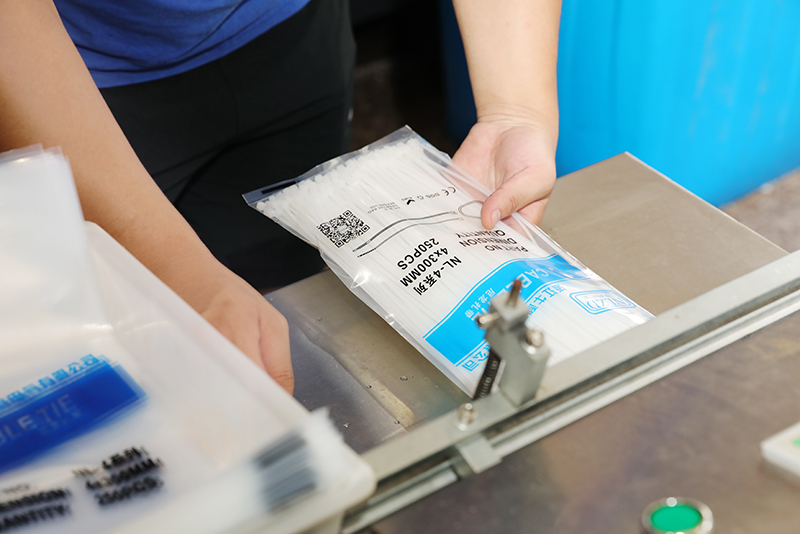
The most important storage rule is simple: keep nylon cable ties in their original sealed packaging until they are needed.
Nylon naturally exchanges moisture with the air. Once packaging is opened, the cable ties are exposed to the warehouse’s relative humidity and can gradually gain or lose moisture.
For bulk inventory:
- Keep unopened bags sealed.
- Avoid opening multiple bags unnecessarily.
- Reseal partially used packages as soon as possible.
- Store cable ties in their original moisture-protective packaging whenever possible.
- Do not transfer large quantities into open containers.
This is particularly important for distributors that may hold inventory for several months.
A properly sealed package helps preserve the moisture condition established during manufacturing and reduces uncontrolled moisture exchange during storage.
Control Humidity and Moisture
Warehouse humidity is one of the most important variables for nylon storage.
For bulk nylon cable ties, a practical warehouse target is approximately 40%–60% relative humidity (RH), with a preferred temperature range of around 15°C–25°C for routine storage. These conditions provide a controlled environment without excessive dryness or unnecessary heat.
The reason is straightforward. PA66 is constantly moving toward equilibrium with the surrounding atmosphere. At approximately 23°C and 50% RH, Niuli’s technical guidance identifies an equilibrium moisture content of around 2.5%for PA66.
This does not mean that every warehouse must maintain exactly 50% RH, but it provides a useful reference point for inventory management.
For industrial warehouses:
| Storage Parameter | Recommended Target |
| Relative Humidity | 40%–60% RH |
| Temperature | 15°C–25°C |
| Packaging | Sealed until use |
| Direct sunlight | Avoid |
| Heat sources | Avoid |
| Inventory rotation | FIFO |
Extremely dry conditions can gradually remove moisture from nylon. Conversely, excessive humidity or prolonged water exposure can cause nylon to absorb too much moisture and alter its mechanical properties. Niuli notes that moisture generally increases flexibility while excessive moisture can reduce tensile strength.
The objective is therefore controlled moisture equilibrium, not maximum humidity.
Avoid Heat and Direct Sunlight
Temperature and sunlight should also be controlled during storage.
Direct sunlight can heat packaged cable ties well above the surrounding warehouse temperature and may expose them to UV radiation even before installation. Long-term heat exposure can accelerate polymer aging, while direct UV exposure can be particularly damaging to products that are not specifically designed for outdoor use.
Do not store bulk cable ties:
- Near heaters or boilers
- Against hot machinery
- In unventilated containers exposed to sunlight
- Near windows receiving direct sunlight for long periods
- Inside vehicles or shipping containers exposed to extreme heat
A cool, shaded, dry, and well-ventilated warehouse is preferable.
For standard Nylon 66 cable ties, Niuli’s product specifications commonly list a working temperature range of -40°C to 85°C, but that operating specification should not be interpreted as a recommendation for long-term warehouse storage at elevated temperatures.
Follow Proper Inventory Rotation
Long storage periods increase the opportunity for moisture content to change, packaging to deteriorate, and products to be exposed to unsuitable conditions.
For this reason, bulk cable-tie inventory should follow a FIFO (First In, First Out) system.
When receiving new stock:
- Record the production or receiving date.
- Place older inventory in front of newer inventory.
- Use older stock first.
- Check packaging integrity periodically.
- Inspect opened bags before installation.
FIFO is especially useful for distributors and contractors handling thousands or millions of cable ties because it reduces the possibility of old stock remaining forgotten at the back of the warehouse.
-
What Happens When Nylon Cable Ties Dry Out?
When PA66 loses excessive moisture, its mechanical behavior can change significantly.
Reduced Flexibility
The material becomes more rigid, making the strap harder to bend around a cable bundle.
Increased Brittleness
Dry nylon is more susceptible to cracking when subjected to bending or sudden tensile stress.
Installation Breakage
A dry cable tie may snap while the installer is pulling the strap through the locking head, particularly when the tie is heavily tensioned.
Reduced Toughness
Dry PA66 can tolerate less deformation before fracture. This can be problematic in applications involving vibration, impact, or repeated movement.
Niuli’s technical guidance identifies moisture levels below approximately 1.2% as a particularly brittle condition for PA66 cable ties.
Importantly, premature cracking is not caused by storage alone. Other factors can contribute, including low-quality raw materials, incorrect cable-tie sizing, excessive installation force, or degraded inventory.
-
How to Restore Moisture to Dried Nylon Cable Ties?
Nylon can absorb moisture again, but restoring dried-out cable ties should be approached carefully.
The safest approach for B2B users is to prevent excessive drying in the first place through proper packaging and warehouse control.
If cable ties have already become excessively dry, uncontrolled soaking is not recommended. Simply placing the products in water can result in uneven moisture absorption and may change the material’s mechanical properties.
Industrial reconditioning should instead use controlled humidity and temperature conditions to allow moisture to diffuse gradually throughout the nylon.
This distinction is important because nylon should not be treated as a material where “more water equals better performance.” Moisture improves flexibility, but excessive moisture can also reduce stiffness and tensile strength.
For large-volume commercial inventory, it is generally preferable to obtain properly conditioned products from the manufacturer rather than relying on improvised rehydration after storage failure.
-
Why Choose Niuli Electric Nylon Cable Ties?
Niuli Electric manufactures Nylon 66 cable ties with controlled material specifications and multiple product options for electrical, industrial, automotive, and lighting applications.
Its cable-tie range uses UL-approved Nylon 66 across relevant products, with specifications including tensile strength, installation temperature, working temperature, and certifications. For example, Niuli’s standard Nylon 66 products commonly specify an installation temperature of -10°C to 85°C and a working temperature of -40°C to 85°C.
A key quality feature for moisture-sensitive nylon products is Niuli’s Factory Hydration Conditioning, which targets approximately 2.5%–3.0% moisture content before shipment. This helps provide a more controlled starting moisture condition and reduces the risk of dry-brittle behavior during installation.
Niuli also offers a wide selection of lengths, widths, bundle diameters, and tensile strengths. This allows B2B customers to match the cable tie to the actual application rather than relying on a single standard specification.
For distributors and OEM customers, maintaining this material condition after delivery is equally important. Proper packaging, warehouse humidity, temperature control, and FIFO inventory management can help preserve the performance established during manufacturing.

-
FAQs
Q1. What is the best humidity for storing nylon cable ties?
A practical industrial storage target is approximately 40%–60% RH, with a temperature of around 15°C–25°C. These conditions help prevent excessive drying while avoiding unnecessary moisture exposure.
Q2. Should nylon cable ties remain in their original packaging?
Yes. Keeping the original packaging sealed until use helps reduce uncontrolled moisture exchange with the surrounding environment.
Q3. Can nylon cable ties dry out in storage?
Yes. Prolonged exposure to very dry air can reduce the moisture content of PA66, making the material stiffer and more brittle.
Q4. At what moisture level can Nylon 66 become brittle?
Niuli’s technical guidance identifies moisture content below approximately 1.2% as a particularly brittle condition for PA66, while approximately 2.5% is associated with equilibrium moisture at 23°C and 50% RH.
Q5. Can I put dried cable ties in water to restore them?
This is not recommended as a simple field-storage solution. Uncontrolled soaking can produce uneven moisture absorption and alter mechanical properties. Controlled conditioning is preferable.
Q6. How long can nylon cable ties be stored?
There is no single universal shelf life because storage temperature, humidity, packaging integrity, product formulation, and inventory conditions all affect material performance. Properly sealed packaging and controlled warehouse conditions help maximize storage stability.
Q7. Does high humidity damage nylon cable ties?
Not necessarily. Nylon naturally absorbs moisture, and moderate humidity is part of its normal conditioning behavior. However, prolonged exposure to very high humidity, liquid water, or unsuitable temperatures can affect mechanical properties and dimensional stability.
-
Conclusion
Proper storage is essential for maintaining the performance of bulk Nylon 66 cable ties.
The key is to preserve the moisture condition established during manufacturing. Keep the original packaging sealed, maintain a controlled warehouse environment of approximately 40%–60% RH and 15°C–25°C, protect inventory from direct sunlight and excessive heat, and use FIFO inventory management.
For nylon cable ties, storage conditions directly affect material condition. Excessive drying can reduce flexibility and increase brittleness, while excessive moisture can also alter tensile performance.
Niuli’s Factory Hydration Conditioning, which targets approximately 2.5%–3.0% moisture content, provides a controlled starting point before the products enter the distribution chain.
For bulk buyers, however, factory conditioning is only the first step. Proper packaging + controlled warehouse conditions + correct inventory rotation are essential to maintaining cable-tie quality all the way to installation.
To review Niuli’s available Nylon 66 specifications, visit the Nylon Cable Tie Catalog. For bulk requirements or storage-sensitive applications, Request Free Samples and evaluate the products before placing a larger order.
Need advice on storing bulk nylon cable ties for your distribution or production facility? Contact Niuli Electric with your storage conditions and purchasing requirements for a suitable solution.
