


Choosing the correct cable tie size is essential for reliable cable management. The right length, width, and material grade help prevent failures, reduce maintenance costs, and ensure long-term performance in electrical, automotive, and industrial applications. Most industrial nylon cable ties are manufactured from virgin PA66 (nylon 66).
What Are Cable Ties?
Cable ties, also known as zip ties or wire ties, are self-locking thermoplastic fasteners designed to bundle, secure, and organize cables, hoses, tubing, and lightweight components. Most industrial-grade variants are molded from virgin polyamide 66 (PA66) for balanced strength, chemical resistance, and long-term durability.
While material grade and environmental rating are key performance factors, proper sizing is the foundation of effective cable management. Even the highest-quality, most chemically resistant tie will underperform or fail if its dimensions do not match the bundle size, load weight, and installation space of the application.
Understanding Cable Tie Dimensions: The 3 Core Sizing Parameters
Cable tie sizing is defined by three interdependent dimensions, each directly influencing fit, load capacity, and installation suitability.
Length (mm & inches): Matching Tie Length to Maximum Bundle Diameter
Cable tie length measures the total usable strap from the base of the locking head to the tapered tip. It is the primary dimension that determines the largest bundle diameter a tie can securely wrap around.
As a universal industry rule of thumb, the selected tie length should exceed the circumference of your bundle by at least 1–2 inches (25–50 mm). This extra length ensures full engagement of the internal ratchet mechanism, which is required to achieve the tie’s published tensile strength. Trimming excess tail after installation is standard and safe practice, but insufficient engagement leads to slippage or sudden failure under mechanical load.
For reference, a 200 mm (8 inch) general-purpose tie typically handles bundle diameters up to roughly 50 mm (2 inches), while 480 mm (19 inch) heavy-duty ties accommodate bundles over 120 mm (4.7 inches) in diameter.
| Width | Length | Typical Application |
| 2.5mm | 100-160mm | Small wire bundles |
| 3.6mm | 150-300mm | Electrical panels |
| 4.8mm | 200-500mm | Industrial wiring |
| 7.6mm+ | Heavy-duty applications |
Width (mm & inches): Direct Correlation to Loop Tensile Strength
Strap width is the primary determinant of a cable tie’s loop tensile strength, measured in pounds (lbf) or kilograms (kgf). Wider straps have a larger cross-sectional material area, enabling them to bear heavier loads and resist creep — gradual deformation under sustained tension.Typical tensile ratings include:
- Light-duty ties (2.5 mm / 0.1 inch wide): Rated for 8–18 kg (18–40 lbf), suitable for small signal wire bundles and light indoor use.
- Medium-duty ties (3.6 mm / 0.14 inch wide): Rated for 22–35 kg (50–80 lbf), the most widely specified grade for general electrical panel and manufacturing assembly.
- Heavy-duty ties (4.8 mm / 0.19 inch wide and above): Rated for 55 kg (120 lbf) or more, designed for large power cables, hydraulic hoses, and permanent outdoor infrastructure loads.
Selecting width based on actual bundle weight, rather than defaulting to the economic option, prevents on-site breakage and reduces long-term maintenance labor.
Thickness & Locking Head Profile: Clearance for Tight Spaces
While less frequently discussed, strap thickness and overall head profile are critical for installations in confined spaces such as control cabinets, engine bays, or compact equipment enclosures.
Thicker straps deliver higher tensile strength, but they also require a larger bending radius and may not feed through narrow openings. Similarly, reinforced heavy-duty heads are bulkier than standard single-piece heads and can interfere with adjacent components in dense wiring setups.
 How to Choose the Right Cable Tie Size for Your Application
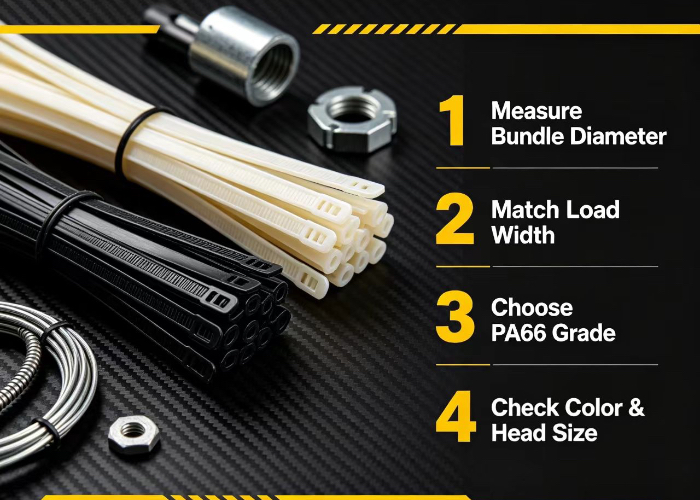
With a clear understanding of core dimensions, you can systematically match cable tie size to your project requirements using the following four-step framework.
Start by Calculating Your Bundle Diameter
Begin by measuring the circumference of your largest cable or hose bundle, or simply measure across the widest point of the fully assembled bundle. Add 1–2 inches of safety margin for ratchet engagement, then select the shortest standard tie length that fully wraps the bundle with room to spare.
For large-diameter bundles of power cables, hydraulic hoses, or conduit, opt for extra-long heavy-duty ties. Joining multiple short ties together is never recommended for load-bearing applications, as it creates a weak point and violates most electrical and industrial installation codes.
Match Strap Width to Load and Operating Environment
Next, align tie width with the weight of the bundle and the conditions it will face. Static, lightweight indoor bundles work well with narrow, light-duty ties. Heavy bundles, outdoor installations subject to wind loading, or equipment exposed to continuous vibration require wider, higher-tensile ties to maintain clamping force over time.
For outdoor use, pair the correct width with UV-stabilized black PA material to ensure both load capacity and weather resistance. For high-temperature environments such as machinery enclosures, select heat-stabilized grades in the appropriate width to prevent softening and creep.
Align Material Grade with Performance Requirements
Size and material work hand in hand. Industrial-grade nylon 66 is the global standard for most heavy-duty and environmental applications, delivering balanced tensile strength, thermal stability, and chemical resistance. Premium formulations like those from Niuli Electric .Niuli Electric manufactures cable ties using high-quality virgin PA66 materials to ensure consistent strength, durability, and dimensional stability ,offering reliable resistance to alkali, oils, greases, oil derivatives, and chloride solvents, alongside high and low temperature tolerance, flame retardancy, and UV stability.
For cost-sensitive, light-duty indoor projects, Nylon 6 ties in equivalent dimensions deliver solid performance at a lower unit cost. For extreme environments including prolonged UV exposure, sustained high heat, or corrosive conditions, size your tie appropriately and upgrade to specialty grades such as heat-stabilized PA66, UV-stabilized black nylon, or stainless steel to match the duty cycle.
Factor in Color and Special Functional Features
Finally, adjust your size selection to accommodate special features. Color-coded ties support circuit identification and inventory classification, but they share the same core dimensions as natural or black variants. Push-mount, marker, or double-lock ties may have slightly larger head profiles, so verify total head dimensions if installation space is limited.
5 Practical Tips for Optimal Cable Tie Sizing and Usage
To maximize performance and value from your cable tie selection, follow these five actionable best practices:
- never too short: It is always acceptable to trim excess strap from a longer tie, but a tie that is too short cannot be safely extended. When in doubt between two lengths, choose the longer option.
- Size up for safety-critical loads: For overhead installations, heavy hose bundles, or infrastructure applications where failure creates a safety risk, select the next wider tie to add an extra safety margin.
- Account for thermal expansion and moisture absorption: Nylon swells slightly as it absorbs moisture and expands with heat. Leave minor slack in bundles exposed to temperature swings, and avoid sizing ties so tightly that they cut into cable insulation.
- Standardize core sizes across facilities: Reduce SKU complexity and lower bulk costs by standardizing on 2–3 core sizes that cover 80% of your daily applications, with specialty sizes on hand for unique projects.
- Validate clearance before bulk ordering: For dense control panels or tight equipment compartments, order sample ties first to verify the head fits within available space without interfering with surrounding components.
Conclusion
Choosing the right cable tie size is a simple but critical procurement decision. Measure bundle diameter to determine length, match width to required tensile strength, and factor in installation space and environmental conditions. This ensures reliable performance at the lowest total cost. Oversizing wastes money. Undersizing risks safety and increases maintenance. The best approach is a focused, application-specific selection—balancing fit, strength, and long-term value.
NIULI Electric,Our cable ties are certified to UL, CE, RoHS, REACH, SGS, and BSCI standards.Niuli Electric supplies nylon cable ties for global industrial customers with certifications including UL, CE, RoHS, REACH, SGS, and BSCI.
We offer full OEM/ODM customization: custom sizes, colors, and packaging. Every order undergoes a three-stage quality inspection, and our trade team provides 24/7 support.
Our engineers will help you select the right size and grade—and quote competitive bulk pricing.
Contact Niuli Electric for samples and sizing guidance:https://www.cabletienylon.com/
FAQs
Q1: How do I calculate what length cable tie I need?
Measure the circumference of your bundle, then add 1–2 inches (25–50 mm) to ensure full ratchet engagement. Select the next longest standard tie size from there.
Q2: Does a wider cable tie always mean a stronger cable tie?
For the same material and thickness, yes — a wider strap has a larger cross-sectional area and delivers higher tensile strength. Material grade and formulation also impact overall strength and durability.
Q3: Can I connect two short cable ties together to make a longer one?
Joining ties is not recommended for load-bearing or permanent installations, as the connection creates a weak point with reduced tensile strength. Use a single properly sized long tie instead.
Q4: What cable tie size is best for electrical control panels?
For most indoor control panel wiring, medium-duty 3.6 mm wide, 200 mm long (8 inch) PA66 cable ties are the standard choice, balancing strength, compact size, and cost efficiency.
Q5: Is it okay to cut off the excess tail of a cable tie?
Yes, trimming the excess strap flush with the head after tightening is standard practice. Use sharp cutters to create a clean edge and avoid sharp protrusions that could cause injury during maintenance.
