


Introduction
An electrical box on a soft concrete wall lives or dies by four fixing points. A single pulled plug leaves a socket dangling and opens a compliance gap no inspector will pass. On dense concrete the job is routine, but on soft concrete the same plug can spin, sink, or walk out within a season. The cause is rarely the plug alone. Soft concrete quietly changes the sizing rules, and most failures come from applying a dense-wall table to a wall that does not behave like one. This article sets out a diameter, length, and material selection method that holds on low-strength and aerated masonry, using values already published for these substrates.
What “Soft Concrete” Does to a Sizing Decision
Soft concrete is a working term, not a single material. It covers low compressive strength pours, aerated autoclaved concrete (AAC), honeycombed or weathered sections, and porous blockwork. On all of them the drill wanders and the bit spalls the rim, so the finished hole ends up 5 to 10 percent larger than the bit’s rated diameter. The plug then grips a wall that is not where the drill said it would be.
Standard sizing tables assume a tight, on-nominal hole. On soft concrete that assumption fails, and the lost margin has to be designed back in through interference and embedment. Treat every soft wall as if the first few millimetres of depth are unreliable, and size the plug to reach past them into sound material.
How to Size Wall Plug Diameter for an Electrical Box
Start from the screw
The plug follows the screw, not the other way round. Choose the screw first from the box’s fixing lugs and the expected load, then pick a plug whose bore is built around that screw shank. A 5 by 40 mm or 5 by 50 mm pan-head or countersunk screw is typical for a single-gang box, while heavier boxes move to 6 mm screws. The plug nominal of 6 mm, 8 mm, or 10 mm is the screw size it is engineered around, not the drill size.
The interference target
The plug must be larger than the hole by a controlled amount. Aim for 0.3 to 0.5 mm of interference between the plug outside diameter and the finished bore. Too little and the plug rotates under torque; too much and the soft wall cracks or the plug folds instead of expanding. On soft concrete, hold the upper end of that band, because some of the interference is spent simply closing the oversize hole the drill left behind.
The tolerance band
Keep the drilled bore inside a ±0.2 mm band (ANSI B212.15-1994). A worn bit loses more than 0.2 mm at the cutting edge and drills oversize, so check the bit roughly every 200 holes. Map the nominal to the bit as follows: a 6 mm plug takes about a 6.6 mm bit, an 8 mm plug about 8.5 mm, and a 10 mm plug about 10.0 to 10.1 mm. The allowed bores for standard fractional bits land at 6.35 mm to 6.60 to 6.81 mm, 7.94 mm to 8.51 to 8.72 mm, and 9.53 mm to 9.91 to 10.11 mm.
| Screw / plug nominal | Plug outside diameter | Recommended drill bit | Allowed bore window |
| 6 mm | ~6.0 mm | 6.6 mm | 6.60 to 6.81 mm |
| 8 mm | ~8.0 mm | 8.5 mm | 8.51 to 8.72 mm |
| 10 mm | ~10.0 mm | 10.0 to 10.1 mm | 9.91 to 10.11 mm |
How to Size Wall Plug Length: The Embedment Formula
Length is the number that gets botched
Most field failures trace back to a plug that is too short for the substrate, not too thin. Length governs embedment, and embedment governs pull-out on soft concrete. A plug that barely reaches the sound layer holds nothing once the surface crumbles under load.
Worked example
Take a 50 mm thick soft block wall and a box whose lug sits 15 mm off the surface after plaster. Required embedment in sound material is 40 mm minimum. Plug length equals surface offset plus embedment plus a 5 mm driving allowance, so 15 + 40 + 5 = 60 mm. A 50 mm plug would fall short of sound material. A 60 mm plug seats in it. On a 100 mm wall the same logic points to 80 mm or more.
Working ranges
For standard concrete, 50 to 60 mm plugs are the norm. For deep, weathered, or high-stability fixings on soft substrates, specify 80 mm and above so the tip reaches sound material beyond the degraded zone. When the wall is the weak link, length beats diameter every time.
| Wall condition | Surface offset | Min embedment | Plug length to specify |
| Standard concrete, box flush | ~10 mm | 40 mm | 50 to 60 mm |
| Soft block, lug off surface | 15 mm | 40 mm | 60 mm |
| Weathered or deep wall | 20 to 30 mm | 50 mm | 80 mm and above |
How to Choose the Plug Material for Soft Concrete
Nylon (PA6/PA66 family) is the default for soft substrates
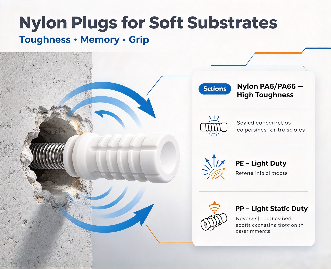
Nylon wall plugs from the PA6/PA66 family carry high toughness and hold their shape under disturbed conditions, which is exactly what soft concrete demands. Published comparison puts PA66 near 80 MPa against PE at 20 to 40 MPa, a margin that matters when the substrate itself is low strength. Niuli’s high-toughness nylon plugs are described as resistant and not easy to break, finished in white and grey, and carry CE, RoHS, REACH, and SGS marks for compliant electrical work.
Mechanical memory matters here
On soft walls the plug gets disturbed during driving and loading. Nylon’s mechanical memory lets the plug re-expand and re-seat after minor movement, so a fixing that would walk out in a brittle polymer stays put. This is why nylon, not PE, is the default where the substrate moves and the fixing is critical.
Where PE and PP still fit
PE and PP plugs remain valid for light, static, indoor duty where the wall is sound and the load is small. PP in particular gives a thick tube wall and good elasticity for lightweight materials, but its lower strength makes nylon the better call for a live electrical box on soft concrete. Reserve PE or PP for the non-critical run.
| Material | Strength context | Best use on soft concrete | Limitation |
| Nylon PA6/PA66 | ~80 MPa | Dynamic or critical fixings, electrical boxes | Higher cost than PE or PP |
| PE | 20 to 40 MPa | Light static indoor duty | Lower toughness |
| PP | 20 to 40 MPa | Lightweight materials, elastic grip | Lower strength, indoor use |
How to Size an Electrical Box Fixing
- Bring the dimensions together into a four-step check before opening the catalogue:
- Read the box lug and pick the screw, usually 5 mm or 6 mm.
- Match the plug nominal to that screw, choosing 6 mm, 8 mm, or 10 mm.
- Set the drill bit from the table and keep the bore inside ±0.2 mm; pilot test 0.5 mm under the callout on an offcut first.
- Set plug length from surface offset plus 40 to 50 mm of embedment, then round up to the next standard length of 60 mm or 80 mm.
Use low impact and never a full hammer on aerated concrete, so the hole stays on size. A correctly sized nylon wall plug holds the box through the thermal and load cycles that would spin a loose PE plug. For the duty-class boundary between plastic plugs and expansion bolts, see the plastic wall plugs versus expansion bolts comparison.
| Box type | Screw | Plug nominal | Bit | Plug length |
| Single-gang flush | 5 mm | 6 mm | 6.6 mm | 50 to 60 mm |
| Single-gang off-surface | 5 mm | 6 mm | 6.6 mm | 60 mm |
| Double-gang, soft block | 6 mm | 8 mm | 8.5 mm | 60 to 80 mm |
What to Do When the Hole Is Already Too Big
A drilled hole that exceeds the bore window will not hold, and forcing the screw only folds the plug or cracks the wall. Work the options in order. Step up one plug size and re-drill to the larger bit. Pack the void only as a temporary field repair, never as the design. Or move to a chemical or sleeve anchor that develops load in deeper sound material. On soft concrete the fix is more embedment or a different anchor class, not more torque. The high-toughness PA66 versus PE dynamic shear piece explains why stepping up material helps when the substrate itself is weak.
Conclusion
Sizing a nylon wall plug for an electrical box on soft concrete starts from the screw and the embedment, not the catalogue nominal. Hold a 0.3 to 0.5 mm interference, keep the bore inside ±0.2 mm, and specify length for sound material rather than wall thickness. Choose nylon PA6/PA66 for the critical fixing and reserve PE or PP for light static runs.
Secure Your Electrical Box Fixings with Niuli Electric: Niuli Electric is a China-based manufacturer of nylon cable ties, cable glands, cable clips, wall plugs, terminals, and soldering accessories, serving distributors, private-label brands, and industrial buyers worldwide.
FAQs
What size wall plug do I need for an electrical box on soft concrete?
Start from the box lug screw, usually 5 mm or 6 mm, then use a 6 mm or 8 mm plug. On soft concrete set the drill bit to 6.6 mm or 8.5 mm and keep the bore inside the ±0.2 mm band. Length matters more than diameter: allow 40 to 50 mm of embedment in sound material beyond the surface offset, so specify 60 mm for a typical wall and 80 mm for a weathered or deep one.
What drill bit size matches a 6 mm, 8 mm and 10 mm wall plug?
A 6 mm plug takes about a 6.6 mm bit, an 8 mm plug about 8.5 mm, and a 10 mm plug about 10.0 to 10.1 mm. These sit inside the allowed bore windows of 6.60 to 6.81 mm, 8.51 to 8.72 mm, and 9.91 to 10.11 mm. Always check the bit for wear past 0.2 mm at the edge and pilot test 0.5 mm under the callout on an offcut before committing to the wall.
How long should a wall plug be for soft concrete?
Long enough to reach sound material. For standard concrete, 50 to 60 mm plugs are normal. On soft, weathered, or deep walls, specify 80 mm and above so the tip clears the degraded surface zone. Use the formula length equals surface offset plus 40 to 50 mm embedment plus a small driving allowance, then round up to the next standard length.
Are nylon wall plugs better than PE or PP for soft concrete walls?
For a live electrical box on soft concrete, yes. Nylon PA6/PA66 runs near 80 MPa against 20 to 40 MPa for PE and PP, and its mechanical memory re-seats after disturbance. PE and PP remain sound choices for light, static, indoor duty where the wall is sound. The deciding factor is whether the fixing is critical and the substrate moves. If both are true, nylon is the default.
How many fixings does an electrical box need on a soft wall?
Follow the box manufacturer’s lug count, normally two or four for a single-gang box and four for a double-gang. On soft concrete, do not reduce that count to compensate for a weak substrate. Instead size each plug for embedment and use nylon for toughness. If the wall is so weak that lugs still pull, add a backplate or move to sleeve anchors rather than overloading the existing holes.
