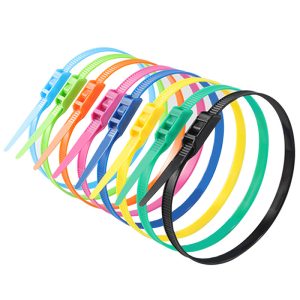
When you manage cables in homes, offices, or industrial systems, you want the setup to look clean while maintaining proper airflow. In-line cable ties help you organize wires in a straight, compact manner, improving aesthetics and reducing airflow blockages. This blog explains why these ties are essential for efficient cable management.
What Are In-line Cable Ties?
In-line cable ties are designed to hold multiple cables in a parallel, streamlined formation. Unlike standard ties that bunch cables together, in-line ties keep them aligned in a flat, neat layout, making them ideal for tight spaces and airflow-sensitive environments.
How In-line Cable Ties Improve Cable Aesthetics
Creating a Clean, Professional Appearance
Cables arranged in straight, parallel lines instantly improve visual appeal, whether in server rooms, office desks, or home entertainment setups.
Reducing Clutter in Tight Spaces
In-line cable ties prevent bulky cable clusters, allowing you to create a minimal, organized look even in limited installation spaces.
Supporting Color-Coded or Labeled Layouts
Keeping cables flat makes labeling and identification much easier, improving maintenance efficiency.
How In-line Cable Ties Improve Airflow
Minimizing Airflow Obstruction
Bunched cables disrupt air circulation inside HVAC systems, network cabinets, and equipment racks. In-line ties keep cables thin and flat, reducing resistance.
Improving Equipment Cooling
By opening more free space around cables, in-line ties allow heat to disperse more naturally, preventing hotspots and protecting components like servers, routers, and power supplies.
Enhancing Energy Efficiency
Better airflow reduces the workload on cooling systems, lowering energy consumption and extending equipment life.
Best Places to Use In-line Cable Ties
Data centers and server racks
HVAC systems and air-handling units
Home theaters and entertainment systems
Office cable routing and desk setups
Industrial control panels
Automotive wire routing
Tips for Installing In-line Cable Ties
Arrange cables by length before securing
Avoid crossing wires to maintain airflow
Leave slight slack to prevent tension damage
Use labels for easy future maintenance
Choose UV-resistant or heat-resistant versions for harsh environments
FAQs
What is the main difference between in-line ties and standard cable ties?
In-line ties align cables in a straight, flat layout, while standard ties bunch them into a round bundle.
Do in-line cable ties really improve airflow?
Yes, the flat arrangement significantly reduces airflow obstruction.
Can I use in-line ties for outdoor installations?
Yes, as long as you choose UV-resistant or weatherproof materials.
Are in-line cable ties reusable?
Some versions are reusable, but most are single-use for secure fastening.
Do they work for thick power cables?
Yes, but heavy cables may require wider in-line tie designs or stainless steel variants.
Conclusion
In-line cable ties give you cleaner cable management and improved airflow performance, whether you’re organizing a server rack or setting up equipment at home. Their streamlined design enhances efficiency and aesthetics. If you need reliable cable ties for any environment, Niuli Electric offers durable, high-quality solutions tailored to your projects.