


Introduction
When it comes to routing and managing cables in engines, industrial ovens, or aerospace applications, using the wrong zip tie is a costly mistake. Standard plastic cable ties are great for the office, but in high-temperature environments, they will dry out, become brittle, melt, and eventually cause catastrophic wiring failures.
If you are an engineer or procurement manager asking, “Which heat-proof cable ties should I buy?” or “Can zip ties melt?”, you are in the right place.
In this complete guide, we will answer your thermal performance questions and break down the Top 6 Best Heat-Resistant Cable Ties available on the industrial market today, ranging from enhanced nylon to extreme-heat stainless steel.
Do Zip Ties Melt? (Understanding Thermal Failure)
Yes, standard plastic zip ties can and will melt when exposed to extreme heat.
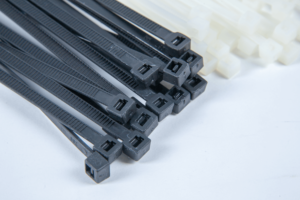
Most general-purpose zip ties are made from Standard Nylon 66. While Nylon 66 has an actual melting point of around 250°C to 260°C (482°F – 500°F), it begins to lose its mechanical strength and structural integrity at a much lower temperature—around 85°C (185°F).
When a standard tie is continuously exposed to temperatures above 85°C, the plasticizers evaporate. The tie won’t turn into a puddle of liquid immediately, but it will warp, deform, and snap under tension, leading to severe safety hazards.
That’s why environments like automotive under-hoods, heavy machinery, and HVAC systems demand high-temperature zip ties engineered with thermal stabilizers or made from entirely different materials.
The Best 6 Heat-Resistant Cable Ties for Industrial Use
Not all high-heat environments are the same. A boiler room requires different fastening solutions than an outdoor solar farm. Here are the 6 most reliable heat-resistant cable ties ranked from moderate high-heat to extreme high-heat.
1. Heat-Stabilized Nylon 66 Cable Ties (The Industry Workhorse)
This is the most popular and cost-effective upgrade from standard ties. During manufacturing, special thermal stabilizers (which often give the tie a slight greenish tint or are blended with black UV stabilizers) are added to the nylon resin.
-
Continuous Operating Temp: Up to 120°C (248°F)
-
Best For: Automotive engine bays, HVAC installations, electrical control panels, and general industrial machinery. Explore our Heat-Stabilized Nylon Cable Ties
2. High-Temperature Nylon 46 Cable Ties
When 120°C isn’t enough, Nylon 46 steps in. It is a highly crystalline polyamide that offers a significantly higher thermal threshold than Nylon 66 while maintaining excellent flexibility and tensile strength.
-
Continuous Operating Temp: Up to 150°C (302°F)
-
Best For: Heavy-duty automotive, commercial vehicle exhausts, and engine compartments where extreme heat spikes occur.
3. ETFE (Tefzel®) Cable Ties
ETFE (Ethylene Tetrafluoroethylene) ties are premium fasteners designed for environments that demand both high heat resistance and extreme chemical/radiation resistance. They do not emit toxic smoke when burned.
-
Continuous Operating Temp: Up to 150°C (302°F)
-
Best For: Nuclear power plants, chemical processing facilities, and aerospace wiring.
4. PEEK Cable Ties (Polyetheretherketone)
PEEK is one of the most advanced, high-performance thermoplastic materials in the world. PEEK cable ties offer the ultimate combination of extreme heat resistance, radiation resistance, and physical strength in a lightweight plastic form.
-
Continuous Operating Temp: Up to 260°C (500°F)
-
Best For: Deep-hole drilling (Oil & Gas), aerospace, and high-heat vacuum environments.
5. Uncoated Stainless Steel Cable Ties (304 / 316 Grade)
When you exceed the limits of all plastics, you must switch to metal. Made from 304 or marine-grade 316 stainless steel, these ties use a self-locking ball-bearing mechanism and are virtually indestructible by heat.
-
Continuous Operating Temp: -80°C to +538°C (-112°F to 1000°F)
-
Best For: Petrochemical plants, mining, shipbuilding, solar farms, and securing heavy industrial pipes. Discover our indestructible Stainless Steel Cable Ties
6. Epoxy/Polyester Coated Stainless Steel Ties
These ties offer the massive 538°C (1000°F) core strength of stainless steel, but feature a rugged epoxy or polyester coating. Why? The coating protects sensitive, soft-jacketed cables from being cut by the metal edges, and prevents galvanic corrosion when strapped to galvanized steel pipes.
-
Continuous Operating Temp: Up to 150°C (302°F) for the coating (Core metal remains heat-proof).
-
Best For: Offshore wind farms, sensitive fiber optic cables in hot zones, and harsh weather environments.
Quick Comparison Chart: High-Temp Cable Ties
| Cable Tie Type | Max Continuous Temp | Primary Advantage |
| Heat-Stabilized Nylon 66 | 120°C (248°F) | Most cost-effective high-heat plastic |
| Nylon 46 | 150°C (302°F) | Better thermal stability than PA66 |
| ETFE (Tefzel) | 150°C (302°F) | Chemical & Radiation proof |
| PEEK | 260°C (500°F) | Ultimate high-temp plastic |
| Coated Stainless Steel | 150°C (Coating limit) | Extreme strength + Cable protection |
| Bare Stainless Steel | 538°C (1000°F) | Fireproof & Indestructible |
Conclusion: Don’t Compromise on Heat Resistance
Understanding the thermal demands of your specific project is critical. Asking “Can zip ties melt?” is just the first step; investing in the correct heat-proof cable tie ensures workplace safety, prevents electrical fires, and drastically reduces long-term maintenance costs.
From standard Heat-Stabilized Nylon to extreme 316 Stainless Steel, choosing a reliable manufacturing partner is just as important as choosing the right material.
Source High-Quality Cable Ties Directly from the Factory
At Niuli Electric (NLZD), we manufacture and supply thousands of tons of rigorously tested cable management solutions for global industries.
Need expert advice on which tie suits your high-temperature application? Want to test our quality for yourself?
Contact our engineering team today for a Free Sample and Wholesale Bulk Pricing!
